
Table of Contents
“Pitcher plant” isn’t one plant — it’s a description that covers several unrelated carnivorous plant families that independently evolved the same trick: a tube-shaped leaf that fills with digestive liquid and lures insects to fall in and drown. Getting pitcher plant care right starts with knowing which family you actually have, because their needs diverge sharply.
The short answer: care for a pitcher plant by matching its type to its native climate. Tropical Nepenthes pitcher plants want warmth, humidity, and no winter dormancy. North American Sarracenia want full sun, wet soil, and a genuine cold dormancy. Both need pure water and nutrient-free soil, and neither needs regular feeding if kept somewhere insects can reach them.
This guide focuses primarily on tropical Nepenthes, since Sarracenia care has enough species-specific detail to warrant its own dedicated Sarracenia care guide. If you already know you have a North American pitcher plant, that guide is the more detailed resource. For the fundamentals shared across all carnivorous plants, start with the complete beginner’s guide.
What Is a Pitcher Plant?
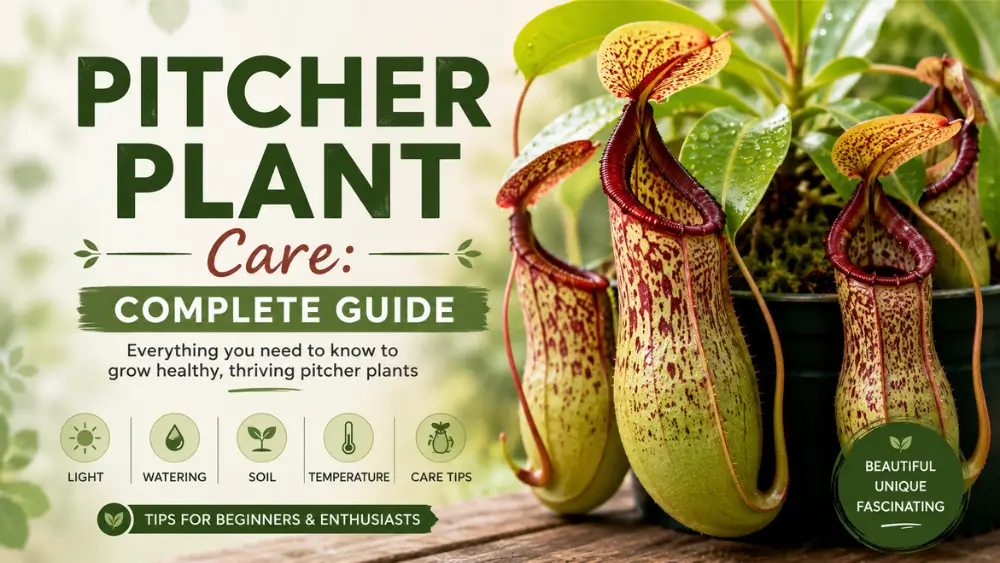
A pitcher plant is any carnivorous plant with a tubular, liquid-filled leaf that traps prey passively — insects are lured in by nectar, color, or scent, lose their footing on a slick inner rim, and fall into digestive fluid below. Several unrelated plant families independently evolved this design:
- Nepenthes (tropical pitcher plants) — vining or rosette-forming plants from Southeast Asia and nearby regions, with pitchers that hang or dangle from tendrils at the leaf tip. This is the group most often sold simply as “pitcher plant” in nurseries and garden centers.
- Sarracenia (North American pitcher plants) — upright, trumpet-shaped pitchers native to bogs in the eastern and southeastern US.
- Darlingtonia californica (cobra lily) — a single unusual species from Northern California and Oregon, with a hooded, cobra-like pitcher and a preference for cool root temperatures.
- Heliamphora (sun pitchers) — high-altitude South American plants with simpler, cup-shaped pitchers, popular with experienced growers but sensitive to heat.
- Cephalotus follicularis (Australian pitcher plant) — a small, slow-growing species with squat, ornate pitchers, prized by collectors but slower and less forgiving than Nepenthes or Sarracenia.
If your plant was labeled simply “pitcher plant” at a general retailer, it’s very likely a Nepenthes hybrid, which is why this guide centers on that group.
Nepenthes Pitcher Plant Care
1. Water
Use pure water only — distilled, reverse osmosis, or clean rainwater. Like all carnivorous plants, Nepenthes are sensitive to the dissolved minerals and salts in tap water, which accumulate in the soil and damage roots over time.
Nepenthes generally prefer soil kept consistently moist but not waterlogged — closer to a well-draining houseplant than a bog plant sitting in standing water. Many growers avoid the tray method for Nepenthes specifically, since their roots want more airflow than Sarracenia roots tolerate, and instead water from the top until it drains through, letting the top layer approach dryness before watering again.
2. Light
Nepenthes want bright light but often perform better with bright, indirect light or filtered sun rather than the harsh full-sun conditions Sarracenia demand.
- Indoors, an east-facing window or a spot a few feet back from a south/west window usually works well.
- A full-spectrum grow light run 12-14 hours a day gives strong, reliable results and is often easier to manage than variable window light.
- Too little light produces small, pale pitchers or a plant that stops making pitchers altogether, growing only leaves.
- Too much direct, hot sun can scorch leaves, especially on plants recently moved from lower light.
3. Soil
Nepenthes want an airy, well-draining, nutrient-free mix rather than a dense, waterlogged bog mix. A common blend is:
- Long-fiber sphagnum moss or peat moss
- Perlite
- Orchid bark or fine fir bark
This combination holds moisture while still allowing air to reach the roots, which matters more for Nepenthes than for bog-native Sarracenia. As with every carnivorous plant, skip regular potting soil and never add fertilizer to the soil.
4. Humidity
This is where Nepenthes diverge most from other pitcher plants, and where indoor growers run into the most trouble.
- Most Nepenthes want 50-70%+ humidity to form healthy, well-shaped pitchers. In drier air, plants often stop making pitchers and grow only leaves — a frustrating but common and fixable problem.
- A terrarium, greenhouse cabinet, or humidity tent solves this reliably for indoor growers in dry climates.
- Misting alone rarely maintains high enough humidity on its own; it helps short-term but isn’t a substitute for a genuinely humid microclimate.
5. Temperature: Highland vs. Lowland Nepenthes
Unlike Sarracenia, Nepenthes don’t need a cold winter dormancy, but they do split into two temperature groups that are easy to confuse when buying a plant without a clear label:
- Lowland Nepenthes come from low elevations near sea level and want consistently warm conditions — roughly 75-95°F (24-35°C) during the day, with only a mild nighttime drop. They struggle if kept much below 65°F (18°C) for extended periods.
- Highland Nepenthes come from cooler mountain elevations and actually want a noticeable day-to-night temperature drop — warm days around 70-85°F (21-29°C) with cooler nights down to 50-60°F (10-15°C). Kept too warm at night with no temperature drop, highland species often decline over time.
Many popular beginner hybrids are labeled as “intermediate,” tolerating a wider range between these two extremes, which is why hybrids are usually the safer starting point over species with narrower requirements.
Feeding Pitcher Plants
Pitcher plants that live outdoors or near open windows typically catch enough insects on their own — that’s the entire function of the pitcher. Feeding is a supplement, not a requirement.
If a pitcher isn’t catching prey naturally (common for terrarium-grown or heavily indoor plants):
- Drop in a small live insect — a fruit fly, small cricket, or similar — appropriately sized for the pitcher.
- Feed no more than one pitcher per plant every few weeks.
- Never add human food, meat scraps, or fertilizer directly into the pitcher fluid — this disrupts the pitcher’s digestive balance and can cause it to rot from the inside rather than digest normally.
- A pitcher that’s caught and processed prey will often turn slightly darker or fill with more fluid — this is normal, not a sign of trouble.
Best Pitcher Plants for Beginners
- Nepenthes × ventrata — a classic, extremely forgiving intermediate hybrid that tolerates a wide temperature and humidity range, making it the most commonly recommended beginner Nepenthes.
- Nepenthes alata complex hybrids — widely available, adaptable to average home humidity better than most species.
- Sarracenia purpurea — the hardiest North American pitcher plant and an easy outdoor option; see the full Sarracenia care guide for details.
Nepenthes vs. Sarracenia: Quick Comparison
| Factor | Nepenthes (Tropical) | Sarracenia (North American) |
|---|---|---|
| Native range | Southeast Asia, tropical | Eastern/Southeastern US |
| Pitcher orientation | Hanging or dangling | Upright, trumpet-shaped |
| Light preference | Bright indirect to filtered sun | Full, direct sun |
| Humidity | High (50-70%+) | Tolerates average household humidity |
| Dormancy | Not required | Required, 3-5 cold months |
| Soil | Airy peat/perlite/bark mix | Denser peat/sand or peat/perlite mix |
| Best setting | Terrarium, greenhouse, humid room | Sunny windowsill, patio, or outdoor bog |
Common Pitcher Plant Care Mistakes
- Assuming all pitcher plants need the same care — Nepenthes and Sarracenia have close to opposite humidity, light, and dormancy needs; confirm which type you have before setting up its environment.
- Using tap water — mineral buildup damages roots regardless of pitcher plant type.
- Keeping Nepenthes in a dense, waterlogged bog mix — this suits Sarracenia, not Nepenthes, which wants an airier, faster-draining medium.
- Not providing enough humidity for Nepenthes — low humidity is the most common reason indoor Nepenthes stop forming pitchers.
- Mixing up highland and lowland Nepenthes needs — a highland species kept too warm at night, or a lowland species kept too cool, will decline gradually rather than fail immediately, which makes the cause easy to miss.
- Feeding table scraps or fertilizer into the pitcher — this disrupts digestion and can rot the pitcher.
- Forcing dormancy on Nepenthes — unlike Sarracenia, tropical Nepenthes don’t need or benefit from a cold rest period.
Repotting and Propagation
Repotting: Nepenthes generally need repotting every 1-2 years as the airy bark-based mix breaks down, or sooner if roots have filled the pot. Repot in spring or early summer when the plant is actively growing, using a fresh peat/perlite/bark mix and handling roots gently, since Nepenthes roots are more delicate than Sarracenia’s.
Propagation methods:
- Stem cuttings are the most common approach for Nepenthes — cut a section of vine with at least one node, remove lower leaves, and root it in moist sphagnum moss under high humidity until new roots and growth appear, typically over several weeks to a few months.
- Basal offshoots — many Nepenthes produce small plantlets at the base of the main stem, which can be separated once they have their own root system.
- Sarracenia propagate differently, primarily through rhizome division; see the Sarracenia care guide at the bottom for that process.
Troubleshooting Pitcher Plant Problems
| Symptom | Likely Cause | Fix |
|---|---|---|
| Plant grows leaves but no pitchers | Low humidity (most common for Nepenthes) or insufficient light | Increase humidity via terrarium/greenhouse; increase light |
| Pitchers turning brown and drying out | Natural aging of older pitchers, or humidity too low | No action needed if new pitchers are forming; otherwise raise humidity |
| Pitcher fluid drying up | Low humidity, or a naturally aging pitcher nearing the end of its life | Increase humidity for younger pitchers; expect natural pitcher turnover over time |
| Mushy, black stem or leaves | Overwatering, poor drainage, or fertilizer exposure | Check soil drainage; repot into airier mix if needed |
| Pale, weak growth | Insufficient light | Increase light or add a full-spectrum grow light |
| Slow decline over months (highland species) | Nights too warm, no day-night temperature drop | Provide a cooler nighttime environment for highland Nepenthes |
| Slow decline over months (lowland species) | Temperatures too cool, especially at night | Keep lowland Nepenthes consistently warm, avoid cold drafts |
Frequently Asked Questions
How do you care for a pitcher plant?
Match the plant to its type first. Tropical Nepenthes want warmth, high humidity, bright indirect light, and an airy peat/perlite/bark soil mix with no dormancy. North American Sarracenia want full sun, constantly wet soil, and a required winter dormancy. Both need pure water and nutrient-free soil.
How do you care for pitcher plants indoors?
Nepenthes do well indoors in a terrarium or humid room with bright indirect light or a grow light. Sarracenia can be grown indoors on a very bright windowsill but still need a genuine cold dormancy period each year, usually achieved with a cold garage, porch, or similar unheated space.
Do pitcher plants need direct sunlight?
Sarracenia do, wanting several hours of direct sun daily. Nepenthes generally prefer bright, indirect, or filtered light rather than harsh direct sun, especially indoors.
Why isn’t my pitcher plant making pitchers?
For Nepenthes, low humidity is the most common cause — pitchers often stop forming below 40-50% humidity. For Sarracenia, insufficient light or being outside its active growing season are the more likely culprits.
Do you need to feed pitcher plants bugs?
No, not usually. Plants kept outdoors or near open windows typically catch enough insects on their own. Indoor plants can be fed a small live insect occasionally, but it isn’t required for survival.
Can pitcher plants be grown indoors year-round?
Nepenthes can, given enough humidity and light. Sarracenia still need an annual cold dormancy, so “indoors year-round” for that type usually means moving the plant somewhere cooler for winter rather than keeping it at room temperature continuously.