
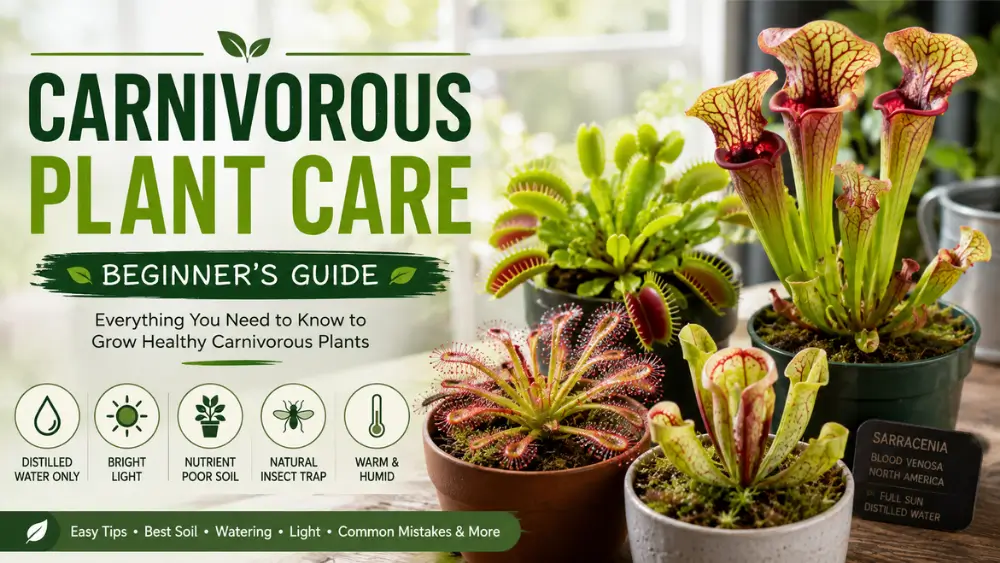
Carnivorous plants have a reputation for being fussy, exotic, and easy to kill. In reality, most die from one of three causes: tap water, regular potting soil, or fertilizer. Fix those three things and nearly any carnivorous plant will thrive on a sunny windowsill.
The short answer: carnivorous plant care comes down to five non-negotiables — pure water, strong light, nutrient-free soil, appropriate humidity, and (for many species) a winter dormancy period. Get those right and feeding, pest control, and repotting are simple.
This guide covers everything you need to grow healthy carnivorous plants indoors or outdoors, whether you’re starting with a Venus flytrap from the grocery store or building a windowsill bog garden.
Table of Contents
What Are Carnivorous Plants?
Carnivorous plants are species that trap and digest insects or other small prey to supplement the nutrients they can’t get from poor, boggy soil. They still photosynthesize like any other plant — trapping bugs is a nutritional bonus, not their main food source.
The plants you’ll most commonly find for sale fall into five groups:
- Venus flytraps (Dionaea muscipula) — snap-trap leaves that close around prey
- Pitcher plants — tube-shaped leaves that lure insects into a pool of digestive liquid; this includes both tropical Nepenthes and North American Sarracenia
- Sundews (Drosera) — leaves covered in sticky, glistening hairs that trap insects like flypaper
- Butterworts (Pinguicula) — flat, sticky leaves that work similarly to sundews but look almost innocent
- Bladderworts (Utricularia) — mostly aquatic, using tiny underwater vacuum traps
All of them evolved in nutrient-poor wetlands — bogs, seepage slopes, and sandy marshes — where ordinary plants struggle. That origin story explains almost every care rule that follows.
The 5 Things Every Carnivorous Plant Needs
1. Pure Water Only
This is the single most important rule in carnivorous plant care, and the one beginners break most often. Carnivorous plants evolved in mineral-poor bog water. Tap water, well water, and most bottled water contain dissolved minerals and salts that build up in the soil and slowly poison the roots.
Use one of the following instead:
- Distilled water (cheapest and easiest to buy)
- Reverse osmosis (RO) water
- Rainwater collected in a clean container
- Steam distiller water
A cheap TDS (total dissolved solids) meter can confirm your water is safe — aim for under 50 ppm, ideally closer to 10-30 ppm.
Most carnivorous plants prefer the tray method: sit the pot in a shallow dish of water year-round so the soil stays constantly moist, refilling as it evaporates. A few species (including most Sarracenia and some sundews) tolerate a brief dry-down between waterings, but when in doubt, keep the soil damp.
2. Bright, Direct Light
Carnivorous plants grow in open, sunny bogs, not shady forest floors. Insufficient light is the second most common killer, usually showing up as weak, floppy, pale green growth instead of the compact, colorful form you see in photos.
- Outdoors: most species want 4-6+ hours of direct sun daily.
- Indoors: a south- or west-facing windowsill can work for sun-loving species, but a full-spectrum LED grow light run 12-14 hours a day gives far more consistent results, especially in winter or in northern latitudes.
- Sign of too little light: long, spindly growth, pale color, traps that stay small or fail to develop red pigment.
- Sign of too much light without enough water: crispy, browning leaf tips.
3. Poor, Nutrient-Free Soil
Regular potting soil and any soil containing fertilizer will kill carnivorous plants outright. Their roots are adapted to sterile, nutrient-free conditions, and added nutrients burn the root system.
The standard mix for most species is a 1:1 ratio of:
- Peat moss or long-fiber sphagnum moss (unfertilized, additive-free)
- Perlite or silica sand (horticultural grade, not builder’s sand with additives)
Some growers substitute coconut coir for peat moss for sustainability reasons, though pure, unfertilized peat remains the most tested option. Whatever mix you use, never add compost, worm castings, or “enriched” potting mixes — carnivorous plants have zero tolerance for standard plant fertilizer in the soil.
4. The Right Humidity
Humidity needs vary more by species than any other factor:
- Sarracenia, Venus flytraps, and most temperate sundews tolerate normal household humidity (30-50%) as long as their roots stay wet.
- Tropical Nepenthes pitcher plants and many butterworts prefer higher humidity (50-70%+) and benefit from a terrarium, greenhouse, or humidity tray.
- Bladderworts are usually grown fully or partially submerged in water, sidestepping the humidity question entirely.
If leaf tips brown and traps fail to form despite correct watering, low humidity is a likely cause — especially for tropical species kept in dry, air-conditioned or heated rooms.
5. A Dormancy Period (for Temperate Species)
This is the rule most beginners have never heard of, and it explains a lot of “my plant died for no reason” stories.
Temperate carnivorous plants — Venus flytraps, most North American Sarracenia, and many temperate sundews — evolved with cold winters and require a dormancy period to survive long-term. Skip it repeatedly and the plant weakens over one to three growing seasons before dying, even with perfect summer care.
- Dormancy trigger: shortening daylight and dropping temperatures in fall
- What it looks like: growth slows, leaves die back, the plant may look mostly dead above ground
- Duration: roughly 3-5 months, typically November through February in the Northern Hemisphere
- Temperature range: most temperate species handle 35-50°F (2-10°C) during dormancy; some tolerate light frost
- How to provide it: an unheated garage, cold frame, or even the refrigerator crisper drawer (for flytraps, wrapped in damp sphagnum moss) if you don’t have a naturally cold spot
Tropical species — most Nepenthes, tropical sundews, and tropical butterworts — don’t need dormancy and can be grown year-round under stable warm conditions.
Quick Reference: Care at a Glance
| Requirement | Temperate Species (flytrap, Sarracenia) | Tropical Species (Nepenthes, tropical butterwort) |
|---|---|---|
| Water | Pure water only, tray method | Pure water only, tray method or misting |
| Light | Full sun, 6+ hrs or strong grow light | Bright indirect to full sun, grow light common |
| Soil | Peat/sphagnum + perlite or sand | Peat/sphagnum + perlite, sometimes with orchid bark |
| Humidity | Tolerates average household humidity | Prefers 50-70%+, terrarium often helpful |
| Dormancy | Required, 3-5 cold months | Not required |
Do You Need to Feed Carnivorous Plants Bugs?
No — not usually. If your plant lives outdoors or near an open window, it will typically catch enough insects on its own. Feeding is optional supplemental care, not a requirement for survival.
If you want to feed a plant that isn’t catching prey naturally (common for indoor plants):
- Use live or freshly killed insects — fruit flies, small crickets, or gnats work well and are appropriately sized for most traps.
- Feed no more than 1-2 traps per plant per month during the growing season. Overfeeding stresses the plant and can rot the trap.
- Never feed human food, meat, cheese, or anything processed — the fats and salts will rot the trap and can kill it.
- Skip feeding entirely during dormancy.
A trap that closes on something too large, or on a piece of debris, will often just reopen and reset within a day or two — this is normal and not something to worry about.
Best Carnivorous Plants for Beginners
If you’re picking your first plant, these are the most forgiving:
- Venus flytrap — iconic, widely available, and tolerant of minor care mistakes once the water and soil rules are followed.
- Purple pitcher plant (Sarracenia purpurea) — the hardiest of the Sarracenia, cold-tolerant, and easy outdoors in a pot with a saucer of water.
- Cape sundew (Drosera capensis) — grows fast, catches gnats and fruit flies aggressively, and doesn’t require dormancy.
- Common butterwort (Pinguicula vulgaris and hybrids) — no dormancy fuss for many hybrids, and effective at controlling fungus gnats on a windowsill.
Caring for Different Types of Carnivorous Plants
The five core rules above apply across the board, but each type has its own quirks worth knowing before you buy.
Venus Flytraps
Flytraps want full sun, constantly moist peat/sand soil, and a real winter dormancy — without it, plants decline over a few seasons even if summer care is flawless. Each trap can only close and reopen a handful of times before it dies naturally and is replaced by new growth, which is normal aging, not a problem to fix.
Pitcher Plants
“Pitcher plant” covers two very different groups with different needs: temperate North American Sarracenia, which want full sun and winter dormancy, and tropical Nepenthes, which want warmth, humidity, and no dormancy at all. Mixing up their care is the most common pitcher plant mistake. The full pitcher plant care guide breaks down both types species by species, including how to tell them apart and troubleshoot pitchers that turn brown or fail to form.
Sarracenia (North American Pitcher Plants)
Sarracenia are among the easiest carnivorous plants to grow outdoors in a sunny, wet spot, and they’re strikingly showy — tall, trumpet-shaped, and often vividly veined. They need full sun, wet feet, and a genuine cold dormancy to thrive long-term. The dedicated Sarracenia care guide covers species selection, potting, and winterizing in depth.
Sundews
Sundews are low-maintenance and visually striking once established, with sticky dew droplets that catch gnats and fruit flies constantly. Temperate species (like Drosera filiformis) need dormancy; tropical and subtropical species (like the Cape sundew) don’t and can be grown year-round on a bright windowsill.
Butterworts
Butterworts look deceptively like an ordinary succulent — flat, often colorful leaves with a slightly greasy sheen — which is exactly what attracts and traps fungus gnats and other tiny insects. Mexican butterworts and their hybrids are especially beginner-friendly, tolerating slightly richer soil and no dormancy requirement. The complete butterwort plant care guide covers the Mexican vs. temperate species split in detail, since it changes soil, water, and dormancy needs significantly.
Where to Keep Your Carnivorous Plant
Outdoors works well for temperate species (flytraps, Sarracenia, temperate sundews) across most of the US during the growing season, as long as they get full sun and a saucer of water underneath the pot to keep roots wet. In regions with mild winters (roughly USDA zones 7-9), many of these can stay outside year-round, going dormant naturally in place. Colder zones need extra winter protection — mulching the pot, moving it to an unheated garage, or sinking the pot into the ground for insulation.
Indoors works for both temperate and tropical species with the right setup:
- A south- or west-facing windowsill suits sun-loving temperate species during the growing season, though a grow light usually produces stronger results.
- A terrarium or humidity dome suits tropical Nepenthes and butterworts that want higher humidity than most homes naturally provide.
- Indoor temperate plants still need a cold dormancy period — a garage, cold porch, or refrigerator method — since indoor heating year-round will not trigger it naturally.
If you’re growing in a hot, dry climate (much of the Southwest, for example), tropical species often do better indoors in a humidity-controlled terrarium than outdoors, while temperate species can still thrive outside with consistent watering.
Common Beginner Mistakes (and How to Avoid Them)
- Using tap water — switch to distilled, RO, or rainwater immediately; mineral buildup is often irreversible once roots are damaged.
- Planting in regular potting soil — repot into a peat/perlite or peat/sand mix as soon as possible if this has already happened.
- Adding fertilizer to the soil — carnivorous plants get nutrients from prey, not soil amendments; skip fertilizer entirely, or use only a heavily diluted foliar orchid fertilizer misted directly on traps if you choose to supplement.
- Skipping winter dormancy for temperate species — plan for a cold rest period from the day you bring the plant home, not after it starts declining.
- Feeding meat, cheese, or table scraps — this rots traps rather than nourishing the plant.
- Letting the soil dry out completely — most species want constant moisture; a dry tray for more than a day or two stresses the plant.
- Not enough light — if growth looks pale, leggy, or the plant refuses to color up, light is the first thing to increase.
- Moving a plant outdoors too abruptly — acclimate gradually over 7-10 days to prevent sunburn on leaves grown indoors.
Repotting and Propagation Basics
When to repot: most carnivorous plants benefit from fresh soil every 1-2 years, since peat breaks down and can compact over time. Spring, just as active growth resumes, is the best time.
How to repot:
- Gently remove the plant and rinse old soil from the roots with pure water.
- Trim any obviously dead, mushy, or rotten roots.
- Repot into fresh peat/perlite or peat/sand mix, at the same depth as before.
- Water thoroughly with pure water and return to the tray method.
Basic propagation methods vary by plant, but the most common beginner-friendly approaches are:
- Leaf pullings (Venus flytraps, some sundews): gently pull a leaf free with a bit of the underground rhizome attached, lay it on top of moist soil, and wait for tiny plantlets to form over several weeks.
- Division (Sarracenia, butterworts): separate naturally occurring offshoots or rhizome sections at repotting time, ensuring each piece has roots attached.
- Leaf cuttings (butterworts, some sundews): lay a healthy leaf flat on moist soil or sphagnum; new plantlets often sprout from the base within a few weeks.
Troubleshooting: Why Is My Carnivorous Plant Dying?
| Symptom | Likely Cause | Fix |
|---|---|---|
| Black, mushy traps or leaves | Overfeeding, rot, or fertilizer exposure | Trim affected leaves; check water and soil source |
| Pale, leggy growth | Insufficient light | Move to full sun or add a grow light |
| Crispy, brown leaf tips | Low humidity or mineral buildup from bad water | Increase humidity; confirm water is pure (test with a TDS meter) |
| No new traps forming | Wrong season (dormancy), poor light, or root stress | Confirm the plant isn’t dormant; check light and root health |
| White, powdery or fuzzy growth on soil | Mold or fungus, often from stagnant air or overwatering trays | Increase airflow; avoid standing water becoming stagnant; ensure soil isn’t waterlogged for non-bog species |
| Traps won’t close or reopen normally | Natural aging (each trap has a limited number of closures) or too-frequent triggering | No action needed if new traps are still forming |
| Plant looks dead in winter | Normal dormancy for temperate species | Reduce watering slightly, keep cool, wait for spring regrowth |
Frequently Asked Questions
Do carnivorous plants need direct sunlight?
Most do. Species like Venus flytraps and Sarracenia want at least 4-6 hours of direct sun or an equivalent full-spectrum grow light. Tropical Nepenthes and some butterworts tolerate bright indirect light but still perform best with strong light exposure.
Can I use tap water for carnivorous plants?
No. Tap water contains minerals and salts that build up in the soil and damage the roots over time. Use distilled water, reverse osmosis water, or collected rainwater instead.
Do I need to feed my carnivorous plant insects?
Not usually. Plants kept outdoors or near open windows generally catch enough prey on their own. Indoor plants can be fed live insects like fruit flies once or twice a month during the growing season, but it isn’t required for survival.
How long do carnivorous plants live?
With correct care, many species live for years and some, like Sarracenia, can live for decades, forming larger clumps over time through natural division.
Can carnivorous plants live indoors year-round?
Tropical species can. Temperate species like Venus flytraps and most Sarracenia still need a cold dormancy period each year, which usually means a cold garage, porch, or refrigerator method rather than a warm windowsill through winter.
Are carnivorous plants hard to take care of?
Not once you know the rules. Almost all beginner failures trace back to tap water, standard potting soil, or added fertilizer. Fix those three things and most species are genuinely low-maintenance.