
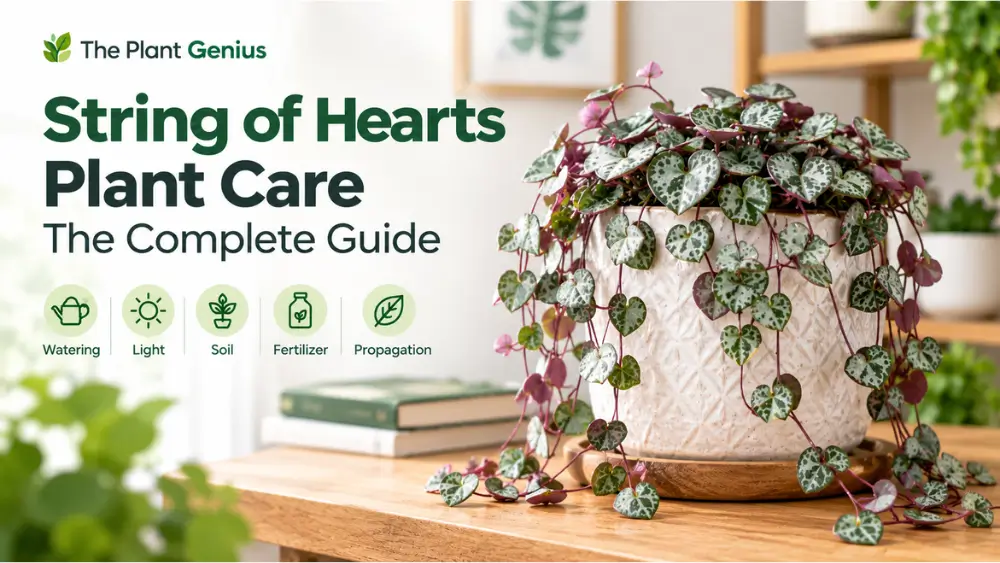
String of Hearts (Ceropegia woodii) needs bright, indirect light with some direct morning or evening sun, soil that dries out completely between waterings, and well-draining soil, ideally a succulent or cactus mix. It’s a trailing, semi-succulent vine from southern Africa grown for its long, delicate stems strung with small, dark green heart-shaped leaves with silver marbling on top and a pinkish-purple underside. Light and drainage are the two factors that matter most: too little light causes pale, widely spaced leaves and straggly growth, while overwatering causes root rot far faster than most people expect.
Table of Contents
Quick Care Facts
| Care Factor | Requirement |
|---|---|
| Scientific name | Ceropegia woodii |
| Common names | String of Hearts, Chain of Hearts, Rosary Vine, Sweetheart Vine |
| Light | Bright, indirect light; some direct morning or evening sun |
| Water | Allow to dry completely between waterings; every 10-14 days typical |
| Soil | Well-draining succulent or cactus mix |
| Temperature | 60-80°F (15-27°C); protect from frost |
| Humidity | Tolerates dry indoor air well; no extra humidity needed |
| Fertilizer | Diluted balanced feed monthly during growing season |
| Toxicity | Generally considered non-toxic to cats and dogs |
| Growth habit | Long, trailing vine; can reach several feet with good light |
| Difficulty | Easy; the main risk is overwatering |
About String of Hearts
String of Hearts, botanically Ceropegia woodii, is a trailing vine native to the rocky hillsides of southern Africa, including parts of South Africa, Eswatini, and Zimbabwe. In its natural habitat it grows in arid to semi-arid conditions, scrambling among rocks and dry brush where its small, succulent-like leaves allow it to store water through dry seasons. In cultivation, this translates to one of the most drought-tolerant trailing houseplants available, and one of the most forgiving of benign neglect.
Its thin, purple-pink stems can reach several feet in length under good light, each strung with pairs of small, distinctly heart-shaped leaves marked with silver-green variegation on top and a pinkish-purple flush underneath. The delicate, dangling stems trailing from a hanging basket or high shelf are the plant’s main visual appeal, and for the same reason String of Hearts is also sometimes called Chain of Hearts or Rosary Vine. In addition to the leaves, it occasionally produces small, tubular, pale pink-purple flowers along its stems, particularly in summer, which are distinctive in shape but easy to miss given how small and subtle they are.
Where to Display String of Hearts
String of Hearts is almost always displayed in a hanging basket or on a high shelf where its trailing stems can cascade freely, which is genuinely the best way to show off its long, delicate strands. The longer and denser the trailing stems, the more impactful the display, so placing it somewhere with good light and leaving it largely undisturbed to grow is the most effective approach. A sunny, east-facing windowsill with the plant perched at the edge, stems trailing down the wall below, or suspended in front of a bright window, are both classic and effective placements that let the plant’s trailing habit do the work visually.
Why String of Hearts Looks Different from Plant to Plant
The amount and quality of light a String of Hearts receives directly determines how closely-spaced and richly colored its leaves are, which causes plants of the same species to look dramatically different depending on where they’re grown.
A plant given several hours of bright light, including some direct sun, develops short internodal spacing, meaning the leaves are packed closely along the stem, with rich silver variegation on a deep green background. A plant in lower light responds by stretching its stems longer between leaf pairs, a process called etiolation, producing a sparse, straggly appearance with pale, less vivid leaves. This is purely a response to light availability, not a different variety or a problem that fertilizer can fix, and moving an etiolated plant to brighter conditions is the only effective solution, though it won’t change existing sparse stems, only new growth going forward.
Light Requirements
String of Hearts does best in a bright spot with several hours of indirect light and some gentle direct sun, particularly morning sun, which tends to be less intense than afternoon exposure. An east- or west-facing window is often ideal. South-facing windows work well too, provided the direct midday sun is filtered by a sheer curtain to prevent leaf scorch on the most sensitive growth.
Avoid placing it in a spot with only low, filtered light for long periods; while it survives, the stretched, sparse growth that results is difficult to correct and doesn’t show the plant at its best.
Watering
Allow the soil to dry out completely between waterings, and when in doubt, wait an extra day or two before watering.
During the active growing season in spring and summer, this means watering roughly every 10-14 days for most indoor conditions, though the frequency should always be based on checking the soil rather than a fixed schedule. In autumn and winter, when the plant’s growth naturally slows, watering every 3-4 weeks, or even less, is typically sufficient.
Overwatering is by far the most common way to damage or kill a String of Hearts. Because its stems are thin and delicate, the early warning signs of root rot can be subtle, and by the time the plant looks visibly distressed, the root system may already be significantly damaged. The combination of well-draining soil, a pot with drainage holes, and allowing the soil to fully dry between waterings is the most reliable defense.
Soil and Potting
A standard succulent or cactus potting mix, or a regular potting soil blended 50/50 with perlite or coarse grit, provides the fast drainage String of Hearts needs. Terracotta pots are an excellent choice because their porous walls help the soil dry out more quickly than plastic, reducing the risk of overwatering.
String of Hearts tends to prefer being slightly rootbound rather than potted in an oversized container, since a large pot holds more moisture than the roots can use, increasing the risk of rot. Repot only when the plant is visibly cramped, moving up just one pot size at a time.
Temperature and Humidity
String of Hearts does well in typical indoor temperatures of 60-80°F (15-27°C) and should be protected from frost, since it has no meaningful cold tolerance. Keep it away from cold drafts and unheated spaces in winter.
It tolerates dry indoor air very well, consistent with its arid-climate origins, and doesn’t need supplemental humidity or misting, making it an excellent choice for centrally heated homes in winter.
Fertilizing
Feed with a diluted balanced liquid fertilizer, roughly once a month during the spring and summer growing season. Skip fertilizing in autumn and winter. Avoid over-fertilizing, which encourages excessive, soft leafy growth that’s more prone to damage than healthy, compact growth.
Propagation
String of Hearts is one of the easiest houseplants to propagate, with several reliable methods:
Stem cuttings in water or soil Snip a strand a few inches long, strip the leaves from the bottom node or two, and place in water or moist succulent soil. Roots form within a few weeks.
Butterfly method Lay a section of stem flat on moist soil and pin it down at the nodes with small wire clips or bent hairpins. Each node can root and produce a new plant while still attached to the parent strand.
Tuber propagation String of Hearts occasionally produces small, bead-like aerial tubers along its stems. These can be gently removed and pressed lightly into moist soil, where they’ll send out roots and new shoots.
Propagating several cuttings back into the parent pot is a simple way to make a sparse-looking plant appear fuller more quickly.
Is String of Hearts Toxic to Pets?
String of Hearts is generally considered non-toxic to cats and dogs, making it a popular choice for pet-friendly households. As with any plant, eating large quantities could potentially cause mild stomach upset, so discouraging pets from regularly chewing on it is still sensible, but there’s no significant toxicity concern with this species.
Common Problems and How to Fix Them
Sparse, straggly stems with widely spaced leaves A light problem, not a watering or fertilizer issue. Move the plant to a significantly brighter spot. Existing sparse stems won’t become denser, but new growth in better light will be more compact.
Yellowing leaves or mushy stems Almost always caused by overwatering or poor drainage. Allow the soil to dry completely, improve drainage, and reduce watering frequency.
Pale, washed-out leaf color Can result from too much intense direct sun bleaching the leaves, or from insufficient light causing them to fade. Bright, indirect light with gentle morning sun is the sweet spot.
No flowers The small tubular flowers appear mainly in summer with good light. If the plant has never flowered, increasing light and confirming the plant is healthy generally helps.
Pests Mealybugs and aphids can occasionally appear. Check regularly around nodes and leaf undersides, and treat with insecticidal soap if spotted.
Seasonal Care Summary
| Season | Watering | Fertilizing | Notes |
|---|---|---|---|
| Spring | Every 10-14 days | Monthly | Good time to propagate and tidy stems |
| Summer | Every 10-14 days | Monthly | May flower; provide bright light |
| Fall | Every 3 weeks | Stop | Begin reducing watering as growth slows |
| Winter | Every 3-4 weeks | None | Minimal water; keep away from frost |
Frequently Asked Questions
How do you care for a String of Hearts plant?
Provide bright, indirect light with some morning sun, allow the soil to dry completely between waterings, use well-draining succulent soil, and pot it in a container that drains freely.
Why are my String of Hearts leaves so far apart?
This is etiolation, caused by insufficient light. Move the plant to a much brighter spot; new growth will be more compact, though existing sparse stems won’t fill in.
How often should you water a String of Hearts?
Every 10-14 days during the growing season, always waiting until the soil is completely dry rather than watering on a fixed schedule, and less often in autumn and winter.
Is String of Hearts toxic to cats and dogs?
No, it’s generally considered non-toxic to both, making it a good trailing plant option for pet-friendly homes.
How do you make a String of Hearts fuller?
Propagate cuttings back into the parent pot, move the plant to brighter light to encourage more compact new growth, and use the butterfly propagation method to root multiple nodes along a single stem simultaneously.
What are the small beads on my String of Hearts stems?
These are aerial tubers, a natural feature of the plant. They can be gently removed and pressed into moist soil to propagate new plants.
Can String of Hearts grow in low light?
It survives in lower light but produces sparse, stretched, pale growth. Bright indirect light is needed for the compact, richly marked foliage the plant is known for.
How long can String of Hearts get?
With good light and time, the trailing stems can reach several feet in length, sometimes over three feet on well-established plants, making it one of the more dramatic trailing succulents available.
Why does my String of Hearts have small bead-like growths on its stems?
These are aerial tubers, a completely natural feature of Ceropegia woodii. They store energy and water for the plant and can also be used for propagation by pressing them gently into moist soil.