
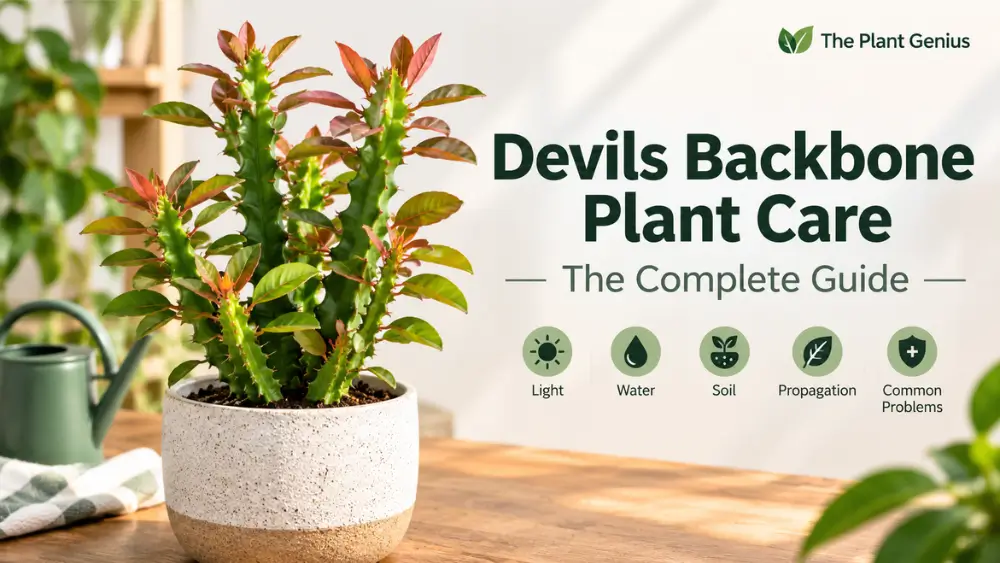
Devil’s Backbone (Euphorbia tithymaloides, formerly Pedilanthus tithymaloides) needs bright, indirect light with a little direct morning or evening sun, soil allowed to dry out between waterings, and warm temperatures throughout the growing season. It’s a drought-tolerant succulent shrub named for its distinctive zigzag stems, which bend sharply at each leaf node, along with small, often variegated leaves that can flush pink or red in bright light. Like other members of the spurge family, its milky sap is irritating to skin and toxic if ingested, so it’s worth handling with a bit of extra care.
Table of Contents
Quick Care Facts
| Care Factor | Requirement |
|---|---|
| Scientific name | Euphorbia tithymaloides (formerly Pedilanthus tithymaloides) |
| Common names | Devil’s Backbone, Zigzag Plant, Jacob’s Ladder, Japanese Poinsettia, Redbird Cactus |
| Light | Bright, indirect light with some direct morning or evening sun |
| Water | Allow soil to dry out between waterings; drought tolerant |
| Soil | Well-draining succulent or potting mix |
| Temperature | 60-85°F (15-29°C); avoid temperatures below 55°F (13°C) |
| Humidity | Tolerates low humidity well |
| Fertilizer | Balanced liquid feed monthly during the growing season |
| Toxicity | Toxic to pets and humans if ingested; sap irritates skin |
| Growth habit | Upright succulent shrub with distinctive zigzag stems |
| Difficulty | Easy and low-maintenance |
About the Devil’s Backbone Plant
Devil’s Backbone gets its dramatic common name from the sharply zigzagging pattern of its fleshy, succulent stems, which bend at a distinct angle at each point a leaf emerges, creating a jagged, spine-like silhouette that’s genuinely unlike any other common houseplant available at typical garden centers. It’s native to the subtropical regions of Mexico, Central America, and the Caribbean, and belongs to the Euphorbiaceae, or spurge, family, making it a relative of both poinsettia and Croton.
The plant’s small, often lance-shaped leaves are frequently variegated in green and white, and can develop pink or reddish tones when grown in bright light. Small, inconspicuous true flowers are accompanied by red, shoe-shaped bracts that some growers call “slipper flowers,” which is where another of its common names, Slipper Plant, comes from. Depending on the cultivar and growing conditions, mature plants can reach anywhere from 3-4 feet to considerably taller in ideal conditions.
Where to Display Devil’s Backbone
Given its bold, architectural stem pattern, Devil’s Backbone works especially well displayed in a tall, upright container that echoes or contrasts with its angular growth, and some growers specifically seek out planters with a chevron or zigzag design to play up the effect further. It makes a striking accent plant on its own rather than blending into a mixed grouping, since its unusual silhouette is really the whole point of growing it. A bright spot near a window where its stems can be appreciated from multiple angles, such as a corner or a spot away from a wall, shows off its structure best.
Devil’s Backbone Varieties
Several cultivars of Devil’s Backbone are available, most sharing the same core zigzag growth habit with some variation in leaf coloring and plant size. ‘Variegatus’ is among the most commonly sold, featuring the classic green-and-white variegated leaves described above. More compact forms are sometimes sold under names like ‘Nana’ for growers who want the same distinctive stem pattern in a smaller footprint, while larger, more vigorous cultivars can grow considerably taller given enough light and space. Care is essentially identical across these variations, since they all share the same species and growth habits.
Why It Grows in a Zigzag
Devil’s Backbone’s signature zigzag pattern comes from the way each new stem segment grows at an angle from the point where the previous leaf attached, rather than continuing in a straight line.
As the plant produces new growth, each segment shifts direction slightly at the node where a leaf has formed, and the leaves themselves are often shed or drop off as the plant matures, leaving behind the bare, angular stem pattern that gives the plant its name. This growth habit is a completely normal, defining trait of the species rather than something to correct, and it’s part of why the plant is so often chosen specifically for its sculptural, architectural look rather than for lush foliage.
Light Requirements
Devil’s Backbone does best in bright, indirect light, and benefits from a bit of direct morning or evening sun, which often deepens the pink or reddish coloring in its stems and leaves. It can tolerate lower light for a period of time, but it tends to lean noticeably toward its light source and become leggy and less attractive if kept in dim conditions long-term, so a consistently bright spot is worth prioritizing from the start rather than trying to correct legginess after the fact.
Watering
Allow the soil to dry out between waterings, then water thoroughly; this plant is genuinely drought tolerant thanks to the water its fleshy stems store.
During the active growing season in spring and summer, this might mean watering every couple of weeks; in fall and winter, when the plant’s growth slows considerably, cut back further, sometimes to as little as once a month. One helpful diagnostic sign: if Devil’s Backbone goes without water for too long, it tends to drop its lower leaves as a stress response, but this typically stops once the plant is watered properly again, making it a fairly forgiving plant to recover if you’ve let it go too dry for a while.
Soil and Potting
A well-draining potting mix, ideally one formulated for succulents or cacti, or a standard potting mix amended with perlite, suits Devil’s Backbone well. Good drainage matters more than soil richness for this plant. Repot as needed when it becomes rootbound, generally choosing a pot only slightly larger than the current one to avoid excess moisture retention.
Temperature and Humidity
Devil’s Backbone prefers warm conditions, ideally 60-85°F (15-29°C), and should be protected from temperatures below about 55°F (13°C) as well as cold drafts near windows and doors. It tolerates low humidity well, making it a comparatively easy plant to grow in typical dry indoor air without needing a humidifier, though good air circulation helps prevent powdery mildew in more crowded or poorly ventilated spaces.
Fertilizing
During the growing season, feed with a balanced, water-soluble liquid fertilizer, diluted according to the product label, once a month during the active growing season in spring and summer. Fertilizing isn’t necessary during fall and winter, when growth naturally slows and the plant needs fewer nutrients.
Pruning
Trimming the tops of the stems encourages the plant to branch out and grow bushier, which also helps take pressure off the root system and makes for a sturdier, more stable plant overall as it matures. Removing any damaged, curling, or unhealthy-looking leaves also encourages fresh new growth to take their place. Because the plant’s sap is irritating, always wear gloves when pruning.
How to Propagate Devil’s Backbone
Devil’s Backbone propagates readily from stem cuttings, a straightforward process that works well even for beginners:
- Using clean shears, and wearing gloves to protect your skin from the sap, remove a healthy stem section from the plant.
- Let the cut end callus over for a few days in a dry spot, an important step for succulents that helps prevent rot once planted in soil.
- Plant the cutting in well-draining soil.
- Keep it in bright, indirect light and water sparingly until roots establish, generally over the following several weeks.
Is Devil’s Backbone Toxic to Pets and Humans?
All parts of Devil’s Backbone are toxic if ingested, and its milky sap can irritate skin and eyes on contact.
Ingesting the plant can cause nausea and other gastrointestinal symptoms in both pets and people, and direct contact with the sap, released whenever a stem or leaf is broken, can cause skin irritation similar to what some people experience with poinsettia, its close relative in the same family. Wear gloves when handling, pruning, or propagating this plant, avoid touching your eyes until you’ve washed your hands thoroughly afterward, and keep it out of reach of pets and children who might chew on it.
Common Problems and How to Fix Them
Dropping lower leaves Usually a sign the plant has gone too long without water. Resume regular watering, and leaf drop typically stops once the plant is properly hydrated again over the following days.
Leggy, stretched growth Caused by insufficient light. Move the plant to a brighter spot and consider pruning back leggy stems to encourage bushier, more compact regrowth over time.
Yellowing leaves or root rot A sign of overwatering. Let the soil dry out more between waterings and confirm the pot drains well.
Dull-looking foliage Can indicate a spider mite infestation. Gently clean the leaves with a damp cloth and treat with insecticidal soap if mites are present.
Powdery mildew Usually linked to poor air circulation. Improve airflow around the plant and avoid overcrowding it with other plants in a tightly grouped display.
Seasonal Care Summary
| Season | Watering | Fertilizing | Notes |
|---|---|---|---|
| Spring | Every 2-3 weeks | Monthly | Good time to prune or take cuttings |
| Summer | Every 2-3 weeks | Monthly | Bright light deepens stem and leaf color |
| Fall | Reduce gradually | Taper off | Growth naturally slows |
| Winter | Sparingly | None | Protect from temperatures below 55F |
Frequently Asked Questions
How do you care for a Devil’s Backbone plant?
Give it bright, indirect light with a little direct sun, let the soil dry out between waterings, use well-draining soil, and handle it with gloves due to its irritating sap.
Why does my Devil’s Backbone plant have zigzag stems?
This is the plant’s natural growth pattern: each new stem segment grows at an angle from the point where the previous leaf attached, creating the characteristic zigzag shape the plant is named for.
Is Devil’s Backbone toxic to cats and dogs?
Yes, all parts of the plant are toxic if ingested, and the sap can also irritate skin on contact, so it should be kept out of reach of pets.
Why is my Devil’s Backbone dropping leaves?
This is most often a sign of underwatering. The plant typically stops dropping leaves once it’s watered properly again.
How often should you water a Devil’s Backbone plant?
Allow the soil to dry out between waterings, typically every couple of weeks during the growing season and considerably less often in fall and winter.
Is Devil’s Backbone the same as a true cactus?
No, it’s a succulent in the Euphorbia genus, unrelated to true cacti, though it shares some drought-tolerant traits with them.
Can Devil’s Backbone tolerate low light?
It can tolerate low light for a period of time, but it tends to lean toward the light source and become leggy if kept in dim conditions long-term.
Is Devil’s Backbone a good outdoor plant?
Yes, in warm climates (USDA zones 9-11) it can be grown outdoors year-round, either in the ground or in containers. In cooler climates, it’s best grown outdoors during warm months and brought inside before temperatures drop.
How tall does Devil’s Backbone grow?
Most plants reach about 3-4 feet tall, though some cultivars can grow considerably taller, up to around 6 feet, under ideal conditions with plenty of light and space.
Does Devil’s Backbone flower?
Yes, it produces small, often inconspicuous true flowers accompanied by more noticeable red, shoe-shaped bracts, sometimes blooming throughout the year under good growing conditions.