
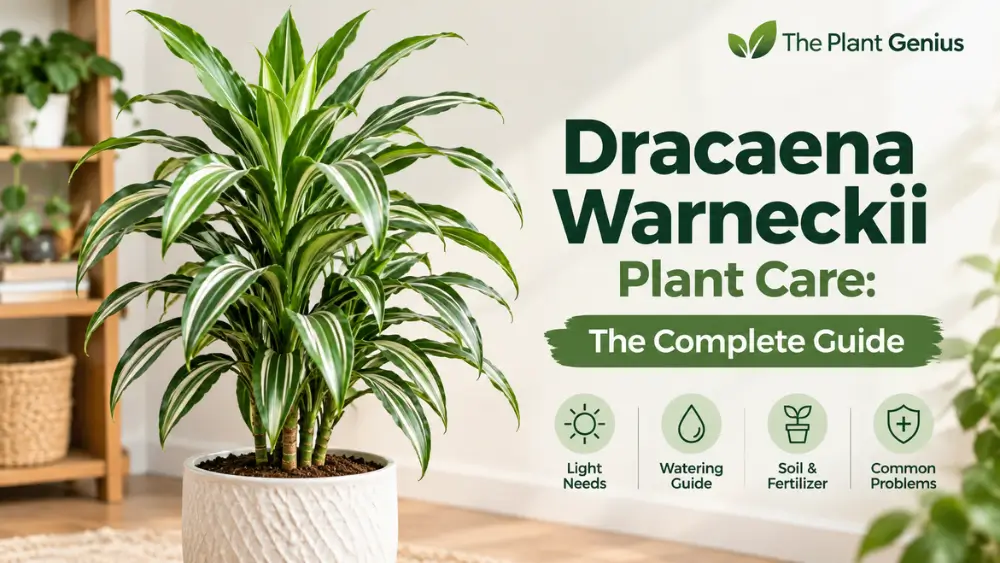
Dracaena Warneckii shares its species and core care with Dracaena Lemon Lime. For general Dracaena background and detailed watering guidance, see our Dracaena Lemon Lime care guide; this guide focuses on what’s specific to plain Warneckii.
Dracaena Warneckii (Dracaena fragrans ‘Warneckii’) needs medium to bright indirect light, soil allowed to dry out somewhat between waterings, and warm temperatures throughout the growing season. Its leaves are striped only in white, cream, and gray-green, without any yellow, which distinguishes it from its popular sibling cultivar, Dracaena Lemon Lime, also sometimes confusingly sold as “Warneckii Lemon Lime.” Plain Warneckii is genuinely the parent cultivar that Lemon Lime was bred from, and it tolerates low light and fluorescent office lighting exceptionally well.
Table of Contents
Quick Care Facts
| Care Factor | Requirement |
|---|---|
| Scientific name | Dracaena fragrans ‘Warneckii’ (also classified Dracaena deremensis ‘Warneckii’) |
| Common names | Dracaena Warneckii, White Striped Dracaena, Striped Dracaena |
| Light | Medium to bright indirect light; tolerates low and fluorescent light well |
| Water | When top of soil is dry; avoid letting it go bone dry for long |
| Soil | Well-draining potting mix |
| Temperature | 65-80°F (18-27°C); avoid cold drafts |
| Humidity | Average household humidity is fine |
| Fertilizer | Balanced liquid feed monthly, spring through summer |
| Toxicity | Toxic to cats, dogs, and humans if ingested |
| Growth habit | Clumping, multi-cane; can reach 4-5 ft indoors |
| Difficulty | Very beginner-friendly, exceptionally tolerant of low light |
About Dracaena Warneckii
Dracaena Warneckii is a striped cultivar of Dracaena fragrans, the same species as Corn Plant, distinguished by long, narrow, sword-shaped leaves banded in white, cream, and gray-green. Unlike its well-known relative Dracaena Lemon Lime, plain Warneckii’s stripes contain no yellow at all, giving it a cooler, more silvery appearance rather than the warm chartreuse tones Lemon Lime is known for. Native to tropical Africa, it grows as a clumping, multi-caned plant, developing several canes topped with rosettes of striped foliage as it matures, and it’s often sold under names like “White Striped Dracaena” or “Striped Dracaena” that emphasize this cooler color palette.
Warneckii vs. Lemon Lime: Clearing Up the Confusion
Plain Dracaena Warneckii and Dracaena Lemon Lime are closely related, but distinctly different in color, and the retail trade doesn’t always make this easy to sort out.
Dracaena Warneckii is actually the parent cultivar that Lemon Lime was bred from, and its leaves are striped strictly in white, cream, and gray-green, with no yellow present anywhere in the pattern. Lemon Lime, by contrast, adds a bold band of neon yellow-green to that same basic striping pattern. To add to the confusion, many nurseries and retailers sell Lemon Lime under the combined name “Warneckii Lemon Lime,” which can make it look like the two are the same plant when shopping online. If your plant’s leaves show any yellow at all, you likely have Lemon Lime rather than plain Warneckii; if the stripes are strictly white and green with no yellow, you have the plant covered in this guide.
Beyond Lemon Lime, Warneckii is also related to Dracaena Janet Craig, an all-green, similarly shade-tolerant cousin without any variegation at all, and Dracaena Compacta, a dwarf, rosette-forming form typically derived from Janet Craig rather than Warneckii. All of these cultivars share the same fundamental care needs despite their different appearances.
Why Warneckii Tolerates Low Light So Well
Among common Dracaena cultivars, plain Warneckii is frequently singled out as one of the most shade-tolerant, genuinely thriving under fluorescent office lighting and in interior rooms with minimal natural light where more light-hungry variegated plants would decline. This resilience, combined with its documented role in NASA’s Clean Air Study on air-purifying houseplants, is a big part of why it became such a fixture in office plantscaping starting in the late 20th century. For home growers, the practical upshot is the same: if you have a dim corner or a room with only artificial light, Warneckii is one of the more reliable variegated plants to try there, even though its stripes will always look their crispest in brighter conditions.
Where to Display Dracaena Warneckii
Because of its tolerance for lower and artificial light, Dracaena Warneckii is a natural fit for interior offices, hallways, and rooms without much natural window light, spaces where more light-demanding variegated houseplants would eventually decline. Its cool white-and-green coloring also pairs nicely as a contrast to warmer-toned plants like Ti Leaf or Dracaena Lemon Lime in a mixed grouping, giving a display some visual variety without clashing.
Light Requirements
Dracaena Warneckii is exceptionally tolerant of lower light, including fluorescent office lighting, making it one of the more shade-tolerant Dracaena cultivars available.
It still does best, with fuller growth and the crispest, most defined striping, in medium to bright indirect light. A spot near an east- or west-facing window works well, though it also performs reliably in dimmer interior rooms and offices where many other houseplants would struggle. Avoid direct, intense sun, which can scorch or bleach the leaves.
Watering
Water when the top of the soil is dry, letting excess water drain away completely. Dracaena Warneckii prefers to dry out somewhat between waterings rather than staying continuously moist, though it shouldn’t be allowed to go bone dry for extended periods either. As with other Dracaena, it can be sensitive to fluoride and chlorine in tap water, which commonly shows up as brown, dry leaf tips; filtered or distilled water can help prevent this over time, particularly if you notice tip browning despite otherwise consistent watering.
Soil and Potting
A standard well-draining potting mix works well, ideally amended with perlite to improve drainage further. Repot every 2-3 years, or once the plant becomes visibly rootbound, moving up one pot size at a time rather than jumping to a significantly larger container, which can hold more moisture than the roots are able to use.
Temperature and Humidity
Dracaena Warneckii does well in typical indoor temperatures, ideally 65-80°F (18-27°C), and should be kept away from cold drafts, exterior doors, and air conditioning vents that could cause sudden temperature swings. It tolerates average household humidity without any special adjustments, though like other Dracaena, it appreciates a bit of extra humidity during dry winter months when indoor heating is running.
Fertilizing
Feed with a balanced, water-soluble liquid fertilizer once a month during spring and summer while the plant is actively growing. Reduce or stop fertilizing in fall and winter, when growth naturally slows and the plant needs fewer nutrients to sustain itself.
Pruning
Lower leaves naturally yellow and drop as the plant ages and its canes lengthen, which is a normal part of its growth; simply trim these away as needed with clean shears. If the plant grows too tall or leggy, it can be cut back to control height, and new growth typically emerges from the cut point within a few weeks to months, the same as with other Dracaena relatives. Wiping dust from the leaves periodically also helps the plant photosynthesize more efficiently and keeps its striping looking crisp.
How to Propagate Dracaena Warneckii
Dracaena Warneckii can be propagated from stem or cane cuttings, using the same reliable technique shared across most of its Dracaena relatives:
- Cut a section of stem at least 4 inches long, ideally including a node.
- Let the cut ends callus over for a day in a dry spot to help prevent rot.
- Plant the cutting in moist, well-draining potting soil, or root it in water first before transferring to soil.
- Keep it in bright, indirect light while it roots, generally taking several weeks to establish new growth.
Is Dracaena Warneckii Toxic to Pets or Humans?
Dracaena Warneckii is toxic to cats, dogs, and humans if ingested.
Like other Dracaena species, it contains saponins that can cause vomiting, sometimes with blood present, along with loss of appetite, excessive drooling, and dilated pupils in cats in particular if the leaves are chewed or eaten. Keep it out of reach of pets that chew on houseplants, and contact your veterinarian if you suspect ingestion and notice these symptoms.
Common Problems and How to Fix Them
Brown, dry leaf tips Usually caused by fluoride or chlorine sensitivity from tap water, or low humidity in the surrounding air. Switching to filtered or distilled water typically helps resolve this over the following weeks.
Fading or loss of white striping A sign the plant needs more light. Moving it to a brighter spot with indirect light usually restores more defined striping in new growth over the following weeks.
Yellowing leaves Widespread yellowing across many leaves at once typically points to overwatering. Let the soil dry out more between waterings and check that the pot drains well.
Leggy growth Usually caused by prolonged low light. Increase light exposure and prune back leggy canes to encourage fuller, more compact regrowth over time.
Pests Spider mites and mealybugs are the most common pests on this plant. Wipe down leaves periodically and treat promptly with insecticidal soap if pests appear, checking closely between the tightly clustered leaves at the base of each cane.
Seasonal Care Summary
| Season | Watering | Fertilizing | Notes |
|---|---|---|---|
| Spring | Every 1-2 weeks | Monthly | Good time to prune, repot, or take cuttings |
| Summer | Every 1-2 weeks | Monthly | Watch for dry-out in bright, warm rooms |
| Fall | Reduce gradually | Taper off | Growth naturally slows |
| Winter | Every 2-3 weeks | None | Keep away from cold drafts and heater vents |
Frequently Asked Questions
How do you care for a Dracaena Warneckii?
Give it medium to bright indirect light, water when the top of the soil is dry, use well-draining soil, and expect it to tolerate lower light noticeably better than most other Dracaena cultivars.
What’s the difference between Dracaena Warneckii and Lemon Lime?
Plain Warneckii has white, cream, and gray-green stripes with no yellow anywhere in the pattern, while Lemon Lime adds a bold neon yellow-green band to that same basic pattern. Warneckii is actually the parent cultivar Lemon Lime was originally bred from.
Why is my Dracaena Warneckii losing its white stripes?
Insufficient light is the most common cause of this issue. Moving the plant to a brighter, indirect-light spot typically restores more defined striping in new growth over time.
Is Dracaena Warneckii toxic to cats and dogs?
Yes, it’s toxic if ingested, similar to other Dracaena species, and should always be kept out of reach of pets that chew on houseplants.
Can Dracaena Warneckii survive in an office with only fluorescent light?
Yes, it’s one of the more shade-tolerant Dracaena cultivars and does notably well under fluorescent office lighting compared to many houseplants.
How tall does Dracaena Warneckii get indoors?
It can reach about 4-5 feet tall indoors over time, growing as a clumping, multi-caned plant.
Is Dracaena Warneckii related to Dracaena Janet Craig?
Yes, they’re closely related cultivars of the same species, though Janet Craig has solid green leaves with no variegation, while Warneckii has white and green striped leaves.
Why does my Dracaena Warneckii do so well in my office with no windows?
This cultivar is known for being especially tolerant of low light and fluorescent lighting, which is part of why it’s such a common choice for offices and other spaces with minimal natural light.
Does Dracaena Warneckii need frequent repotting?
No, it’s a fairly slow grower and typically only needs repotting every 2-3 years, or once it becomes visibly rootbound.