
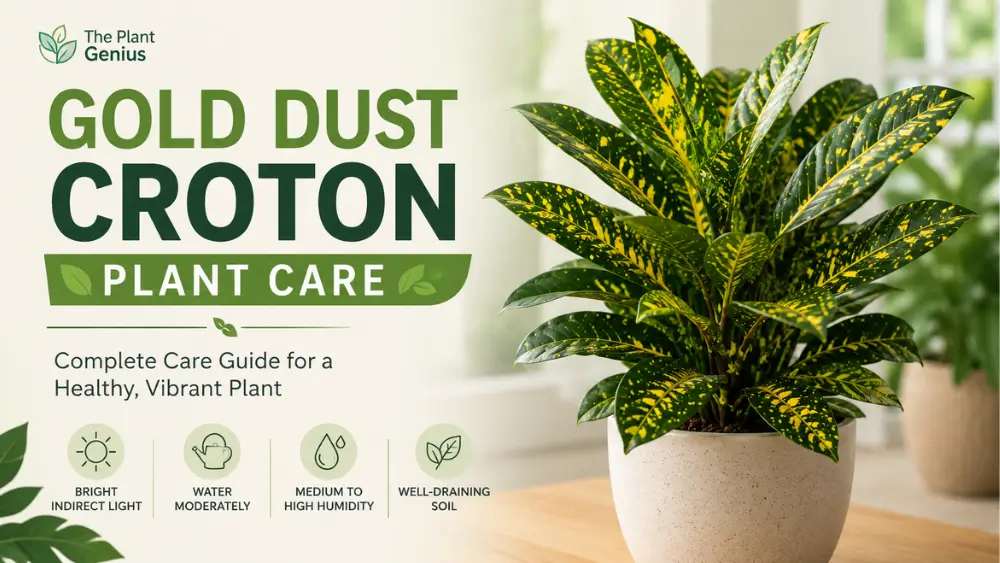
Gold Dust Croton (Codiaeum variegatum ‘Gold Dust’) needs bright, indirect light with some gentle direct sun, soil kept consistently moist but never waterlogged, and warm temperatures with high humidity levels throughout the year. It’s grown for its glossy, dark green leaves speckled with bright golden-yellow spots, a confetti-like pattern that gives the plant its name. It has a reputation as a moderately demanding houseplant, largely because its vivid gold coloring is directly tied to how much light it receives, but consistent care rewards growers with genuinely striking, colorful foliage.
Table of Contents
Quick Care Facts
| Care Factor | Requirement |
|---|---|
| Scientific name | Codiaeum variegatum ‘Gold Dust’ |
| Common names | Gold Dust Croton, Variegated Croton, Garden Croton |
| Light | Bright, indirect light, 4-6 hours minimum, plus some gentle direct sun |
| Water | When top inch of soil is dry; keep consistently moist, never soggy |
| Soil | Well-draining, slightly acidic potting mix with perlite |
| Temperature | 60-80°F (16-27°C); avoid cold drafts and sudden changes |
| Humidity | High, ideally 40-60% or above |
| Fertilizer | Balanced liquid feed, diluted to half strength, monthly during the growing season |
| Toxicity | Toxic to pets if ingested; sap can irritate skin on contact |
| Growth habit | Upright shrub; typically 2-3 ft tall indoors |
| Difficulty | Moderate; light consistency is the key factor for good color |
About the Gold Dust Croton
Gold Dust Croton is a cultivar of Codiaeum variegatum, a subtropical evergreen shrub native to Indonesia, southern Asia, and Pacific Island regions, and a member of the Euphorbiaceae, or spurge, family, making it a relative of the widely recognized holiday plant poinsettia. It’s grown almost entirely for its striking foliage: glossy, dark green leaves scattered with bright golden-yellow speckles that create a paint-splattered, confetti-like effect unlike almost any other common houseplant. Indoors, it typically grows to about 2-3 feet tall, though outdoors in warm, humid climates (USDA zones 10-12), some Croton varieties can reach considerably larger sizes.
Gold Dust Croton has a longstanding reputation among houseplant growers as being somewhat high-maintenance or finicky. In practice, this comes down mainly to its need for consistently bright light and steady humidity, rather than any particular fragility; growers who meet those two needs reliably tend to find it a genuinely rewarding, long-lived plant rather than a difficult one.
Croton as a broader group includes many cultivars beyond Gold Dust, ranging widely in leaf shape and color combinations, from narrow, curling leaves to broad, oak-like ones, and from mixes of red, orange, and purple to the yellow-speckled pattern that defines the Gold Dust variety specifically. Whichever cultivar you have, the same core care principles outlined in this guide generally apply, since they all share the same species and the same fundamental light and humidity preferences.
Where to Display Gold Dust Croton
Given its need for strong, consistent light, Gold Dust Croton is best placed directly in or very near your brightest window rather than tucked into a decorative corner further from natural light. Its bold, colorful foliage works well as a standalone focal point in a living room or entryway, and it also pairs nicely with other colorful tropical foliage plants, such as Ti Leaf, in a grouped display where the different pigmented leaves complement each other.
Why Light Determines Your Croton’s Color
More than almost any other common houseplant, Gold Dust Croton’s signature coloring is directly dependent on how much light it receives: the brighter the light, the more vivid and pronounced the gold speckling, while insufficient light causes the coloring to fade and dull.
This makes light the single most important factor to get right with this plant. A spot with strong, bright indirect light for at least several hours a day is the minimum for maintaining good color, and a bit of gentle direct morning sun often intensifies the variegation further. If your Croton’s leaves look increasingly plain green and washed out compared to when you first got it, moving it to a brighter location is almost always the fix, well before considering fertilizer or other adjustments.
Watering
Water when the top inch of soil is dry, aiming to keep the soil consistently moist without letting it become waterlogged.
Gold Dust Croton is sensitive to both extremes: consistently soggy soil can lead to root rot, while letting the plant dry out too much or too often can cause leaf drop, a somewhat unusual dual sensitivity compared to many houseplants that lean clearly toward one risk or the other. Water thoroughly, let any excess drain away completely, and check the soil regularly rather than watering on a fixed calendar schedule.
Soil and Potting
A well-draining, slightly acidic potting mix suits Gold Dust Croton well, ideally amended with perlite or coco coir to improve aeration alongside some organic matter to enrich the soil and support healthy root development. A layer of organic mulch around the base can help retain soil moisture and keep the root zone cooler during warm weather. Repot every 1-2 years, or when roots become visibly cramped, choosing a pot only 1-2 inches larger in diameter than the current one, since oversized pots hold excess moisture that can lead to soggy soil.
Temperature and Humidity
Gold Dust Croton does best in warm conditions, ideally 60-80°F (16-27°C), and is sensitive to cold drafts and sudden temperature changes, both of which can trigger leaf drop. Keep it away from drafty windows, exterior doors, and air conditioning vents that could expose it to sudden shifts in temperature throughout the day.
High humidity is important for this plant, ideally in the 40-60% range or higher. A pebble tray or room humidifier are the most effective ways to maintain adequate humidity; misting can help too, but should be done sparingly rather than frequently, since excess moisture sitting on the leaves can contribute to fungal leaf problems over time, particularly in a room with limited airflow.
Fertilizing
Feed monthly during the growing season, spring through early fall, with a balanced liquid fertilizer diluted to half strength. Watering the plant before applying fertilizer helps prevent root burn from concentrated nutrients touching dry roots directly. Stop fertilizing in late fall and winter, when the plant enters a natural rest period and isn’t actively using additional nutrients.
Pruning and Leaf Care
Gold Dust Croton responds well to pruning, particularly if it’s become leggy, and a hard prune at the start of the growing season, followed by a move to a brighter, sunnier spot, often encourages vigorous new growth with improved coloring. When pruning, use clean, sharp shears and cut above a node to support healthy healing, and if a stem has lost most of its leaves and looks bare, it can be cut back flush rather than left in place.
Because dust accumulating on the broad leaves can measurably reduce how efficiently the plant photosynthesizes, wiping the leaves down periodically with a damp sponge is a simple habit that supports better overall health and keeps the gold speckling looking its most vivid and eye-catching.
How to Propagate Gold Dust Croton
Gold Dust Croton is most reliably propagated from stem cuttings taken during the active growing season:
- Take a cutting that includes 3-4 leaves, cutting just below a node.
- Plant the cutting in moist, well-draining soil.
- Cover the pot loosely with a clear plastic bag to help maintain high humidity while it roots.
- Keep it warm and in bright, indirect light, checking periodically that the soil stays lightly moist.
Is Gold Dust Croton Toxic to Pets and Humans?
Gold Dust Croton is toxic to pets if ingested, and its milky sap can also irritate skin on contact.
Ingesting any part of the plant can cause gastrointestinal distress in cats and dogs, so it should always be kept out of reach of pets that chew on houseplants. Separately, the plant’s sap, common among members of the Euphorbiaceae family, can cause skin irritation if it comes into contact with bare skin, so it’s worth wearing gloves and washing your hands thoroughly whenever you’re pruning, propagating, or repotting this plant to avoid any discomfort afterward.
Common Problems and How to Fix Them
Faded, dull, or plain green leaves Almost always a sign of insufficient light. Move the plant to a brighter spot with several hours of indirect light, plus a little gentle direct sun if possible, and watch for improved coloring in the next round of new growth.
Leaf drop Can be caused by underwatering, cold drafts, or a sudden change in temperature or location, somewhat unusually for a houseplant, since it isn’t limited to just overwatering-related causes.
Root rot A sign of overwatering or poor drainage in the container. Let the soil dry out more between waterings and confirm the pot drains well.
Pests Spider mites, mealybugs, and scale are the most common pests on this plant. Inspect regularly, especially the undersides of leaves, and treat infestations early with insecticidal soap or neem oil to prevent them from spreading.
Seasonal Care Summary
| Season | Watering | Fertilizing | Notes |
|---|---|---|---|
| Spring | Every 5-7 days | Monthly, half strength | Good time for a hard prune if leggy |
| Summer | Every 5-7 days | Monthly, half strength | Peak color with bright light |
| Fall | Reduce gradually | Taper off | Growth naturally slows |
| Winter | Reduce further | None | Watch humidity with indoor heating running |
Frequently Asked Questions
How do you care for a Gold Dust Croton?
Give it bright, indirect light with some gentle direct sun, water when the top inch of soil is dry, provide high humidity, and feed monthly during the growing season for the most vivid gold coloring.
Why is my Gold Dust Croton losing its gold color?
This is almost always caused by insufficient light. Moving the plant to a brighter spot typically restores more vivid coloring in new growth over time.
Is Gold Dust Croton toxic to cats and dogs?
Yes, it’s toxic if ingested, and its sap can also irritate skin on contact, so gloves are recommended when handling or pruning the plant.
Why is my Gold Dust Croton dropping leaves?
Leaf drop can result from underwatering, cold drafts, or sudden temperature changes, in addition to the overwatering-related causes common to many houseplants.
Is Gold Dust Croton hard to care for?
It has a reputation for being moderately demanding, mainly due to its need for consistent bright light and high humidity, rather than being especially fragile overall.
How often should you water a Gold Dust Croton?
Water when the top inch of soil is dry, typically every 5-7 days, keeping the soil consistently moist without letting it become waterlogged.
How big does Gold Dust Croton get indoors?
It typically reaches about 2-3 feet tall indoors, though outdoors in warm, humid climates it can grow considerably larger.
Is Gold Dust Croton the same as other Croton varieties?
It’s one specific cultivar of Codiaeum variegatum. Other Croton cultivars vary widely in leaf shape and color, but they share the same species and generally the same core care requirements.
Can Gold Dust Croton grow outdoors?
Yes, in warm, humid climates (USDA zones 10-12) it can grow outdoors year-round, often reaching a larger size than it would indoors. In cooler climates, it’s best kept as a houseplant or moved outdoors only during warm months.
Why does my Gold Dust Croton have sap that irritates my skin?
This is a normal trait shared by many plants in the Euphorbiaceae family, which includes poinsettia. Wearing gloves during pruning, propagation, or repotting helps avoid skin irritation from contact with the sap.