
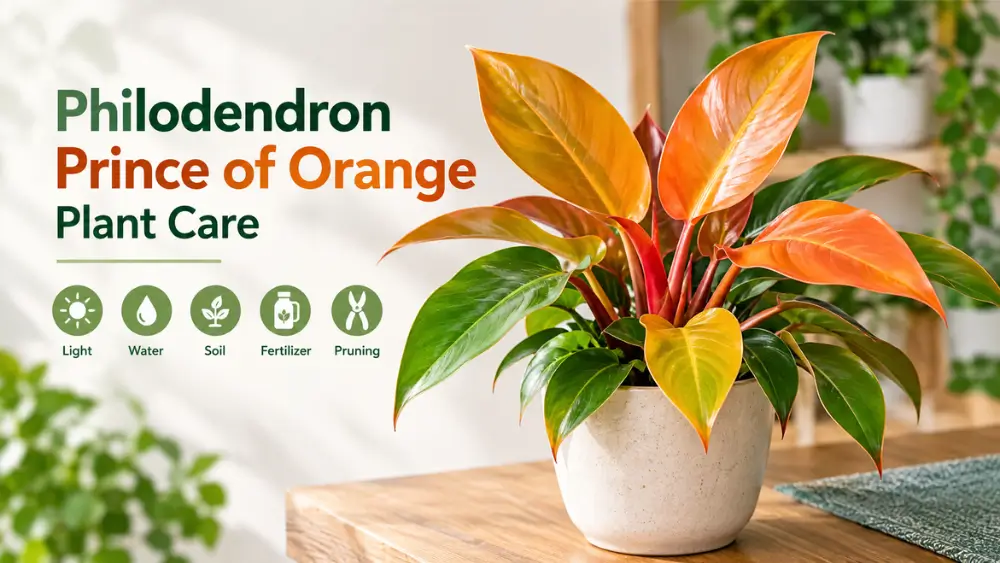
Philodendron ‘Prince of Orange’ needs bright, indirect light, soil kept lightly and consistently moist, and warm temperatures with average to moderate humidity levels year-round. It’s a self-heading, non-climbing hybrid Philodendron prized for its dramatic leaf color changes: new leaves emerge in vivid orange, gradually shifting through copper, yellow, and lime before settling into dark green as they mature. This is a completely normal developmental process, not a sign of poor care, and it means a healthy plant will typically show several different leaf colors at once.
Table of Contents
Quick Care Facts
| Care Factor | Requirement |
|---|---|
| Scientific name | Philodendron ‘Prince of Orange’ (hybrid cultivar) |
| Common names | Prince of Orange, Orange Prince |
| Light | Bright, indirect light; a little gentle direct morning or evening sun |
| Water | When top inch of soil is dry; keep lightly, consistently moist |
| Soil | Well-draining aroid potting mix |
| Temperature | 60-85°F (15-29°C); not frost tolerant |
| Humidity | Average to moderate; benefits from more |
| Fertilizer | Balanced liquid feed monthly during the growing season |
| Toxicity | Toxic to cats, dogs, and humans if chewed or ingested |
| Growth habit | Self-heading (non-vining); compact rosette, up to about 2-3 ft |
| Difficulty | Beginner-friendly despite its dramatic appearance |
About Philodendron Prince of Orange
Philodendron ‘Prince of Orange’ is a hybrid cultivar created by crossing different Philodendron varieties, rather than a naturally occurring wild species, though its parent genus is native to the tropical rainforests of the Americas and Caribbean. It’s a self-heading Philodendron, meaning it grows upright from a central rosette rather than climbing or trailing on vines, similar in overall form to its relative Philodendron Selloum, though considerably more compact, typically reaching only about 2-3 feet tall and wide at most.
The plant’s defining feature is its dramatic, ever-changing leaf color. Its glossy, oval leaves emerge from the center of the rosette in a vivid orange or yellow-orange hue, sometimes with reddish tones depending on the individual plant and its growing conditions, then gradually shift through shades of copper, salmon, and lime as they age, finally settling into a deep, glossy green once fully mature. Because new leaves are constantly emerging while older ones continue maturing, a healthy plant typically displays several different colors at once.
Understanding Ontogenic Color Change (Why New Leaves Turn Green)
The color transformation in Prince of Orange’s leaves is a normal, expected developmental process called ontogenic color change, meaning the color shift is tied to the age of the leaf rather than being a fixed pattern or a sign of a problem.
This is genuinely different from variegation, where a leaf’s pattern is fixed once it forms and stays that way for the life of the leaf. With Prince of Orange, every single leaf follows the same lifecycle: a young leaf emerges with bright orange pigments (specifically anthocyanins and carotenoids) that are gradually replaced by chlorophyll as the leaf matures, causing the color to shift toward green over a period of weeks. This isn’t the leaf “losing” its special color due to a care mistake; it’s simply growing up. New leaves continually emerge from the center of the rosette to replace the transition, so the orange color show never really stops on a healthy, actively growing plant.
It’s worth distinguishing this from a separate, unrelated process: older leaves toward the outer edge of the plant will also naturally yellow over time as part of normal aging, before eventually dropping. This is a different phenomenon happening at a different point in the leaf’s life and in a different location on the plant than the young-to-mature color transition at the center, and it’s easy to mistake one for a symptom of the other. As a general rule, color change happening at the newest growth in the center of the rosette is the expected ontogenic shift; yellowing on the oldest, outermost leaves is simply natural aging before leaf drop.
Light Requirements
Light plays a major role in how vivid Prince of Orange’s orange phase appears: a plant in bright light typically shows deeper, more saturated orange and copper tones, while a plant in dim light may see new leaves skip the orange stage almost entirely and emerge closer to green.
Bright, indirect light is ideal, with a little gentle direct sun in the morning or evening tolerated and sometimes even beneficial for color intensity. Avoid strong, prolonged direct sun, particularly during the middle of the day, which can scorch the leaves or cause new growth to look pale and washed out rather than vividly colored. Because this plant tends to lean and grow toward its light source, rotating the pot every few weeks helps it fill out evenly on all sides rather than growing lopsided.
Watering
Water when the top inch of soil is dry, keeping the soil lightly and consistently moist, particularly if you want the plant to produce its largest, healthiest leaves.
One practical tip worth knowing when you first bring this plant home: nursery soil is often compacted for shipping, which can make the surface look and feel drier than the soil underneath actually is. Check the moisture level a bit below the surface before watering a newly acquired plant, and consider gently aerating the soil to help it absorb water more evenly. Going forward, avoid letting the plant sit in soggy, waterlogged soil, which can lead to root rot.
Soil and Potting
A well-draining potting mix formulated for aroids, or a standard potting mix amended with perlite and orchid bark, suits Prince of Orange well. Repot every 1-2 years in spring, once roots fill the pot or begin growing through the drainage holes, moving up only one pot size at a time; a pot that’s too large relative to the root ball holds excess moisture and can contribute to soggy soil.
Temperature and Humidity
Prince of Orange does well in typical indoor temperatures, ideally 60-85°F (15-29°C), and isn’t frost tolerant, so keep it away from cold drafts and unheated spaces in winter. If grown outdoors, it’s only hardy in USDA zones 10-12.
It tolerates average household humidity reasonably well, though like most tropical aroids, it appreciates a bit of extra humidity, particularly during dry winter months when indoor heating is running.
Fertilizing
Feed with a balanced, water-soluble liquid fertilizer once a month during spring and summer while the plant is actively growing. Reduce or stop fertilizing in fall and winter, when growth naturally slows.
Pruning
Because Prince of Orange is self-heading rather than vining, pruning mainly involves removing spent or yellowed leaves at the outer edge of the rosette as part of normal maintenance, rather than cutting back long stems the way you might with a trailing houseplant. Regularly rotating the plant, as mentioned above, also helps maintain a fuller, more balanced shape over time.
How to Propagate Philodendron Prince of Orange
Like other self-heading Philodendron relatives such as Selloum, Prince of Orange doesn’t produce easy-to-root trailing stems, so propagation typically relies on offsets:
- Look for a basal offset, a smaller plantlet growing from the base of the parent, particularly on a more established specimen.
- Once the offset has developed a few of its own leaves and some root growth, carefully separate it from the parent plant using a clean, sharp knife.
- Pot the offset in fresh, well-draining soil.
- Keep it warm, in bright indirect light, and consistently moist while it establishes on its own.
Because offsets don’t always form reliably or quickly, propagation is generally less commonly attempted with this plant than with vining aroids like pothos or Monstera.
Is Philodendron Prince of Orange Toxic to Pets or Humans?
Philodendron Prince of Orange is toxic to cats, dogs, and humans if chewed or ingested.
Like other Philodendron and aroid relatives, its leaves and sap contain calcium oxalate crystals, which cause immediate irritation, burning, and swelling in the mouth and throat if bitten into, along with drooling, vomiting, and difficulty swallowing in pets. Keep the plant out of reach of pets and small children, and contact a veterinarian or poison control center if ingestion occurs.
Common Problems and How to Fix Them
New leaves emerging pale or washed out instead of vivid orange Usually a sign of too much intense direct light. Move the plant to a spot with bright but indirect light.
New leaves skipping the orange stage and emerging green Typically a sign of insufficient light. Increasing light exposure generally restores more vivid coloring in subsequent new leaves.
Yellowing on outer, older leaves This is usually normal aging rather than a problem, especially if it’s limited to the oldest leaves at the edge of the plant while the center continues producing healthy new growth.
Root rot A sign of overwatering or poor drainage. Let the soil dry out more between waterings and confirm the pot drains well.
Pests Spider mites, mealybugs, and scale can occasionally appear. Wipe down leaves periodically and treat promptly with insecticidal soap if pests are spotted.
Seasonal Care Summary
| Season | Watering | Fertilizing | Notes |
|---|---|---|---|
| Spring | When top inch is dry | Monthly | Good time to repot or separate offsets |
| Summer | When top inch is dry | Monthly | Watch for dry-out in bright, warm rooms |
| Fall | Reduce gradually | Taper off | Growth naturally slows |
| Winter | Every 1-2 weeks | None | Keep away from cold drafts |
Frequently Asked Questions
How do you care for a Philodendron Prince of Orange?
Give it bright, indirect light, water when the top inch of soil is dry, use well-draining soil, and rotate the pot periodically to encourage even, balanced growth.
Why do Prince of Orange leaves turn from orange to green?
This is a normal process called ontogenic color change, where each leaf’s color shifts as it matures, from orange pigments in young growth to green chlorophyll in mature leaves. It isn’t a sign of a care problem.
Why aren’t my Prince of Orange’s new leaves very orange?
Insufficient light is the most common cause. Moving the plant to a brighter spot typically results in more vivid orange and copper tones in the next round of new growth.
Is Philodendron Prince of Orange toxic to cats and dogs?
Yes, it’s toxic if chewed or ingested, due to calcium oxalate crystals in the leaves and sap, and should be kept out of reach of pets.
Does Philodendron Prince of Orange climb like other Philodendron?
No, it’s self-heading, meaning it grows upright from a central rosette rather than climbing or trailing, so it doesn’t need a moss pole or other support.
How big does Philodendron Prince of Orange get?
It stays fairly compact for a Philodendron, typically reaching about 2-3 feet tall and wide at most indoors.
Is Philodendron Prince of Orange easy to care for?
Yes, despite its dramatic appearance, it’s considered a fairly easy, forgiving houseplant, adapting well to normal indoor conditions as long as it gets reasonably bright light.
Does Philodendron Prince of Orange flower?
It can occasionally produce small, plain white flowers typical of the Philodendron genus, but this is rare indoors, and the plant is grown almost entirely for its foliage rather than any expectation of blooms.
How is Prince of Orange different from a variegated Philodendron?
Variegation is a fixed pattern that stays the same for the life of a leaf, while Prince of Orange’s color change is age-linked, meaning every leaf moves through the same sequence of colors as it matures rather than keeping one fixed pattern.