
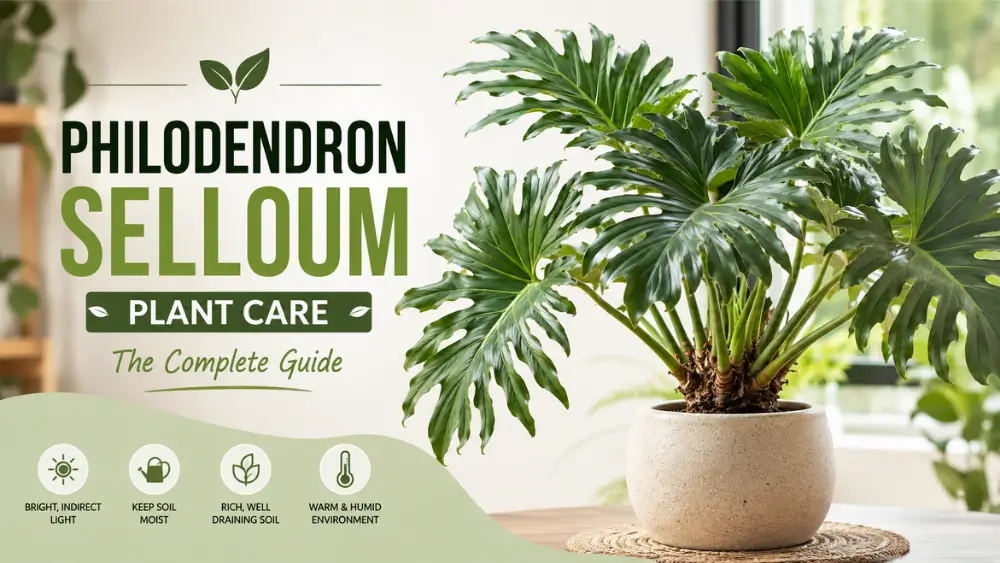
You’ll see this plant searched for as both “Selloum” and “Philodendron Selloum” — same plant, and this guide covers both.
Philodendron Selloum (Thaumatophyllum bipinnatifidum, formerly classified as Philodendron bipinnatifidum) needs bright, indirect light, soil that’s allowed to dry out somewhat between waterings, and warm temperatures with average to moderate humidity levels. Unlike its climbing relative Monstera, Selloum is a self-supporting, non-climbing plant that develops a thick, semi-woody trunk over time and doesn’t need a moss pole. Its large, deeply lobed, feathery-edged leaves make it a popular architectural statement plant for spacious rooms, offices, and atriums.
Table of Contents
Quick Care Facts
| Care Factor | Requirement |
|---|---|
| Scientific name | Thaumatophyllum bipinnatifidum (also Philodendron bipinnatifidum, ‘Selloum’) |
| Common names | Philodendron Selloum, Tree Philodendron, Lacy Tree Philodendron, Horsehead Philodendron |
| Light | Bright, indirect light; tolerates medium to lower light well |
| Water | When top 1-2 inches of soil are dry |
| Soil | Well-draining, rich potting mix |
| Temperature | 65-85°F (18-29°C); not cold tolerant |
| Humidity | Average to moderate; tolerates typical household humidity |
| Fertilizer | Balanced liquid feed monthly, spring through summer |
| Toxicity | Toxic to cats, dogs, and humans if chewed or ingested |
| Growth habit | Self-heading, non-climbing; develops a thick trunk with age |
| Difficulty | Beginner-friendly and adaptable to a range of light conditions |
About Philodendron Selloum
Philodendron Selloum is widely grown for its large, dramatically lobed, deeply cut leaves, which can reach several feet across on a mature plant, giving it a bold, architectural presence unlike almost any other common houseplant available at typical garden centers. It’s native to the rainforests of Brazil, Paraguay, and Argentina, where it grows as a large understory shrub. Botanically, it was recently reclassified from Philodendron bipinnatifidum into the newer genus Thaumatophyllum, alongside several other large, non-climbing Philodendron relatives, though “Philodendron Selloum” remains by far the most common name used in the plant trade and in everyday conversation.
You may occasionally see this plant nicknamed “Split-Leaf Philodendron” as well, a name more commonly associated with Monstera deliciosa. The overlap exists because both plants have deeply cut or perforated foliage, but they’re easy to tell apart once you know what to look for: Monstera’s leaves develop discrete holes and splits within an otherwise solid leaf surface, while Selloum’s leaves are deeply lobed and feathery along their entire edge, without the enclosed holes characteristic of Monstera.
Using Philodendron Selloum as a Statement Plant
Because of its eventual size and bold, sculptural leaf shape, Philodendron Selloum is a favorite choice for filling large, empty corners in spacious living rooms, offices, and lobbies where a smaller houseplant would simply disappear and fail to make a visual impact. Its non-climbing, self-supporting growth habit also makes it more practical than a vining plant for these settings, since it doesn’t need a trellis, moss pole, or other structure taking up additional space. As it matures and develops its characteristic trunk, it can even begin to resemble a small indoor tree, with the trunk visible beneath a canopy of large leaves, an effect many growers specifically cultivate by removing lower leaves as the plant ages.
Selloum vs. Monstera: A Different Kind of “Split Leaf”
Despite sharing a family and a superficially similar reputation for dramatic, split foliage, Selloum and Monstera actually grow in fundamentally different ways.
Monstera is a climbing vine that uses aerial roots to scale trees in search of light, and it genuinely benefits from a moss pole indoors to encourage larger, more fenestrated leaves. Philodendron Selloum, by contrast, is self-heading, meaning it grows upright on its own without needing to climb anything, gradually forming a thick, semi-woody trunk as it matures rather than a climbing vine. It does produce aerial roots of its own, but these primarily provide extra structural support and help stabilize the plant’s increasingly heavy canopy as it grows, rather than serving as climbing anchors the way Monstera’s aerial roots do.
In practical terms, this means Selloum doesn’t need a moss pole or any support structure at all; simply give it enough floor or shelf space to grow outward and upward on its own over the years.
Light Requirements
Philodendron Selloum does best in bright, indirect light, but it’s genuinely one of the more adaptable common houseplants when it comes to light tolerance, handling medium and even fairly low light reasonably well without major issues. A spot near a bright window works well, though it will also get by in a dimmer corner with somewhat slower growth. Avoid intense, prolonged direct sun, which can scorch the leaves.
Watering
Water when the top 1-2 inches of soil are dry, and always let excess water drain away completely.
Selloum tolerates occasional missed waterings better than it tolerates consistently soggy soil, which can lead to root rot over time. During the growing season, watering roughly once a week is typical, with longer gaps between waterings in fall and winter as growth slows.
Soil and Potting
A well-draining, rich potting mix suits this plant well, ideally amended with perlite to improve drainage further. Because Philodendron Selloum can grow quite large and develops a substantial root system over time, plan for periodic repotting into progressively larger, sturdy containers every couple of years, or as needed once roots become visibly crowded and start circling the bottom of the pot.
Temperature and Humidity
Philodendron Selloum does well in typical indoor temperatures, ideally 65-85°F (18-29°C), and isn’t cold tolerant, so keep it away from cold drafts, exterior doors, and air conditioning vents.
It tolerates average household humidity reasonably well, making it more forgiving on this front than some of its more humidity-demanding aroid relatives, such as African Mask Plant. Additional humidity is appreciated but not essential for healthy growth.
Fertilizing
Feed with a balanced, water-soluble liquid houseplant fertilizer once a month during spring and summer while the plant is actively growing. Reduce or stop fertilizing in fall and winter, when growth naturally slows.
Pruning and Managing Size
Because Philodendron Selloum can eventually grow quite large, several feet tall and equally wide indoors, occasional pruning helps keep it manageable in a home setting. Lower leaves naturally yellow and drop as the plant ages and its trunk lengthens, which is a normal part of its growth rather than a problem; simply trim these away as needed with clean, sharp shears. If space becomes limited, larger leaves and stems can be cut back, though keep in mind that a heavily pruned Selloum will take considerable time to regrow its characteristic large, deeply lobed foliage, since new leaves take a while to reach full size.
How to Propagate Philodendron Selloum
Unlike vining aroids such as Monstera or pothos, Philodendron Selloum doesn’t produce long trailing stems that are easy to cut and root, so propagation looks a little different:
- Look for offsets or basal shoots the plant sometimes produces at its base, particularly on older, more established plants.
- Once an offset has developed a few of its own leaves and roots, carefully separate it from the parent plant using a clean, sharp knife.
- Pot the separated offset in fresh, well-draining soil.
- Keep it warm, in bright indirect light, and consistently moist while it establishes on its own.
Because Selloum doesn’t reliably produce easy-to-root cuttings the way many other houseplants do, propagation is generally slower and less commonly attempted by home growers than with more vining relatives like Monstera or pothos. Most home growers simply enjoy their Selloum as a single long-term specimen rather than actively propagating new plants from it.
Is Philodendron Selloum Toxic to Pets or Humans?
Philodendron Selloum is toxic to cats, dogs, and humans if chewed or ingested.
Like other aroids, including Monstera and arrowhead plant, its leaves and sap contain calcium oxalate crystals, which cause immediate irritation, burning, and swelling in the mouth and throat if bitten into, along with drooling, vomiting, and difficulty swallowing in pets. Keep the plant out of reach of pets and small children, and contact a veterinarian or poison control center if ingestion occurs.
Common Problems and How to Fix Them
Yellowing leaves Usually a sign of overwatering. Let the soil dry out more between waterings and check that the pot drains well. Occasional yellowing of a single old leaf here and there can also simply be normal aging.
Leggy or sparse growth Can occur in very low light, though this plant is more tolerant of dim conditions than many others. Moving it to a brighter spot generally improves growth density.
Brown, crispy leaf edges Usually linked to underwatering or low humidity. Water more consistently and consider increasing humidity if the issue persists.
Lower leaves dropping as the plant ages This is a normal part of Selloum’s growth as its trunk lengthens over time, not typically a sign of a problem, as long as the rest of the plant looks healthy.
Pests Spider mites, mealybugs, and scale can occasionally appear. Wipe down leaves periodically and treat promptly with insecticidal soap if pests are spotted, giving extra attention to the undersides of the large leaves where pests often go unnoticed.
Seasonal Care Summary
| Season | Watering | Fertilizing | Notes |
|---|---|---|---|
| Spring | Weekly | Monthly | Good time to repot as needed |
| Summer | Weekly | Monthly | Watch for dry-out in bright, warm rooms |
| Fall | Reduce gradually | Taper off | Growth naturally slows |
| Winter | Every 1-2 weeks | None | Keep away from cold drafts |
Frequently Asked Questions
How do you care for a Philodendron Selloum?
Give it bright, indirect light, water when the top 1-2 inches of soil are dry, use well-draining soil, and don’t worry about providing a moss pole, since this plant grows upright on its own without climbing.
Does Philodendron Selloum need a moss pole like Monstera?
No, unlike Monstera, Selloum is self-heading and doesn’t climb, so it doesn’t need any support structure to grow well.
Is Philodendron Selloum the same as Split-Leaf Philodendron?
It’s sometimes called that, but the nickname is more commonly associated with Monstera deliciosa. The two are different plants: Monstera has holes within its leaves, while Selloum has deeply lobed, feathery-edged leaves without enclosed holes.
How big does Philodendron Selloum get indoors?
It can grow quite large indoors, often reaching several feet tall and equally wide over time, making it a popular choice for spacious rooms and offices.
Is Philodendron Selloum toxic to cats and dogs?
Yes, it’s toxic if chewed or ingested, due to calcium oxalate crystals in the leaves and sap, and should be kept out of reach of pets.
Why is my Philodendron Selloum losing its lower leaves?
This is a normal part of the plant’s growth as its trunk lengthens with age, similar to how a tree naturally sheds lower branches over time, rather than a sign of a care problem.
Is Philodendron Selloum easy to propagate?
It’s more difficult to propagate than many vining aroids, since it doesn’t produce easy-to-root trailing stems. Propagation is generally done by separating basal offsets from an established plant instead.
Does Philodendron Selloum tolerate low light?
Yes, it’s fairly tolerant of medium and even somewhat low light compared to many other aroids, though growth will be slower and less lush than in brighter conditions.
How is Philodendron Selloum different from other Philodendron varieties?
Unlike smaller vining Philodendron species that trail or climb, Selloum grows as a large, self-heading plant that develops its own trunk over time rather than needing to climb, and its leaves are far more deeply lobed and larger than most other common Philodendron varieties.