
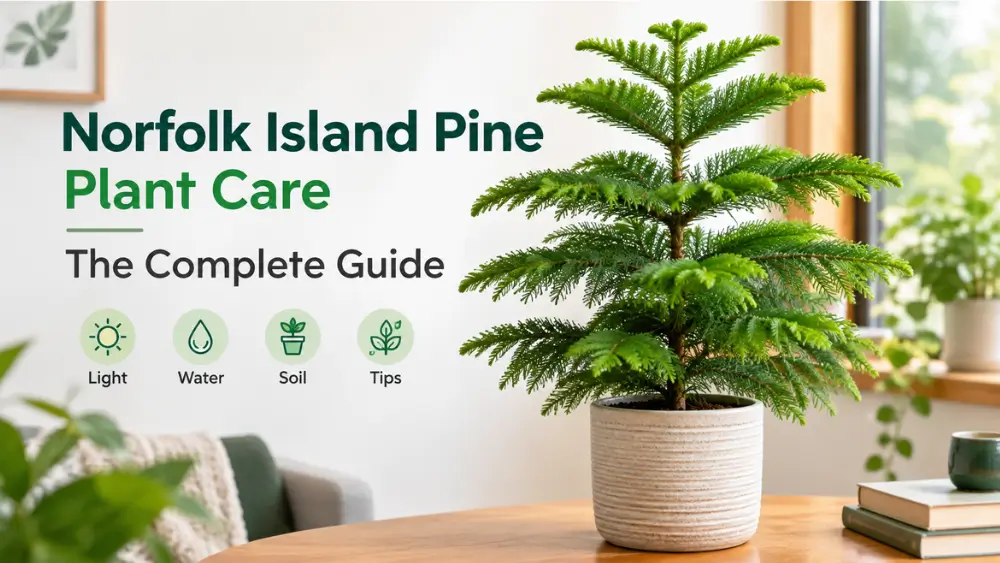
Norfolk Island Pine (Araucaria heterophylla) needs bright light with some direct sun, evenly moist soil that never fully dries out, and consistently high humidity to thrive indoors over the long term. Despite its pine-like appearance, it’s actually a tropical conifer, not a true pine, and popular as a living Christmas tree thanks to its naturally symmetrical, tiered branching. The single most important thing to know before growing one: unlike most houseplants, needles lost to dry air or low light do not grow back, making prevention far more important than trying to fix damage after the fact.
Table of Contents
Quick Care Facts
| Care Factor | Requirement |
|---|---|
| Scientific name | Araucaria heterophylla |
| Common names | Norfolk Island Pine, Star Pine |
| Light | Bright light with some direct sun; rotate regularly for even growth |
| Water | When the top inch of soil is dry; keep evenly moist, never soggy |
| Soil | Well-draining, slightly acidic mix with good organic content |
| Temperature | 65-75°F (18-24°C); protect below 50°F (10°C) |
| Humidity | High; dry air is the leading cause of needle loss |
| Fertilizer | Diluted balanced liquid feed during the growing season |
| Toxicity | Non-toxic to cats, dogs, and humans |
| Growth habit | Slow-growing, symmetrical, tiered conifer; 3-8 ft indoors |
| Difficulty | Moderate; humidity and consistent light are essential |
About the Norfolk Island Pine
Norfolk Island Pine gets its name from the tiny South Pacific island between Australia and New Zealand where it was first documented by Captain James Cook’s expedition in 1774. Despite looking every bit the part of a classic conifer, it isn’t a true pine at all; it belongs to the ancient Araucaria genus, whose lineage actually predates true pines by millions of years, making it a genuine living link to a much older era of plant evolution. Its other common name, Star Pine, comes from the distinctive star-like pattern its branches form when viewed from directly above.
In the wild, Norfolk Island Pine is a genuine giant, capable of reaching 200 feet tall. In fact, the British Royal Navy once considered the tree as a source of ship masts when wartime supply lines cut off other timber, though the wood ultimately proved too brittle for the job. As a houseplant, it stays far more modest, typically growing slowly to somewhere between 3 and 8 feet over many years, with soft, short needles arranged in flat, tiered branches that make it a popular and visually striking living Christmas tree each winter.
Can Norfolk Island Pine Live Outdoors?
In genuinely mild, frost-free climates, Norfolk Island Pine can be grown outdoors year-round, where it will eventually reach a much larger size than it ever could in a pot. In most other climates, it can spend summer outdoors in a shaded spot, since intense direct sun can scorch it in ways that indoor light rarely does, but it needs to come back indoors well before temperatures drop toward 50°F (10°C) in fall, since it has no meaningful frost tolerance despite its evergreen conifer appearance.
Why Needle Loss Is Permanent (And Why Prevention Matters So Much)
Unlike most common houseplants, which can recover fully once a care issue is corrected, Norfolk Island Pine’s needles do not grow back once they’re lost to dry soil, dry air, or low light.
A branch that’s dropped its needles will stay bare indefinitely, since new growth emerges only from the growing tips of the plant rather than regenerating along already-established branches. This makes Norfolk Island Pine meaningfully different from, say, a Dracaena that can be cut back and reliably resprout, or a Pothos that bounces back from a rough patch. With this plant, consistent humidity, steady moisture, and reliable light aren’t just nice-to-haves; they’re the only real way to keep the plant looking full and healthy over the long run, since there’s no simple fix once bare patches appear.
Light Requirements
Norfolk Island Pine does best in bright light, including a few hours of direct sun, and tends to lean noticeably toward its light source over time. Rotating the pot every week or two helps the plant develop evenly on all sides rather than growing lopsided and unbalanced. It tolerates medium light for a while, but will grow leggy and sparse if kept too dim for extended periods, and as established earlier, this kind of light-related thinning won’t reverse once it happens.
Watering
Water when the top inch of soil feels dry, aiming to keep the soil evenly moist rather than letting it dry out completely or sit in standing water.
After watering, check any decorative pot or saucer after about 20 minutes and empty out anything that’s collected, since standing water at the base can lead to root rot over time. Smaller potted specimens in particular can dry out faster, sometimes needing water every 3-5 days in a warm, dry room, so checking the soil directly with your finger is more reliable than watering on a fixed calendar schedule.
Soil and Potting
A well-draining potting mix with good organic content and a slightly acidic pH suits Norfolk Island Pine’s needs well. Repot as the plant grows, gently loosening some of the old soil from the root ball at that time, generally every couple of years for a younger, actively growing plant, and less frequently as it matures and growth slows further.
Temperature and Humidity
Norfolk Island Pine prefers steady room temperatures of 65-75°F (18-24°C) and should be protected from temperatures below 50°F (10°C), since it’s genuinely frost tender despite its pine-like looks. Keep it away from cold drafts as well as heat sources like radiators and heating vents, both of which stress the plant.
High humidity is essential, and dry air is the single most common reason this plant declines indoors. Brown, dry needle tips are typically the first visible warning sign of insufficient humidity, appearing well before more serious needle drop sets in. Watch particularly for spots near active radiators or air conditioning vents, which can create pockets of especially dry air even in a room that otherwise seems reasonably humid. A cool-mist humidifier placed nearby is the most reliable solution; regular misting with room-temperature water can help too, and this is one of the few plants where frequent misting is genuinely beneficial rather than something to use sparingly.
Fertilizing
Feed with a balanced liquid fertilizer, diluted to half strength, during the active growing season. Many growers find feeding roughly once every 4-8 weeks keeps the plant’s needles a healthy green and supports steady new growth; more frequent light feeding at half strength also works well if you prefer a regular monthly routine instead. Skip fertilizing entirely in fall and winter, when the plant’s growth naturally slows.
Pruning
Because damaged branches won’t regrow needles or fill back in, pruning should be approached cautiously and mainly limited to removing branches that are already dead or severely damaged, rather than routine shaping. The plant’s naturally symmetrical, tiered growth habit generally doesn’t need active shaping the way many houseplants do.
Propagation
Norfolk Island Pine is commercially propagated from seed or cuttings, but this isn’t especially practical for home growers, since cuttings from side branches tend to grow sideways rather than developing the classic upright, symmetrical form of a plant grown from its central leader, resulting in an oddly lopsided specimen. Most home growers simply purchase an already-established plant rather than attempting propagation themselves.
Is Norfolk Island Pine Toxic to Pets?
Norfolk Island Pine is non-toxic to cats, dogs, and humans, making it a genuinely safe choice as a living Christmas tree in households with curious pets or small children, a meaningful advantage over some other holiday plants.
Common Problems and How to Fix Them
Brown, dry needle tips An early warning sign of insufficient humidity in the surrounding air. Increase humidity right away with a humidifier or regular misting before more significant needle drop occurs.
Needle drop that doesn’t grow back Usually the result of dry air, dry soil, or low light sustained over time. Since lost needles won’t return, focus on preventing further loss through consistent humidity, watering, and light going forward, rather than expecting the affected branches to fill back in.
Leggy or lopsided growth A sign of insufficient or uneven light exposure over time. Move the plant to a brighter spot and rotate it regularly to encourage more even, balanced growth on all sides.
Yellowing lower branches Can occur naturally with age on the very lowest branches, though widespread yellowing across many branches points to overwatering or poor drainage rather than simple aging.
Pests Spider mites and mealybugs can appear, particularly in dry conditions that also stress the plant in other ways. Increasing humidity helps prevent infestations in the first place; treat active problems with insecticidal soap.
Seasonal Care Summary
| Season | Watering | Fertilizing | Notes |
|---|---|---|---|
| Spring | Every 1-2 weeks | Every 4-8 weeks, diluted | Good time to repot if needed |
| Summer | Every 1-2 weeks | Every 4-8 weeks, diluted | Can move outdoors to a shaded spot |
| Fall | Reduce slightly | Taper off | Bring outdoor plants back inside before cold weather |
| Winter | Every 1-2 weeks | None | Watch humidity closely with indoor heating running |
Frequently Asked Questions
How do you care for a Norfolk Island Pine?
Give it bright light with some direct sun, keep the soil evenly moist, maintain high humidity with a humidifier or regular misting, and protect it from cold drafts and temperatures below 50°F.
Why are my Norfolk Island Pine’s needles falling off?
This is usually caused by dry air, dry soil, or insufficient light over time. Unlike many houseplants, lost needles don’t grow back, so prevention through consistent humidity and watering matters more than trying to fix bare branches afterward.
Is Norfolk Island Pine a real pine tree?
No, despite its name and appearance, it belongs to the ancient Araucaria genus rather than true pines, and it’s actually a tropical conifer rather than a cold-climate evergreen.
Is Norfolk Island Pine toxic to cats and dogs?
No, it’s considered non-toxic to both cats and dogs, making it a safe living Christmas tree option for homes with pets.
Can Norfolk Island Pine be kept as a Christmas tree every year?
Yes, with good care it can live for many years and be decorated as a small living Christmas tree annually, growing slowly taller with each passing year.
Should I mist my Norfolk Island Pine?
Yes, this is one of the few common houseplants where regular misting is genuinely beneficial, since it’s especially sensitive to dry air.
How big does Norfolk Island Pine get indoors?
It typically grows slowly to somewhere between 3 and 8 feet tall indoors over many years, compared to the 200-foot giants it can become in its native habitat.
Can Norfolk Island Pine live outdoors?
Yes, in genuinely mild, frost-free climates it can grow outdoors year-round. In other climates, it can spend summer outside in a shaded spot but must come back indoors before temperatures drop toward 50°F.
Why is Norfolk Island Pine called Star Pine?
This nickname comes from the distinctive star-like pattern its branches form when the plant is viewed from directly above, a result of its symmetrical, tiered branching structure.
Does Norfolk Island Pine clean the air?
It’s included on NASA’s list of houseplants studied for air-purifying qualities, though as with any single houseplant, its practical effect on a room’s air quality in a typical home is modest at best and shouldn’t be the main reason to choose it.