
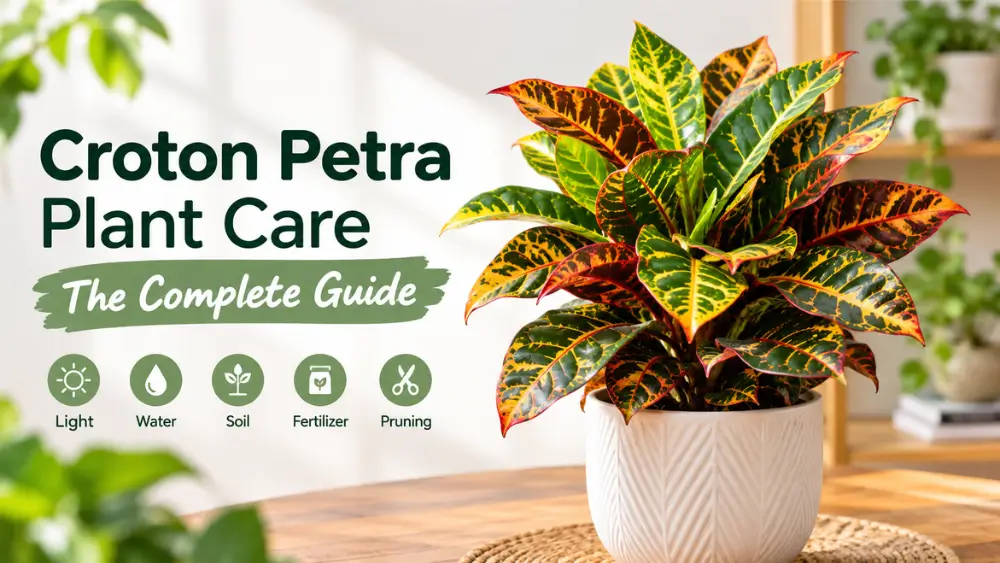
Croton Petra shares its species and core care with Gold Dust Croton. For general Croton background and detailed light guidance, see our Gold Dust Croton care guide; this guide focuses on what’s specific to the Petra cultivar.
Croton Petra (Codiaeum variegatum ‘Petra’) needs bright, indirect light for at least 4-6 hours a day, soil kept lightly moist but never soggy, and warm temperatures with humidity of 40-60%. It’s grown for its large, leathery, prominently veined leaves in shades of green, yellow, orange, and red, with the veins themselves picked out in contrasting color. Like other Crotons, its coloring depends heavily on light, and it’s notoriously prone to dropping leaves after being moved, which is normal adjustment rather than a sign of failure.
Table of Contents
Quick Care Facts
| Care Factor | Requirement |
|---|---|
| Scientific name | Codiaeum variegatum ‘Petra’ |
| Common names | Croton Petra, Petra Croton, Golden Petra |
| Light | Bright, indirect light, 4-6 hours daily; a little direct sun tolerated |
| Water | When the top 25-50% of soil is dry; keep lightly moist, never soggy |
| Soil | Well-draining potting mix for tropical houseplants |
| Temperature | 60-85°F (16-29°C); avoid cold drafts and windowpanes in winter |
| Humidity | 40-60%; mist sparingly to avoid fungal issues |
| Fertilizer | General houseplant feed 3 times a season: early spring, early summer, mid-summer |
| Toxicity | Moderately toxic to pets and humans; sap can irritate skin |
| Growth habit | Upright, slow-growing shrub; 3-6 ft indoors |
| Difficulty | Moderate; light and stable placement matter most |
About Croton Petra
Croton Petra is one of the most widely sold cultivars of Codiaeum variegatum, distinguished by its large, broad, leathery, oval-to-elongated leaves with prominently marked veins. Where many Croton cultivars scatter their color in speckles or irregular splashes, Petra’s coloring follows the leaf’s vein structure, producing a bold, almost hand-painted look in shades of green, yellow, orange, and deep red. It’s sometimes sold under the name Golden Petra.
Like other Crotons, it’s native to Southeast Asia, Australia, and the Pacific Islands, and belongs to the Euphorbiaceae family alongside poinsettia and Devil’s Backbone. Indoors, Petra is a slow grower that can eventually reach 3-6 feet tall, making it one of the larger Croton cultivars commonly kept as a houseplant. It’s also a popular gift plant in some traditions, associated with renewal and vitality.
Where to Display Croton Petra
Given its eventual size and bold coloring, Croton Petra works best as a floor-standing statement plant in a bright room, an entryway container, or a sunny corner where its foliage can be appreciated from across the space. It also does well on a covered patio or balcony during warm weather, where the extra light often deepens its coloring noticeably.
Two practical placement considerations matter more with this plant than most. First, choose the spot before you bring it home rather than moving it around afterward, since relocation reliably triggers leaf drop. Second, given its toxicity and skin-irritating sap, avoid placing it somewhere pets or small children brush past it regularly, such as a narrow hallway or beside a favorite pet resting spot.
Croton Petra vs. Gold Dust Croton
Both are cultivars of the same species and share essentially identical care, but they look quite different:
Croton Petra has large, broad, leathery leaves with color following the vein structure, creating bold bands of yellow, orange, and red radiating through a green leaf. It’s the more dramatic, larger-leaved of the two.
Gold Dust Croton has smaller, glossier green leaves scattered with fine golden-yellow speckles, creating a confetti-like effect rather than Petra’s painted-vein look.
If you’re deciding between them, Petra makes a bigger visual statement as a floor plant, while Gold Dust works well as a more compact tabletop or shelf specimen. The care guidance in this guide applies equally to both.
Why Croton Petra Drops Leaves After You Bring It Home
Croton Petra strongly dislikes being moved, and dropping several leaves within the first week or two of arriving in a new home is normal adjustment behavior rather than a sign you’ve done something wrong.
This catches a lot of new owners off guard, particularly with a plant this expensive-looking. The plant is responding to the abrupt change in light levels, humidity, and temperature between the greenhouse it was grown in and your living room. Sudden temperature fluctuations, such as being placed near a drafty door or a cold windowpane, can trigger the same response.
The right approach is patience combined with stability: choose a good spot before you unpack it, keep it there rather than experimenting with different rooms, follow consistent watering and light guidance, and give it a few weeks. New growth emerging is the sign it has settled in, and those new leaves will gradually mature into their full coloring.
Light Requirements
Croton Petra needs bright, indirect light for roughly 4-6 hours a day to produce and maintain its vivid multicolored foliage.
An east- or west-facing window with filtered light is generally ideal. A few hours of gentle direct sun is fine and can intensify the coloring, but prolonged harsh direct sun will scorch the leaves. In insufficient light, the plant grows tall and lanky with sparse leaves, and the rich colors fade toward plain green, which is the single most common complaint with this cultivar.
Watering
Water when the top 25-50% of the soil has dried out, watering thoroughly until liquid flows from the drainage hole and discarding anything that collects in the saucer. The goal is soil that stays lightly moist rather than either soggy or bone dry.
Water quality is worth attention with Petra specifically: some growers find that using distilled or filtered water helps prevent the leaf spotting that can develop with mineral-heavy tap water, similar to the sensitivity seen in Dracaena and Calathea.
Soil and Potting
A well-draining potting mix formulated for tropical houseplants works well. Repot every 1-2 years, or when the root system becomes visibly cramped, choosing a pot 1-2 inches larger in diameter than the current one. Gently loosen the root ball when transferring, and expect some temporary leaf drop afterward, consistent with this plant’s general dislike of disruption.
Temperature and Humidity
Croton Petra prefers warm conditions, roughly 60-85°F (16-29°C), and is genuinely sensitive to cold. Keep it away from drafts, air conditioning vents, and cold windowpanes in winter, all of which can trigger leaf drop.
It appreciates humidity of 40-60%, higher than most homes provide naturally. A pebble tray or room humidifier are the most reliable options. Misting can help, but should be done sparingly rather than routinely, since water sitting on the leaves can encourage fungal problems.
Fertilizing
Rather than a strict monthly schedule, a straightforward approach that works well for Croton Petra is feeding with a general houseplant fertilizer three times across the growing season: once in early spring, once in early summer, and once in mid-summer. Do not feed in fall or winter, when growth slows considerably.
Pruning and Leaf Care
To encourage a bushier, fuller plant rather than a tall, bare-stemmed one, prune stems right above a leaf node, which prompts branching at that point. Because Petra’s leaves are large and broad, they collect dust readily, and wiping them periodically with a damp cloth genuinely helps the plant photosynthesize efficiently while keeping the colors looking their most vivid.
How to Propagate Croton Petra
Croton Petra propagates reliably from stem cuttings:
- Take a stem cutting roughly 3-4 inches long, using clean shears and wearing gloves to protect your skin from the sap.
- Plant the cutting in moist, well-draining soil.
- Cover with a transparent plastic bag to raise humidity around the cutting while it roots.
- Place in a brightly lit spot out of direct sun, and keep the soil lightly moist.
- Remove the bag once new growth appears, indicating roots have established.
Is Croton Petra Toxic to Pets and Humans?
Croton Petra is moderately toxic to pets and humans if ingested, and its milky sap can irritate skin on contact.
Ingestion typically causes mouth and stomach irritation and possible vomiting. Separately, the sap released when stems or leaves are broken can cause skin irritation, a trait shared across the Euphorbiaceae family. Keep the plant out of reach of pets and small children, and wear gloves when pruning, propagating, or repotting.
Common Problems and How to Fix Them
Leaf drop after moving or repotting Normal adjustment behavior for this cultivar. Keep the plant in a stable spot with consistent care and wait for new growth rather than making further changes.
Fading color, leaves turning plain green Insufficient light is the usual cause. Move the plant somewhere brighter with more indirect light.
Tall, lanky growth with sparse leaves Also a light issue. Increase light exposure and prune above leaf nodes to encourage branching.
Brown, crispy leaf tips Usually caused by dry air. Raise humidity with a pebble tray or humidifier rather than relying on misting alone.
Leaf spotting Can result from mineral-heavy tap water. Try distilled or filtered water.
Pests Mealybugs, spider mites, and aphids are the most common. Inspect regularly, treat with insecticidal soap or horticultural oil, and maintain good air circulation to discourage fungal disease.
Seasonal Care Summary
| Season | Watering | Fertilizing | Notes |
|---|---|---|---|
| Spring | When top 25-50% is dry | Feed in early spring | Good time to prune, repot, or propagate |
| Summer | When top 25-50% is dry | Feed early and mid-summer | Colors most vivid with good light |
| Fall | Reduce gradually | None | Growth slows; move away from cooling windows |
| Winter | Reduce further | None | Keep away from cold panes and drafts; watch humidity |
Frequently Asked Questions
How do you care for a Croton Petra?
Give it bright, indirect light for 4-6 hours daily, water when the top quarter to half of the soil is dry, maintain humidity of 40-60%, and keep it in a stable spot away from drafts.
Why is my Croton Petra dropping leaves?
Croton Petra dislikes being moved and commonly drops leaves after arriving in a new home or being repotted. This is normal adjustment; keep conditions stable and wait for new growth.
Why is my Croton Petra losing its color?
Insufficient light is almost always the cause. Move it to a brighter spot with indirect light, since this cultivar’s coloring depends directly on light levels.
What’s the difference between Croton Petra and Gold Dust Croton?
Both are cultivars of the same species with identical care. Petra has large leathery leaves with color following the veins, while Gold Dust has smaller glossy leaves with fine yellow speckling.
Is Croton Petra toxic to cats and dogs?
Yes, it’s moderately toxic if ingested, causing mouth and stomach irritation, and its sap can irritate skin on contact.
How big does Croton Petra get indoors?
It’s a slow grower that can eventually reach 3-6 feet tall indoors, making it one of the larger commonly grown Croton cultivars.
How often should you fertilize a Croton Petra?
Three times across the growing season works well: early spring, early summer, and mid-summer. Skip feeding entirely in fall and winter.
Can Croton Petra go outside in summer?
Yes, it does well on a covered patio or balcony during warm weather, and the extra light often intensifies its coloring. Bring it back indoors well before temperatures drop, since it’s sensitive to cold.
Should I mist my Croton Petra?
Only sparingly. It appreciates humidity of 40-60%, but water sitting on the leaves can encourage fungal problems, so a pebble tray or humidifier is a better way to raise humidity than frequent misting.