
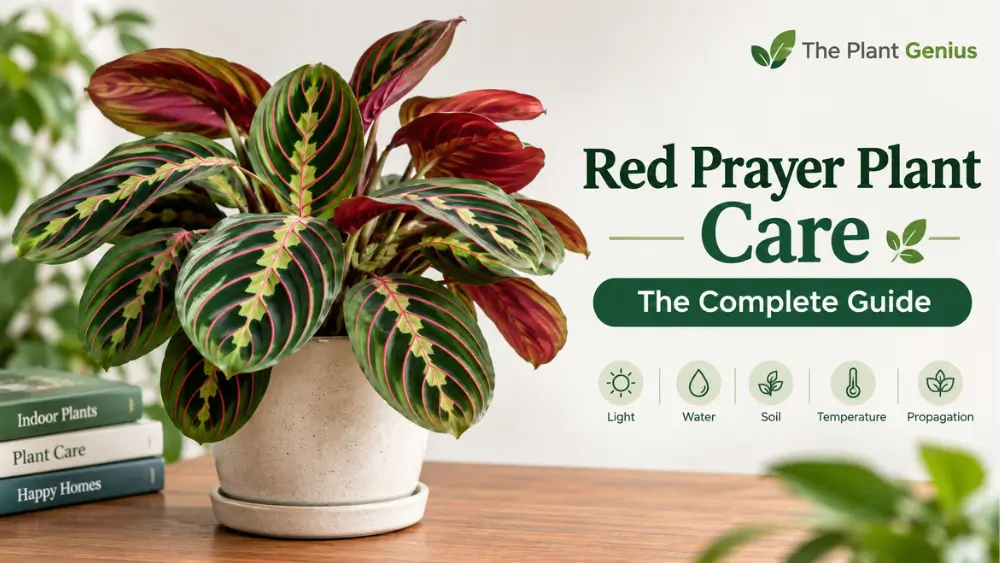
Red Prayer Plant (Maranta leuconeura var. erythroneura) needs medium to bright indirect light, consistently moist soil, and higher-than-average humidity, though it’s generally more forgiving overall than its close relative Calathea. It’s grown for its oval, dark green leaves marked with vivid red veins in a herringbone pattern and a lighter feathery band along the midrib. It’s also the plant that gave the entire “prayer plant” family its name, thanks to its leaves folding upward at night like hands folded in prayer, then lowering flat again each morning.
Table of Contents
Quick Care Facts
| Care Factor | Requirement |
|---|---|
| Scientific name | Maranta leuconeura var. erythroneura |
| Common names | Red Prayer Plant, Herringbone Plant, Red-Veined Prayer Plant |
| Light | Medium to bright indirect light; no direct sun |
| Water | Consistently moist, never soggy; filtered or distilled water preferred |
| Soil | Well-draining, moisture-retentive mix with perlite |
| Temperature | 65-80°F (18-27°C); avoid cold drafts |
| Humidity | Above average preferred; more tolerant of average humidity than Calathea |
| Fertilizer | Light, diluted balanced feed monthly during growing season |
| Toxicity | Non-toxic to cats and dogs |
| Growth habit | Low, spreading, slightly trailing as it matures |
| Difficulty | Beginner-to-moderate; easier than most Calathea relatives |
About the Red Prayer Plant
Red Prayer Plant, Maranta leuconeura var. erythroneura, is native to the rainforests of Brazil and grown for its striking oval leaves, deep green with vivid red veins arranged in a herringbone pattern radiating out from a lighter, feathery yellow-green band along the central rib. The undersides of the leaves carry a reddish-purple hue, visible whenever the plant’s leaves fold up at night, adding another layer of visual interest beyond the top-side pattern most people notice first.
This is genuinely the original “prayer plant,” the species that gave its common name to the wider Marantaceae family, including its more demanding relative Calathea, which shares the same nightly leaf-folding behavior but belongs to a different genus. Red Prayer Plant grows low and spreading rather than upright, and as it matures, its stems can begin to trail somewhat, making it a good candidate for both a tabletop pot and, later, a hanging display.
Red Prayer Plant is one of several color varieties within Maranta leuconeura, alongside relatives like the green-and-cream Rabbit’s Foot Prayer Plant and the more subtly marked Green Prayer Plant. All share the same basic care needs, so if you’re growing more than one variety, the guidance in this article applies across the group.
Where to Display Red Prayer Plant
Because of its low, spreading habit, Red Prayer Plant works especially well as a tabletop centerpiece where its patterned leaves and nightly movement can be observed up close, or in a terrarium-style display where the enclosed humidity suits it well. As stems begin to trail with age, moving the plant to a hanging basket or an elevated shelf lets the cascading growth show off naturally, similar to how many trailing houseplants are displayed once they mature past their initial compact stage.
Why It’s Called a “Prayer Plant”
Red Prayer Plant’s leaves fold upward each evening into a shape resembling hands folded in prayer, then lower back down flat again as light returns in the morning, a movement called nyctinasty.
This daily rhythm, driven by a small hinge-like structure at the base of each leaf called a pulvinus, is a light-driven response rather than anything related to actual moisture or temperature. It’s a completely normal, healthy behavior, and if you notice your plant’s leaves standing more upright in the evening than during the day, that’s simply the plant doing exactly what it’s named for. This same trait appears across the wider prayer plant family, including Calathea, but Maranta is the genus the common nickname originally comes from, and watching the movement happen over the course of an evening is one of the small everyday pleasures of growing this particular plant.
Is Red Prayer Plant Easier Than Calathea?
Generally, yes. Red Prayer Plant shares many of the same care preferences as Calathea but tends to be noticeably more forgiving of average household humidity and minor watering lapses.
If you’ve found Calathea’s specific humidity and water-quality demands frustrating, Red Prayer Plant is a reasonable next step toward the same look and behavior with a bit more margin for error. It still benefits from the same good practices, filtered water, consistent moisture, and decent humidity, but it’s less likely to sulk dramatically the moment conditions dip slightly below ideal, making it a good choice for someone who loves the prayer-plant aesthetic but wants a gentler introduction to the family.
Light Requirements
Red Prayer Plant does best in medium to bright indirect light, and should never be placed in direct sun, which fades its red veining and can scorch the leaves. It tolerates somewhat lower light better than many Calathea varieties, though the vivid red coloring is most pronounced with reasonably bright, indirect exposure throughout the day.
Watering
Keep the soil consistently, evenly moist, watering again once the top inch begins to dry rather than letting the pot dry out fully. Filtered water, distilled water, or rainwater is preferable to tap water, which can cause the same brown, crispy leaf edges seen across the wider Calathea and Maranta family, though Red Prayer Plant tends to tolerate occasional tap water better than its fussier relatives, which is one more reason it’s often recommended as a gentler entry point into growing prayer plants.
Soil and Potting
A well-draining but moisture-retentive potting mix works best, typically a standard potting soil amended with perlite for drainage and a bit of peat moss or coco coir to help maintain even moisture. Repot every year or two in spring, ideally alongside dividing the clump if it’s grown large enough. Because the plant spreads rather than growing upright, a wider, shallower pot suits its growth habit well and gives the spreading rhizomes room to fill in.
Temperature and Humidity
Red Prayer Plant does best in warm, stable conditions, ideally 65-80°F (18-27°C), away from cold drafts and sudden temperature swings that can stress the plant. It appreciates humidity above average household levels, though it’s genuinely more tolerant of typical indoor humidity than Calathea, and a humidifier, while beneficial, isn’t quite as essential here as it is for its fussier relatives, particularly if you’re consistent with watering and light.
Fertilizing
Feed with a balanced, water-soluble liquid fertilizer diluted to half strength, applied roughly once a month during spring and summer. Stop fertilizing in fall and winter, when growth naturally slows and the plant needs fewer nutrients.
Pruning
Trim back leggy or damaged stems as needed to keep the plant looking full, and pinch growing tips occasionally to encourage bushier, denser growth rather than a sparse, trailing habit developing too early in the plant’s life.
How to Propagate Red Prayer Plant
Unlike Calathea, which is propagated only by dividing the root clump, Red Prayer Plant can be propagated from stem cuttings, since its trailing stems produce usable nodes that Calathea’s growth habit doesn’t offer.
- Take a stem cutting a few inches long, cutting just below a leaf node.
- Remove the lowest leaves so a bare node is exposed.
- Place the cutting in water, or directly into moist, well-draining soil.
- Keep it warm and in bright, indirect light while it roots, typically within a few weeks.
Division of the root clump also works well, particularly for a more established plant, and follows the same basic process used for Calathea, giving you two reliable propagation options to choose from depending on the plant’s age and growth stage.
Is Red Prayer Plant Toxic to Pets?
Red Prayer Plant is considered non-toxic to cats and dogs, consistent with the rest of the Marantaceae family, making it a popular pick for households with pets. As with any houseplant, it’s still sensible to discourage regular chewing on the leaves, even though there’s no significant toxicity risk with this particular plant.
Common Problems and How to Fix Them
Brown, crispy leaf edges Usually linked to low humidity or tap water sensitivity. Switch to filtered or distilled water and consider increasing humidity if the problem continues to persist.
Curling leaves A sign of low humidity or inconsistent watering. Address both factors together for the best and most lasting improvement.
Fading red veining Typically caused by too much direct light, which bleaches out the coloring, or occasionally by insufficient light causing overall dullness. Bright, indirect light without direct sun usually strikes the right balance and keeps the veining looking its most vivid.
Yellowing leaves A sign of overwatering. Let the soil dry slightly more between waterings and check that the pot drains well before watering again.
Pests Spider mites can appear in low humidity. Raising humidity helps prevent infestations in the first place; treat active problems with insecticidal soap and by wiping down affected leaves.
Seasonal Care Summary
| Season | Watering | Fertilizing | Notes |
|---|---|---|---|
| Spring | Keep evenly moist | Monthly, diluted | Good time to propagate or repot |
| Summer | Keep evenly moist | Monthly, diluted | Watch humidity with AC running |
| Fall | Keep evenly moist | Taper off | Growth begins to slow |
| Winter | Keep evenly moist, slightly less | None | Humidity still helps with indoor heating running |
Frequently Asked Questions
How do you care for a Red Prayer Plant?
Give it medium to bright indirect light, keep the soil consistently moist with filtered or distilled water, and provide above-average humidity, though it’s more forgiving than Calathea if conditions occasionally slip.
Why does my Red Prayer Plant fold its leaves up at night?
This is a normal, healthy behavior called nyctinasty, where the leaves rise in the evening and lower again in the morning in response to light. It’s the trait that gives the whole prayer plant family its name.
Is Red Prayer Plant easier to care for than Calathea?
Generally yes. It shares similar preferences but tolerates average household humidity and occasional watering lapses noticeably better than most Calathea varieties.
Is Red Prayer Plant toxic to cats and dogs?
No, it’s considered non-toxic, making it a popular choice for pet owners.
Can you propagate Red Prayer Plant from cuttings?
Yes, unlike Calathea, which requires division, Red Prayer Plant can be propagated from stem cuttings since it produces trailing stems with usable nodes.
Why is the red veining on my Red Prayer Plant fading?
This is usually caused by too much direct light bleaching the color. Move it to a spot with bright but indirect light instead.
How often should you water a Red Prayer Plant?
Water often enough to keep the soil consistently moist, typically every 5-7 days indoors, without letting it dry out completely or become waterlogged.
Is Red Prayer Plant the same as a Calathea?
No, though they’re closely related and share the same prayer-plant leaf movement behavior. Maranta and Calathea are different genera within the same family, with Maranta generally being the more forgiving of the two to grow.
Can Red Prayer Plant grow in a hanging basket?
Yes, once mature its stems begin to trail, making it a good fit for a hanging basket display, though younger plants are typically grown in a standard pot until they reach that stage.
Does Red Prayer Plant need to be repotted often?
No, it’s a relatively slow to moderate grower and typically only needs repotting every year or two, or when it becomes visibly crowded in its current container.