
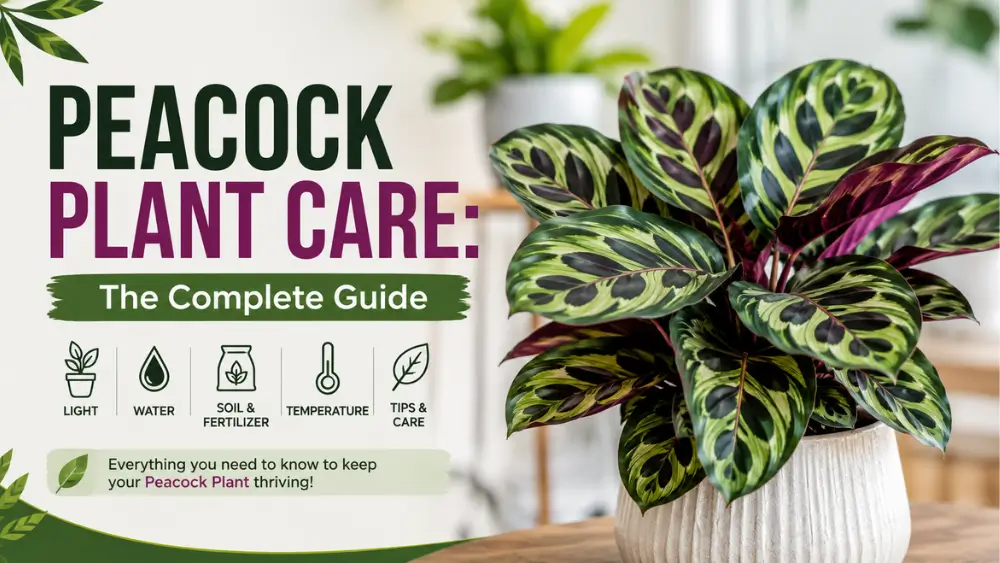
You’ll often see this plant sold or searched for as “Calathea Makoyana” rather than “Peacock Plant” — they’re the same plant, so this guide covers both names. For general Calathea background, humidity basics, and leaf-movement behavior shared across the whole genus, see our complete Calathea Plant Care guide.
Peacock Plant (Calathea makoyana) needs bright indirect light, consistently moist soil watered with filtered or distilled water, and humidity of 50% or higher, the same core requirements shared across the Calathea genus. What sets it apart is its especially thin, almost translucent, paper-like leaves, marked with dark green feathery blotches on top and a matching maroon-purple pattern on the underside, a pattern that resembles both a peacock’s tail feathers and stained glass, which is where its two common names come from. Its delicate leaf texture makes it a bit more prone to physical damage and to showing drooping stress quickly if watering is inconsistent.
Table of Contents
Quick Care Facts
| Care Factor | Requirement |
|---|---|
| Scientific name | Calathea makoyana (also Goeppertia makoyana) |
| Common names | Peacock Plant, Calathea Makoyana, Cathedral Windows |
| Light | Bright, indirect light; no direct sun |
| Water | Consistently moist, never soggy; use filtered or distilled water |
| Soil | Well-draining, moisture-retentive mix with perlite |
| Temperature | 65-80°F (18-27°C); avoid cold drafts |
| Humidity | High, ideally 50% or above |
| Fertilizer | Light, diluted balanced feed monthly during growing season |
| Toxicity | Non-toxic to cats and dogs |
| Growth habit | Compact, low-growing clump; more petite than many other Calathea |
| Difficulty | Moderate to challenging; delicate leaves need gentle, consistent car |
About Peacock Plant (Calathea Makoyana)
Peacock Plant is the common name for Calathea makoyana, prized for having some of the thinnest, most delicate-looking foliage in the entire Calathea genus. Its pale green leaves are marked with dark green, feathery, almost brushstroke-like blotches radiating out from the central rib, with the underside displaying a mirrored pattern in deep maroon-purple. Held up to the light, the leaves have a faintly translucent quality that’s given rise to its less common alternate nickname, “Cathedral Windows,” alongside the more widely used “Peacock Plant,” a reference to how the leaf pattern resembles the eye-spots of a peacock’s tail feathers.
Like other Calathea, Peacock Plant belongs to the Marantaceae, or prayer plant, family and shares the same daily leaf movement common to the genus, rising at night and lowering during the day. For a full explanation of that behavior, along with general Calathea background on humidity and water quality, see the complete Calathea Plant Care guide linked above; the rest of this guide focuses on what’s specific to Makoyana.
Compared to some other Calathea varieties, such as the taller, more upright Calathea Ornata, Peacock Plant tends to stay more compact and low-growing, forming a fuller, denser clump rather than reaching significant height.
Choosing and Displaying a Healthy Peacock Plant
Because Peacock Plant’s leaves are so easily damaged, it’s worth inspecting a plant carefully before buying, checking for tears, creases, or bruised patches rather than just admiring the overall pattern from a distance. Choose a plant with firm, upright leaves free of physical damage, and be prepared for some possible leaf stress during the first few weeks after bringing it home, since transport alone can be enough to cause a bit of drooping even in an otherwise healthy plant.
Once home, place it somewhere it won’t be regularly brushed against by foot traffic, pets, or other plants, since its thin leaves are more vulnerable to accidental damage than sturdier houseplants. A tabletop, shelf, or plant stand in a low-traffic but bright spot generally works better for this variety than a spot along a busy walkway.
Why Peacock Plant’s Leaves Need Extra Gentle Handling
Peacock Plant’s leaves are noticeably thinner and more paper-like than many other Calathea varieties, which makes them more prone to tearing, creasing, and showing stress quickly.
This delicate leaf texture means a couple of things in practice. First, it’s worth handling the plant gently when moving it, dusting the leaves, or repotting, since a torn or creased leaf won’t heal and will stay damaged until it’s eventually replaced by new growth. Second, Peacock Plant tends to visibly droop or curl its leaves fairly quickly in response to inconsistent watering or a sudden drop in humidity, often faster than the more robust leaves of a Calathea Ornata would show similar stress. This isn’t a sign the plant is more fragile overall so much as an early warning system: a drooping Peacock Plant is telling you something needs adjusting sooner rather than later, which can actually make it easier to catch and correct problems before they become serious.
Light Requirements
Peacock Plant needs bright, indirect light and should never be placed in direct sun, which quickly fades and can scorch its thin leaves faster than it would the thicker leaves of some other Calathea. A spot a few feet back from an east-facing window, or filtered light near a north- or west-facing window, works well. In light that’s too low, growth slows and the leaf pattern tends to look duller and less defined.
Watering
Keep the soil consistently, evenly moist, watering again once the top inch begins to dry rather than letting the pot dry out fully. As with other Calathea, water quality matters significantly: filtered water, distilled water, or rainwater is strongly recommended, since tap water’s chlorine, fluoride, and dissolved minerals commonly cause the same brown, crispy edges on Peacock Plant that they cause across the genus. Because of its thin leaves, Peacock Plant can also show wilting or drooping somewhat faster than sturdier Calathea varieties if watering becomes inconsistent, so keeping a steady routine matters more here than with some of its relatives.
Soil and Potting
A well-draining but moisture-retentive potting mix works best, typically a standard potting soil amended with perlite for drainage and a bit of peat moss or coco coir to help maintain even moisture. Repot every year or two in spring, sizing up gradually. Because Peacock Plant grows in a more compact, clumping form rather than upright like Calathea Ornata, a wider, shallower pot generally suits its growth habit well.
Temperature and Humidity
Peacock Plant does best in warm, stable conditions, ideally 65-80°F (18-27°C), away from cold drafts and sudden temperature changes.
Humidity of 50% or higher is important, as it is for the whole Calathea genus. A humidifier remains the most reliable way to maintain this consistently; misting provides only a brief, minor improvement and isn’t a substitute for genuinely raising the humidity in the room, especially given how quickly this plant’s thin leaves respond to dry air.
Fertilizing
Feed with a balanced, water-soluble liquid fertilizer diluted to half strength, roughly once a month during spring and summer. Like other Calathea, Peacock Plant is sensitive to fertilizer salt buildup, so it’s better to fertilize lightly and infrequently than heavily. Stop fertilizing in fall and winter.
Propagation
Like other Calathea, Peacock Plant is propagated by dividing the root clump rather than from stem cuttings:
- Remove the plant from its pot and gently loosen the soil around the roots.
- Identify natural divisions in the root mass, where sections have their own roots and leaves.
- Gently separate the clump into smaller sections, keeping healthy roots intact with each division.
- Plant each division in fresh, well-draining, moisture-retentive soil.
- Keep divisions warm, humid, and out of direct light while they establish; new growth signals a successful division.
Handle the leaves carefully throughout this process, since Peacock Plant’s thin foliage tears more easily than that of sturdier houseplants during handling.
Is Peacock Plant Toxic to Pets?
Peacock Plant is considered non-toxic to cats and dogs, consistent with the rest of the Calathea genus, making it a popular pick for pet owners who want dramatic, patterned foliage without toxicity concerns. As with any houseplant, it’s still sensible to discourage pets from regularly chewing on the leaves, both for the plant’s sake given how delicate they are, and as general good practice.
Common Problems and How to Fix Them
Torn or creased leaves Usually simple physical damage from handling, moving, or a pet or child brushing against the plant. Handle the foliage gently, and know that damaged leaves won’t repair themselves, though new growth will eventually replace them.
Drooping or curling leaves Often an early sign of low humidity or inconsistent watering, appearing somewhat faster on this variety than on sturdier Calathea types. Address humidity and watering consistency promptly when you notice this.
Brown, crispy leaf edges The classic Calathea complaint, tied to low humidity, tap water sensitivity, or both. Switch to filtered or distilled water and increase humidity if you haven’t already.
Yellowing leaves Typically a sign of overwatering or poor drainage. Let the soil dry slightly more between waterings and confirm the pot drains well.
Pests Spider mites are common on Calathea generally, especially in low humidity. Raising humidity helps prevent infestations; treat active problems with insecticidal soap.
Seasonal Care Summary
| Season | Watering | Fertilizing | Notes |
|---|---|---|---|
| Spring | Keep evenly moist | Monthly, diluted | Good time to divide or repot |
| Summer | Keep evenly moist | Monthly, diluted | Watch humidity closely with AC running |
| Fall | Keep evenly moist | Taper off | Growth begins to slow |
| Winter | Keep evenly moist, slightly less | None | Humidity is critical with indoor heating running |
Frequently Asked Questions
Is Peacock Plant the same as Calathea Makoyana?
Yes, Peacock Plant is simply the common name for Calathea makoyana; both names refer to the exact same plant.
Why are Peacock Plant’s leaves so thin and delicate?
This is a natural trait of the species, giving it an almost translucent, paper-like leaf texture that contributes to its dramatic appearance but also makes it more prone to tearing and to showing drooping stress quickly.
Why is my Peacock Plant drooping?
Drooping is usually an early sign of low humidity or inconsistent watering. Because its leaves are thinner than many other Calathea varieties, Peacock Plant tends to show this stress signal faster, so addressing watering and humidity promptly usually resolves it.
Is Peacock Plant safe for cats and dogs?
Yes, it’s considered non-toxic to cats and dogs, consistent with other Calathea varieties.
How is Peacock Plant different from Calathea Ornata?
Peacock Plant grows more compact and low, with thinner, more delicate feathery-patterned leaves, while Calathea Ornata grows taller and more upright, with sturdier leaves marked by pink pinstripes that fade to white with age.
Does Peacock Plant need a humidifier?
While not strictly required, a humidifier is strongly recommended, since this variety’s thin leaves are especially quick to show stress, like drooping or curling, in low humidity.
Can a torn Peacock Plant leaf heal?
No, once a leaf is torn or creased, the damage is permanent on that leaf. New growth will eventually replace it, so handling the plant gently is the best way to keep its foliage looking its best.
Where should I place a Peacock Plant to avoid damaging its leaves?
Choose a low-traffic spot, such as a tabletop or shelf, rather than along a busy walkway or somewhere pets or other plants regularly brush against it, since its thin leaves tear more easily than sturdier houseplant foliage.
Is Peacock Plant a good choice for beginners?
It’s better suited to growers with some houseplant experience, given its humidity needs and delicate leaves, though a humidifier and a gentle touch make it very manageable even for a motivated newer grower.