
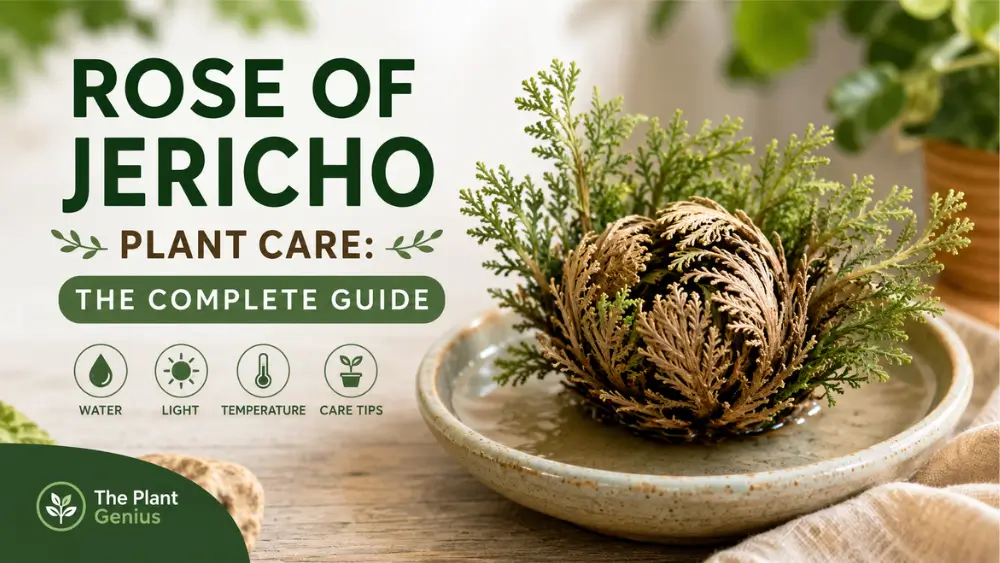
The Rose of Jericho most commonly sold and kept as a houseplant is Selaginella lepidophylla, a desert spikemoss that survives extreme drought by curling into a tight, dry ball, then unfurling into a green rosette within hours of contact with water, an eye-catching transformation that has made it a beloved novelty plant for generations. Care is refreshingly simple: soak the dried plant in shallow distilled or rainwater until it turns green and opens up, then let it dry out again after about a week, repeating this cycle indefinitely. A completely different plant, the true biblical Rose of Jericho (Anastatica hierochuntica), shares the same name and a similar-looking trick, but isn’t grown as a living houseplant in the same way.
Table of Contents
Quick Care Facts
| Care Factor | Requirement |
|---|---|
| Scientific name | Selaginella lepidophylla (the plant actually grown as a houseplant) |
| Common names | Rose of Jericho, Resurrection Plant, False Rose of Jericho, Stone Flower, Dinosaur Plant |
| Light | Bright, indirect light |
| Water | Soak in shallow distilled or rainwater to revive; let dry out after about a week |
| Soil | None required; typically grown on a dish of pebbles rather than in soil |
| Temperature | Average room temperature; not cold sensitive in its dried state |
| Humidity | Tolerant of average humidity; benefits from light misting between soakings |
| Fertilizer | Rarely needed; dilute feed once or twice a year at most |
| Toxicity | Considered non-toxic |
| Growth habit | Low, compact rosette; curls into a ball when dry |
| Difficulty | Very easy; genuinely low-maintenance once you understand the wet-dry cycle |
About the Rose of Jericho: Two Different Plants, One Name
Before anything else, it’s worth knowing that “Rose of Jericho” refers to two entirely different, unrelated plants, and only one of them is typically grown as a living houseplant.
Anastatica hierochuntica is the true, biblical Rose of Jericho, a small desert annual native to North Africa and the Middle East. As it dries out at the end of its life cycle, it curls into a tight ball and can tumble across the desert like a tumbleweed, eventually opening back up when it encounters moisture, which helps disperse its seeds. Despite the dramatic reopening, its dried tissue doesn’t actually come back to life; it’s a clever seed-dispersal mechanism rather than true biological resurrection, and it isn’t typically sold or grown as a continuously reusable living houseplant.
Selaginella lepidophylla is the plant almost universally sold online and in nurseries as “Rose of Jericho,” and it’s the one this care guide focuses on. Native to the Chihuahuan Desert of the United States and Mexico, it belongs to the spikemoss family, an ancient group of plants related to club mosses rather than true ferns or flowering plants. Unlike Anastatica, its dried tissue is genuinely alive and dormant rather than dead, allowing it to be rehydrated and dried out repeatedly, sometimes for years, as a long-term, reusable novelty plant.
A Genuinely Ancient Survival Strategy
Spikemosses like Selaginella lepidophylla belong to one of the oldest lineages of vascular plants still alive today, with relatives appearing in the fossil record long before flowering plants evolved. Its ability to survive near-complete desiccation, losing the vast majority of its water content and appearing entirely dead, then resuming normal growth and photosynthesis within hours of rehydration, is a genuinely remarkable physiological trait rather than just a novelty trick. This resilience is exactly what allows the same small plant to be sold dry, shipped without water for extended periods, and still successfully revive once it reaches a new home, which is part of why it’s remained such a popular and enduring curiosity plant for generations.
How to Revive and Care for Rose of Jericho
The core of caring for this plant is a simple wet-dry cycle, and it genuinely requires very little beyond that.
To revive a dried Rose of Jericho, place the curled brown ball in a shallow dish with just enough distilled water or rainwater to cover the base of the plant, without fully submerging it. Within a few hours, and often within less than a day, the plant will absorb the water, uncurl, and turn a vivid green, a transformation dramatic enough that it’s often used as a science demonstration or a way to introduce children to plant biology. Once open, you can keep it sitting in shallow water, or move it to a dish of moist pebbles, for about a week before allowing it to dry out again, at which point it will curl back into its familiar dormant ball. This cycle can be repeated indefinitely, and the plant doesn’t need to be planted in soil to survive.
Use distilled water or rainwater rather than chlorinated tap water when possible, since chlorine and other tap water additives can affect the plant over repeated cycles. Avoid leaving the plant sitting in standing water for extended periods beyond its typical week-long green phase, since prolonged waterlogging can lead to rot rather than benefiting the plant.
Light Requirements
Rose of Jericho does well in bright, indirect light. It doesn’t need intense direct sun, and in fact, its natural desert habitat means it’s adapted to surviving long stretches without ideal conditions at all. A windowsill with filtered light is generally more than sufficient, whether the plant is currently in its dried, dormant state or its green, hydrated phase.
Soil and Potting
Uniquely among houseplants, Rose of Jericho doesn’t require soil to survive its typical care cycle. Most growers keep it in a shallow dish, often lined with decorative pebbles or stones, where it can be soaked periodically and allowed to dry between cycles, making it an unusually low-commitment plant in terms of equipment and setup. Some growers do choose to pot it in a well-draining, sandy potting mix for a more traditional houseplant appearance, in which case it should be watered similarly to other drought-tolerant plants, allowed to dry out between waterings, though the pebble-dish method remains the most common and traditional way to display and care for it.
Temperature and Humidity
Rose of Jericho tolerates a wide range of typical indoor temperatures and isn’t particularly sensitive to normal household conditions, especially while in its dried, dormant state. It tolerates average home humidity well; light misting during its green, hydrated phase can help keep it looking fuller for longer between soak cycles, though it isn’t strictly necessary for the plant’s survival.
Fertilizing
Rose of Jericho needs very little supplemental feeding. If you’d like to fertilize it, a heavily diluted balanced liquid fertilizer, applied once or twice a year at most during its active green phase, is plenty. Avoid fertilizing a newly acquired or recently revived plant for the first couple of months.
Propagation
Rose of Jericho can be propagated by dividing a healthy section of the plant while it’s in its hydrated, green state, then allowing the divided piece to establish on its own dish of moist pebbles or sandy mix. Division isn’t as commonly practiced with this plant as with many typical houseplants, since most owners simply enjoy cycling a single specimen through its wet-dry transformation repeatedly rather than propagating new plants from it.
Is Rose of Jericho Toxic?
Rose of Jericho (Selaginella lepidophylla) is generally considered non-toxic, making it a safe, low-risk novelty plant to keep around pets and children, though as with any plant, ingestion in any quantity isn’t recommended and should be discouraged.
Common Problems and How to Fix Them
Plant won’t turn green after soaking Give it more time; reviving can take anywhere from a few hours to about a day. If a plant that’s been properly stored dry for a long time still doesn’t respond after a full day of soaking, it may have been damaged or may have exceeded its viable dormancy period.
Rot or mushy texture Caused by leaving the plant in standing water too long or too often. Stick to the typical cycle of roughly a week hydrated followed by a dry period, rather than keeping it constantly wet.
Plant looks dry and shriveled even during its “green phase” This can happen if it’s kept too far from adequate light or humidity during its hydrated period. Light misting and a brighter spot can help it stay fuller and greener for longer before it naturally curls back up.
Doesn’t fully open into a flat rosette Some variation in how fully a Rose of Jericho unfurls is normal and can depend on the specific plant, water quality, and how long it’s been soaking. A partially open plant that’s turned visibly green is still successfully reviving.
Seasonal Care Summary
| Season | Watering | Fertilizing | Notes |
|---|---|---|---|
| Spring | Soak weekly cycle as desired | Optional, diluted | Good time to start regular wet-dry cycling if newly acquired |
| Summer | Soak weekly cycle as desired | Optional, diluted | No special seasonal changes needed |
| Fall | Soak weekly cycle as desired | None needed | No special seasonal changes needed |
| Winter | Soak weekly cycle as desired | None | Keep away from cold drafts near windows |
Frequently Asked Questions
How do you care for a Rose of Jericho plant?
Soak the dried, curled plant in shallow distilled or rainwater until it turns green and unfurls, typically within a few hours to a day, then let it dry out again after about a week and repeat the cycle as desired.
Is Rose of Jericho a real resurrection plant?
The plant commonly sold as “Rose of Jericho,” Selaginella lepidophylla, is a genuine resurrection plant whose dried tissue is truly alive and dormant. The true biblical Rose of Jericho, Anastatica hierochuntica, is a different plant whose reopening is a seed-dispersal mechanism rather than living tissue reviving.
How often should you water a Rose of Jericho?
There’s no fixed schedule; instead, soak it to revive it, let it stay green for about a week, then allow it to dry out and curl back into a ball before soaking it again whenever you’d like to see it revive.
Does Rose of Jericho need soil?
No, it’s typically grown without soil, kept on a dish of pebbles and periodically soaked in shallow water rather than planted in a traditional pot.
Can Rose of Jericho die if not watered?
It can survive extended dry, dormant periods, sometimes for years, but an extremely old or damaged specimen may eventually fail to revive. Under normal conditions, though, it can be cycled between dry and green states indefinitely.
Is Rose of Jericho toxic to pets?
No, it’s generally considered non-toxic, making it a low-risk novelty plant for households with pets or children.
Why do some Rose of Jericho plants not fully open?
Some variation in how completely the plant unfurls is normal and can depend on the individual specimen and water quality. As long as it’s turned green, it’s successfully reviving.
Can you keep Rose of Jericho green all the time instead of letting it dry out?
It’s better to follow the natural wet-dry cycle rather than trying to keep it perpetually hydrated, since prolonged constant moisture increases the risk of rot. The cycling between dormant and green states is part of how this plant is meant to be enjoyed and cared for.
How long can a dried Rose of Jericho survive without water?
It can remain in its dried, dormant state for extended periods, commonly cited as surviving for months to years in storage, thanks to its extreme desiccation tolerance, and will typically still revive once finally given water.