
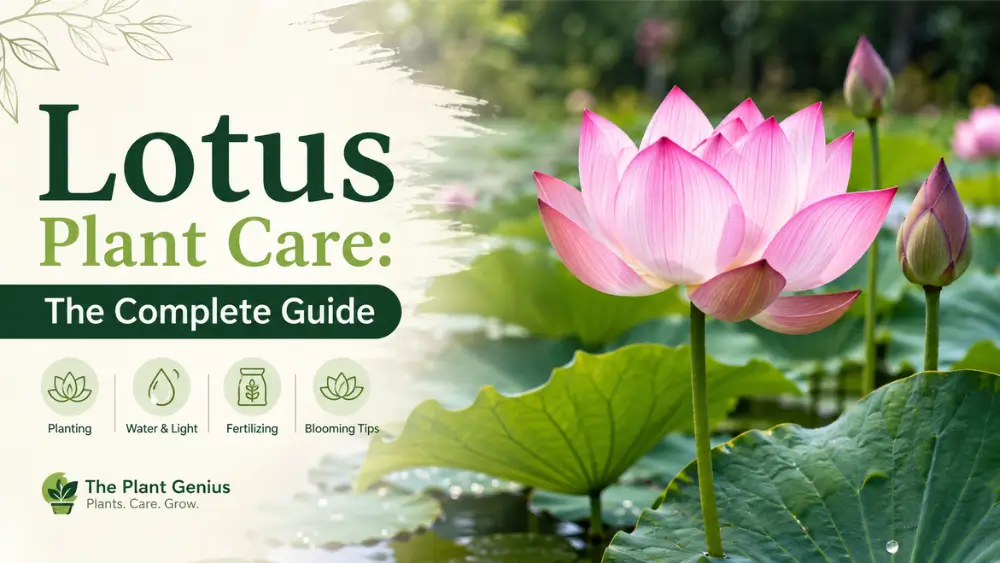
Lotus (Nelumbo nucifera) is a hardy aquatic perennial grown in ponds, water gardens, or large water-filled containers rather than as a typical indoor houseplant. It needs at least 6 hours of direct sun daily, warm water above 70°F (21°C) to actively grow and bloom, and heavy aquatic planting soil rather than regular potting mix. Grown from a rhizome, it produces large round leaves and dramatic fragrant flowers each summer, then dies back and goes dormant over winter, resprouting from the same rhizome the following spring.
Table of Contents
Quick Care Facts
| Care Factor | Requirement |
|---|---|
| Scientific name | Nelumbo nucifera (Sacred Lotus); also Nelumbo lutea (American Lotus) |
| Common names | Lotus, Sacred Lotus, Indian Lotus |
| Light | Full sun; at least 6 hours of direct sunlight daily |
| Water | Grown submerged in a pond or container; warm water above 70°F (21°C) for active growth |
| Soil | Heavy aquatic/pond planting soil, not regular potting mix |
| Temperature | Warm season grower; goes dormant when water cools in fall/winter |
| Fertilizer | Aquatic plant fertilizer tablets during the growing season |
| Toxicity | Non-toxic; lotus root and seeds are widely eaten as food |
| Growth habit | Spreading rhizome producing floating and aerial leaves, tall flower stalks |
| Difficulty | Moderate; mainly about matching pond depth, sun, and winter protection to your climate |
About the Lotus Plant
Lotus, most commonly Nelumbo nucifera, is an aquatic perennial grown from a spreading underground rhizome, closely related to (though botanically distinct from) water lilies. It’s native to Asia, including India and China, and holds deep cultural and religious significance in Buddhism and Hinduism, where it’s a longstanding symbol of purity and rebirth. A related species, Nelumbo lutea, or American Lotus, is native to parts of North America and is cared for in essentially the same way.
Lotus produces large, rounded leaves, some floating flat on the water’s surface and others held well above it on tall, sturdy stems, along with equally tall flower stalks bearing large, fragrant blooms in shades of pink, white, or yellow depending on the variety. Flowering typically peaks in summer, with each individual bloom lasting only a few days before giving way to the plant’s distinctive flat-topped seed pod, instantly recognizable and often used in dried floral arrangements.
It’s worth noting that “lotus plant” is sometimes confused with an entirely different, unrelated plant: Lotus berthelotii and other members of the genus Lotus, low-growing garden groundcovers sometimes called “parrot’s beak,” which have nothing to do with the aquatic lotus covered in this guide. If you’re looking for information on a small, trailing garden plant rather than a pond plant with large round leaves and dramatic flowers, you likely have one of these unrelated Lotus species instead.
Where and How to Grow Lotus
Lotus is grown submerged in a pond, water garden, or a large, water-filled container such as a half-barrel or dedicated aquatic planting tub, never in regular potting soil in a standard pot. It needs full sun, at least 6 hours of direct sunlight daily, to grow and flower well; lotus grown in shade tends to produce weak growth and rarely blooms.
Plant the rhizome horizontally, just barely covered, in a wide, heavy aquatic planting container filled with dense clay-loam pond soil, specifically formulated for aquatic plants rather than standard potting mix, which is too light and will simply float away in water. Once planted, position the container so that only an inch or two of water initially covers the soil surface, gradually increasing the water depth as the plant grows taller and stronger over the following weeks. Mature plants, depending on variety, generally do well with 6-12 inches of water over the crown, though dwarf and miniature varieties need considerably shallower water.
Water Temperature and Growing Season
Lotus is a warm-season grower and needs water temperatures above roughly 70°F (21°C) to actively grow and bloom. In cooler water, growth slows dramatically or stalls entirely, which is why lotus planted too early in spring, before the water has warmed, often sits dormant for weeks longer than expected. Patience matters here: many growers assume a newly planted lotus has failed when it’s simply waiting for warmer water before sending up its first leaves.
Fertilizing
Feed with fertilizer tablets specifically formulated for aquatic plants, pushed a few inches into the soil near the root zone rather than applied to the water itself. Regular granular or liquid fertilizers made for garden or houseplants aren’t appropriate in a pond setting, since they dissolve into the surrounding water and can quickly promote algae growth rather than feeding the lotus directly. Fertilize roughly every 3-4 weeks during the active growing season, and stop once the plant begins slowing down in fall.
Winter Care and Dormancy
Lotus is a hardy perennial in many climates, but its rhizome needs to stay below the freeze line through winter to survive.
As water temperatures drop in fall, the leaves and flower stalks naturally yellow and die back; this is a normal part of the plant’s cycle rather than a sign of a problem, and spent foliage can be trimmed back once fully brown. In climates where the pond doesn’t freeze solid at the depth the rhizome sits, typically 18 inches or deeper, the lotus can safely overwinter in place. In colder regions, or in shallow containers that could freeze through completely, move the container to a deeper part of the pond, into an unheated garage or basement in a bucket of water, or into cold storage where it will stay cool but won’t freeze solid. New growth resumes on its own once the water warms again in spring.
Growing Dwarf “Bowl Lotus” Varieties
In addition to full-sized pond lotus, a number of dwarf cultivars, often called bowl lotus or tea-cup lotus, have been specifically bred to grow in shallow containers as small as a wide bowl or tub, making lotus accessible even without a full pond. These dwarf varieties follow the same basic care as full-sized lotus: full sun, warm water, and aquatic planting soil, just scaled down to a much shallower container, typically just a few inches of water depth rather than the 6-12 inches needed by larger varieties. Bowl lotus makes an excellent option for a sunny patio, balcony, or deck when an in-ground pond isn’t practical.
Propagation
Lotus is propagated by dividing the rhizome, ideally done in spring before active growth resumes:
- Carefully lift the rhizome from its container, handling it gently since the growing tips are fragile and easily damaged.
- Divide the rhizome into sections, making sure each division includes at least one healthy growing eye, or node, since new growth emerges from these points.
- Replant each division horizontally in fresh aquatic planting soil, just barely covered.
- Gradually increase water depth as the new division establishes and produces its first leaves.
Lotus can also be grown from seed, though this is far less common for named varieties, both because seed-grown plants don’t reliably come true to the parent’s flower color or form, and because lotus seeds have an extremely hard outer coat that requires scarification, lightly filing or nicking the shell, before they’ll germinate. Lotus seeds are also famous in botanical circles for their remarkable longevity; viable ancient lotus seeds recovered from dried lakebeds have successfully germinated after being dormant for well over a thousand years, among the longest documented seed viability of any plant species.
Is Lotus Toxic?
Lotus is non-toxic, and in fact, nearly every part of the plant, including the root, seeds, leaves, and stems, is eaten as food in various Asian culinary traditions, particularly in Chinese, Indian, and Southeast Asian cooking. This makes lotus one of the few ornamental pond plants that’s also genuinely edible, though ornamental cultivars grown for flowers rather than food production aren’t typically selected with culinary quality in mind.
Common Problems and How to Fix Them
Leaves staying flat on the water instead of standing upright This is often simply a sign the plant is still young or newly divided; aerial leaves typically develop as the plant matures and gains strength over the growing season. Insufficient sun can also prevent this transition.
No flowers Usually caused by insufficient sun, water that hasn’t warmed enough, or a plant that’s still establishing after a recent division; lotus often doesn’t bloom in its first year after being divided or planted.
Yellowing, dying leaves in fall A completely normal part of the plant’s seasonal cycle as it prepares for winter dormancy, not a sign of disease.
Weak or stalled growth after planting Frequently caused by planting too early, before water temperatures have warmed sufficiently, or by burying the rhizome too deep or at the wrong depth relative to the water level.
Algae buildup in the container or pond Usually a sign of overfertilizing, particularly with fertilizers not intended for aquatic use. Switch to proper aquatic fertilizer tablets applied directly into the soil rather than the water.
Pests Aphids can sometimes colonize the leaves and stems above the waterline. A strong spray of water or insecticidal soap approved for use near water features can help manage infestations.
Seasonal Care Summary
| Season | Water Depth | Fertilizing | Notes |
|---|---|---|---|
| Spring | Start shallow, increase gradually | Every 3-4 weeks once growing | Wait for water to warm above 70°F before expecting active growth |
| Summer | Full mature depth | Every 3-4 weeks | Peak growth and flowering season |
| Fall | Maintain until dieback | Stop as growth slows | Foliage yellows and dies back naturally |
| Winter | Below the freeze line | None | Protect rhizome from freezing solid |
Frequently Asked Questions
How do you care for a lotus plant?
Plant the rhizome in heavy aquatic soil in a pond or water-filled container, provide at least 6 hours of direct sun daily, keep water temperatures above 70°F for active growth, and feed with aquatic fertilizer tablets during the growing season.
Can you grow lotus indoors?
Traditional lotus needs full sun and is best grown outdoors in a pond or sunny container. Dwarf bowl lotus varieties can be grown in a shallow container on a bright, sunny balcony or patio, but lotus generally isn’t suited to typical indoor low-light conditions.
Does lotus need a pond to grow?
No, a full in-ground pond isn’t required. Lotus, especially dwarf bowl varieties, can be grown successfully in a large water-filled container or tub as long as it gets full sun and warm water.
Why is my lotus plant not flowering?
The most common causes are insufficient direct sun, water that hasn’t warmed enough, or a young plant that’s still establishing after a recent division; first-year plants often don’t bloom.
Is lotus the same as water lily?
No, though they’re often confused. Lotus leaves and flowers are typically held above the water on tall stems, while water lily leaves and flowers generally float directly on the water’s surface.
How do you overwinter a lotus plant?
In climates where the pond doesn’t freeze solid at the rhizome’s depth, lotus can overwinter in place. In colder climates or shallow containers, move it to a deeper part of the pond or store it in a cool, frost-free space in water until spring.
Is lotus plant toxic to pets?
No, lotus is non-toxic, and its root, seeds, and other parts are widely eaten as food in various culinary traditions.
How deep does water need to be for a lotus plant?
Mature standard lotus varieties generally do well with 6-12 inches of water over the crown, while dwarf bowl lotus varieties need only a few inches of water depth.