
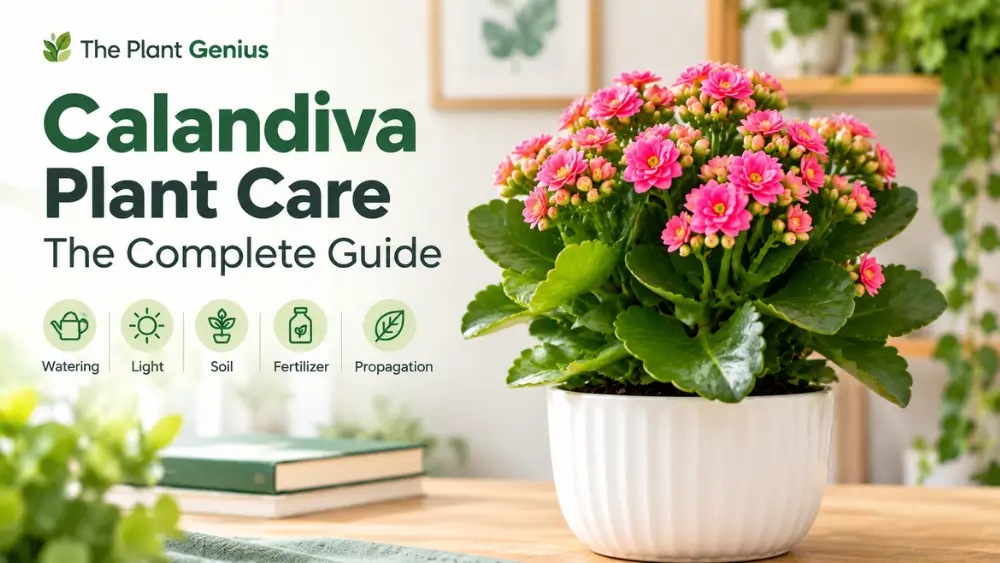
Calandiva (Kalanchoe blossfeldiana ‘Calandiva’) needs bright, indirect light for at least 6-8 hours daily, well-draining succulent or cactus soil that’s allowed to dry out completely between waterings, and warm temperatures of 60-75°F (15-24°C). It’s a compact succulent hybrid grown for its dense clusters of fully double, rose-like blooms in vivid shades of red, orange, pink, yellow, and white, which last significantly longer than the single-flowered standard Kalanchoe. Getting it to rebloom requires a deliberate 6-8 week dark-period treatment each autumn.
Table of Contents
Quick Care Facts
| Care Factor | Requirement |
|---|---|
| Scientific name | Kalanchoe blossfeldiana ‘Calandiva’ |
| Common names | Calandiva, Calandiva Kalanchoe, Double Kalanchoe |
| Light | Bright, indirect light 6-8 hours daily; some direct morning sun tolerated |
| Water | When soil dries out completely; every 10-14 days typical |
| Soil | Well-draining succulent or cactus mix |
| Temperature | 60-75°F (15-24°C); protect below 50°F (10°C) |
| Humidity | No extra humidity needed; tolerates dry indoor air well |
| Fertilizer | Balanced liquid feed monthly during growing season |
| Toxicity | Toxic to cats and dogs if ingested |
| Growth habit | Compact, bushy succulent; typically 10-16 inches tall |
| Difficulty | Easy; reblooming requires a specific dark-period treatment |
About Calandiva
Calandiva is a trademarked cultivar of Kalanchoe blossfeldiana, developed in 1998 by the Dutch horticultural firm Fides Oro. Where standard Kalanchoe produces single, four-petaled flowers, Calandiva produces fully double blooms with many densely packed petals that closely resemble miniature roses, which is exactly what makes it so distinctive and immediately recognizable on the shelf. This doubling of petals also extends its bloom time considerably, with flowers commonly lasting 8-10 weeks or longer, compared to the shorter display of single-flowered forms, and accounts for much of its popularity as both a gift plant and a garden-center staple.
Like standard Kalanchoe, it’s a succulent belonging to the Crassulaceae family, native to Madagascar, and bred specifically for ornamental flowering rather than any other use. Its compact, naturally bushy growth habit and genuine drought tolerance make it one of the more low-maintenance flowering plants available for a home or office, with most of its care centered on getting the watering routine right, providing adequate light, and understanding its reblooming trigger once the initial flower display has finished.
Calandiva vs. Standard Kalanchoe: What’s Different
The primary differences between Calandiva and standard Kalanchoe blossfeldiana are the fully double blooms and significantly longer flowering period; the core care is otherwise nearly identical.
If you’ve successfully grown standard Kalanchoe, you already know most of what Calandiva needs. The doubling of its petals is a purely aesthetic modification rather than a care-affecting one, so any Kalanchoe care guide applies to Calandiva as well. That said, Calandiva’s longer bloom period can sometimes make growers forget about post-bloom care entirely, which is when the most interesting and rewarding step, getting it to rebloom the following year, actually begins. Treating it as a disposable seasonal plant, as many gift-plant receivers do, means missing the fact that it can reliably flower again and again with only a modest amount of deliberate care after the initial bloom ends.
Where to Display Calandiva
Calandiva is at its best when the flowers are at eye level and close enough to appreciate the fully double, almost rose-like blooms. A bright windowsill, a sunny kitchen counter, or a well-lit tabletop all work well. Because it needs no extra humidity and tolerates dry air, it’s a particularly practical choice for rooms with forced-air heating in winter, where many tropical plants struggle. It also works nicely on a covered outdoor patio or balcony during summer in climates where nights stay above 50F, returning indoors before autumn temperatures drop.
Light Requirements
Calandiva does best in bright, indirect light for at least 6-8 hours daily. A spot near an east-, south-, or west-facing window works well indoors. It tolerates some gentle direct morning sun, but intense midday direct sun can scorch the fleshy leaves, so filtered exposure is generally safer, particularly in warmer months. In insufficient light, growth becomes leggy and the plant produces fewer blooms.
Watering
Calandiva is a true succulent and should be allowed to dry out completely between waterings, with water every 10-14 days a common rhythm during its growing season.
Overwatering is by far the most common way to lose this plant. It stores water in its fleshy leaves and stems and genuinely prefers drought over moisture, so if in doubt, wait another day or two rather than watering early. When you do water, soak the soil thoroughly and let any excess drain away completely, never letting the pot sit in standing water. Reduce watering frequency during fall and winter, when the plant’s growth slows.
Soil and Potting
A well-draining succulent or cactus mix is ideal, either used straight from the bag or blended 50/50 with standard potting soil. Calandiva doesn’t need to be repotted often; simply move it up one pot size as needed, typically every 1-2 years.
Temperature and Humidity
Calandiva prefers warm indoor temperatures of 60-75°F (15-24°C) and should be protected from temperatures below 50°F (10°C), since it’s a tropical succulent with no meaningful frost tolerance. It tolerates typical dry indoor air well without any supplemental humidity, which makes it a practical choice for centrally heated homes where many tropical houseplants struggle in winter.
Fertilizing
Feed with a balanced liquid fertilizer diluted to half strength, roughly once a month during the growing season from spring through early fall. Over-fertilizing encourages excessive leafy growth at the expense of flowers, so restraint is better here than generosity. Some growers switch to a fertilizer higher in phosphorus, which supports flowering, once buds begin to form, though a standard balanced feed is perfectly adequate for most home growers.
Deadheading and Pruning
Remove spent flower heads by pinching them off at the base of their stems once individual flowers have faded, which helps the plant put its energy into remaining blooms rather than into setting seed. Once a flower cluster has fully finished, cut the entire stem back cleanly to the base. This tidying step also prepares the plant for the reblooming treatment that follows and keeps the overall shape of the plant looking neat and intentional rather than scraggly.
If stems have become leggy over time, a hard prune after flowering, cutting stems back to just a few inches above the soil, encourages a denser, more compact plant for the following season.
How to Get Calandiva to Rebloom
Calandiva is a short-day plant, meaning it needs long nights to trigger flowering, and getting it to rebloom is entirely achievable at home if you follow the dark-period treatment consistently.
This is the single most commonly asked question about this plant, and it’s often where growers give up and throw it away, thinking it’s done. Here’s the process:
- After the blooms finish, continue normal care for a few weeks to let the plant recover.
- Starting in early fall, about 8-10 weeks before you want flowers, keep the plant in complete darkness for 14 hours every night. Many growers use a spare room with no light leaks, a box, or a closet.
- During those same 14-hour dark nights, keep daytime conditions bright, with 10 hours of good light each day.
- Maintain this cycle consistently for 6-8 weeks. Even a few nights with partial light exposure can interrupt the process and delay flowering.
- Once flower buds have formed and are visible, the dark-period treatment is complete and normal care resumes.
It’s a real commitment of consistency, but it reliably produces the same dense double blooms that made the plant attractive in the first place, effectively giving you a renewed flowering plant from the same specimen year after year. Many gardeners find it easiest to set a phone reminder each evening rather than relying on memory alone, since even a single missed night with the lights left on can set the process back significantly.
How to Propagate Calandiva
Calandiva propagates readily from stem cuttings:
- Take a stem cutting with at least 4-5 healthy leaves.
- Remove the bottom 1-2 leaves to expose a bare node.
- Allow the cut end to callus in a dry spot for 1-2 days.
- Optional: dip the calloused end in rooting hormone powder.
- Plant in moist, well-draining succulent soil or lay flat on the soil surface with the node touching the mix.
- Keep in bright, indirect light and water lightly until new growth appears.
Is Calandiva Toxic to Pets?
Calandiva is toxic to cats and dogs if ingested.
Like other Kalanchoe species, it contains bufadienolide compounds, a type of cardiac glycoside, that can cause vomiting, drooling, diarrhea, and in serious cases, heart irregularities in pets if ingested in significant quantities. It should be kept out of reach of animals that chew on houseplants, and a veterinarian should be contacted promptly if ingestion is suspected.
Common Problems and How to Fix Them
Wilting, yellowing, or mushy stems Overwatering and root rot. Allow the soil to dry more completely between waterings and ensure the pot drains freely.
Leggy growth with few flowers Insufficient light. Move to a brighter spot with 6-8 hours of indirect light daily.
Plant doesn’t rebloom The dark-period treatment wasn’t consistent or long enough. A single night of light exposure can interrupt the cycle, so strict 14-hour darkness is essential for the full 6-8 weeks.
Powdery mildew or gray mold Usually linked to poor airflow or excessive moisture on leaves. Improve ventilation and water only at the soil level.
Pests Mealybugs and aphids can occasionally appear. Inspect regularly and treat with insecticidal soap.
Seasonal Care Summary
| Season | Watering | Fertilizing | Notes |
|---|---|---|---|
| Spring | When fully dry | Monthly | Typically flowering or recently finished |
| Summer | When fully dry | Monthly | Allow plant to recover after bloom cycle |
| Fall | Reduce | Stop | Begin dark-period treatment for reblooming |
| Winter | Reduce | None | Buds should form after 6-8 week dark treatment |
Frequently Asked Questions
How do you care for a Calandiva plant?
Provide bright, indirect light for 6-8 hours daily, allow the soil to dry completely between waterings, use well-draining succulent soil, and follow the dark-period treatment in autumn to trigger reblooming.
How is Calandiva different from regular Kalanchoe?
Calandiva is a cultivar of Kalanchoe blossfeldiana with fully double, rose-like flowers and a longer bloom period; its core care requirements are identical to standard Kalanchoe.
Why isn’t my Calandiva reblooming?
It needs a strict 6-8 week period of 14 hours of complete darkness each night to trigger new buds. Even occasional light exposure during the dark hours can interrupt the process.
Is Calandiva toxic to cats and dogs?
Yes, it contains compounds toxic to pets, including cardiac glycosides, and should be kept out of reach of animals.
How long do Calandiva flowers last?
The double blooms typically last 8-10 weeks or longer, considerably longer than the single-flowered standard Kalanchoe.
Can Calandiva grow outdoors?
Yes, in warm climates (USDA zones 10-11) it can grow outdoors year-round. In other climates, it works well as a summer outdoor plant as long as it comes back inside before temperatures drop toward 50°F.
How often should I water a Calandiva?
Every 10-14 days is typical during its growing season, but always wait until the soil has dried out completely rather than watering on a fixed schedule.
Why are my Calandiva leaves turning yellow?
Yellowing is usually caused by overwatering. Allow the soil to dry fully between waterings and confirm the pot drains well.
Does Calandiva need to be repotted every year?
No, it’s a compact, slow-growing plant that only needs repotting every 1-2 years, or when its roots become visibly cramped in the current container.