
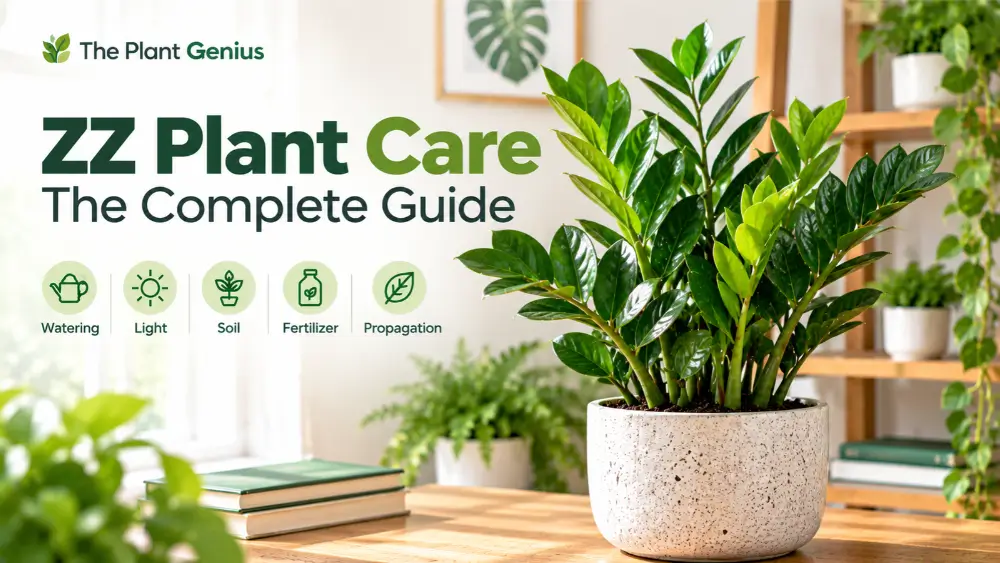
ZZ Plant (Zamioculcas zamiifolia) needs bright to low indirect light, soil allowed to dry out completely between waterings, and warm temperatures. It’s genuinely one of the most low-maintenance houseplants available, capable of tolerating neglect, low light, and irregular watering far better than most. Its one real weakness is overwatering, which causes root rot more quickly than most people expect from such a tough-looking plant. Given the right drainage and restraint with water, a ZZ Plant can live and look healthy for many years with minimal attention.
Table of Contents
Quick Care Facts
| Care Factor | Requirement |
|---|---|
| Scientific name | Zamioculcas zamiifolia |
| Common names | ZZ Plant, Zanzibar Gem, Zuzu Plant, Eternity Plant |
| Light | Bright, indirect light preferred; tolerates low light well |
| Water | Only when soil is completely dry; every 2-4 weeks typical |
| Soil | Well-draining potting mix; cactus/succulent blend works well |
| Temperature | 65-85°F (18-29°C); sensitive to cold below 45°F (7°C) |
| Humidity | Average household humidity is fine |
| Fertilizer | Balanced liquid feed 1-2 times during the growing season |
| Toxicity | Toxic to pets and humans if ingested; sap can irritate skin |
| Growth habit | Slow-growing, upright; 2-4 feet tall and wide at maturity |
| Difficulty | Very easy; one of the most forgiving houseplants available |
About the ZZ Plant
ZZ Plant, botanically Zamioculcas zamiifolia, is native to the dry grasslands and forests of eastern Africa, from Kenya and Tanzania south through Zimbabwe. In its natural environment it grows through periods of severe drought, drawing on water stored in its large, fleshy underground rhizomes to survive when rain doesn’t come. This drought-adapted biology is exactly what makes it so forgiving as a houseplant: it genuinely stores water reserves that buffer it against irregular care in ways that tropical moisture-lovers simply can’t match.
Its glossy, deep green pinnate leaves, each composed of several pairs of oval leaflets arranged along a central stem, give it a clean, architectural look that’s made it popular in offices, hotel lobbies, and modern interiors since it began to appear widely in cultivation in the 1990s and early 2000s. It grows slowly, typically a few new stems per year under typical indoor conditions, but what it produces is consistently glossy, dense, and attractive.
Where to Display ZZ Plant
Because it tolerates low light genuinely well, ZZ Plant is one of the few houseplants that can be placed in interior rooms or offices with minimal natural light and still look respectable over the medium term. That said, a spot with more light always produces better results. Its upright, architectural form makes it a natural fit for modern and minimalist interiors, either as a floor plant in a large container or as a smaller tabletop specimen. The Raven ZZ cultivar’s near-black foliage in particular pairs dramatically with light-colored walls and furniture, making it a strong design choice for anyone who wants a bold, low-maintenance statement plant.
Why Overwatering Is Its Main Weakness
Despite looking like a tough, almost indestructible plant, the ZZ’s single most common cause of serious decline and death is overwatering — specifically, keeping the soil consistently moist the way many other houseplants prefer it.
Its underground rhizomes store water effectively, but they also rot quickly in consistently wet soil. The timing between “time to water” and “overwatered” is shorter than most people expect, and the early warning signs of root rot are subtle enough that many growers don’t notice until stems start yellowing or collapsing. The safest approach: always wait until the soil is fully dry, check by pushing a finger a couple of inches into the soil or lifting the pot to feel how light it is, and when in doubt, wait another week before watering.
The Rhizome: Why ZZ Plants Store Water Differently
ZZ Plant’s underground rhizomes aren’t just roots — they’re large, potato-like storage organs that hold both water and nutrients. This is the biological mechanism behind its legendary drought tolerance, and it also explains why the plant can survive occasional complete neglect far better than a typical tropical houseplant. When you water correctly, you’re essentially topping up reserves that the plant draws on gradually over the following weeks. When you overwater, you’re keeping those rhizomes perpetually saturated, which is when rot sets in.
This also explains why ZZ Plant grows slowly even with excellent care: it’s investing significant energy into building and maintaining those rhizomes underground, which isn’t immediately visible in above-ground growth but contributes to the plant’s long-term stability and resilience.
Light Requirements
ZZ Plant is often cited as one of the best choices for low-light spaces, and it genuinely does tolerate dim conditions better than almost any other popular houseplant. That said, “low light” doesn’t mean “no light” — a spot with some natural light, even if indirect and modest, is always better than a completely dark interior corner. In brighter, indirect light it grows faster, produces glossier leaves, and looks its best. In very low light it will still survive for a considerable time, but growth slows to nearly nothing and the plant gradually weakens over years.
Avoid placing it in direct, intense sun, which scorches and bleaches the glossy leaves relatively quickly.
Watering
Water only when the soil is completely dry throughout the pot, not just at the surface, and then water thoroughly until excess drains from the bottom.
During the growing season, this is typically every 2-4 weeks depending on your home’s light and temperature. In winter, once a month or even less is often sufficient. The easiest check is to lift the pot: a ZZ Plant ready for water feels noticeably lighter than when it was recently watered, since the rhizomes have drawn down their water reserves. Make sure the pot has drainage holes and empty any water that collects in a saucer after about 20 minutes.
Soil and Potting
A well-draining potting mix is important. A standard all-purpose potting mix blended with perlite works well, or a cactus and succulent mix straight from the bag is a practical shortcut that provides excellent drainage. ZZ Plants grow slowly and can go 2-3 years or more before needing repotting. When you do repot, be careful not to damage the rhizomes, which are large and somewhat brittle.
Temperature and Humidity
ZZ Plant does well in typical warm indoor conditions, ideally 65-85°F (18-29°C), and should be protected from temperatures below about 45°F (7°C), since cold is one of the few conditions that genuinely stresses it. Average household humidity is perfectly adequate — unlike many tropical houseplants, this one requires no supplemental misting, pebble trays, or humidifiers.
Fertilizing
ZZ Plant is a light feeder. One or two applications of a balanced, diluted liquid fertilizer during the growing season, once in spring and once in midsummer, is usually plenty. Over-fertilizing does more harm than under-fertilizing with this plant, potentially causing salt buildup in the soil and damaging the roots. Skip fertilizing entirely in autumn and winter.
ZZ Plant Varieties Worth Knowing
Standard ZZ (Zamioculcas zamiifolia) — the widely available form with deep green glossy leaves.
Raven ZZ (Zamioculcas zamiifolia ‘Raven’) — a striking cultivar whose new leaves emerge bright lime green before maturing to a very dark, near-black color, creating a dramatic two-tone display. It shares identical care with the standard form.
Zenzi ZZ — a compact, bushy cultivar with shorter, more tightly clustered stems and leaves, often growing to only about a foot tall, ideal for smaller spaces.
How to Propagate ZZ Plant
ZZ Plant can be propagated by leaf cuttings, stem cuttings, or rhizome division, though all methods are slow:
Leaf cutting in water or soil Remove a healthy leaf and place the cut end in water or moist soil. A small rhizome will develop at the base over several months — patience is essential since this is notably slow even by ZZ Plant standards.
Stem cutting Cut a healthy stem with several leaflets, let the cut end dry briefly, and plant in moist, well-draining soil. Roots and a rhizome develop from the base over time.
Rhizome division During repotting, carefully separate a section of the rhizome with its own stems and pot it separately. This is the fastest propagation method since the division already has an established rhizome.
Is ZZ Plant Toxic to Pets and Humans?
ZZ Plant is toxic to cats, dogs, and humans if the leaves or stems are chewed or ingested, causing gastrointestinal symptoms including vomiting and diarrhea. Its sap can also cause skin irritation on contact, so wearing gloves when pruning or repotting is a sensible precaution. Despite rumors that have circulated online, it is not exceptionally dangerous — it produces calcium oxalate crystals similar to other aroids rather than particularly severe toxins — but it should still be kept out of reach of pets and children who might chew on it.
Common Problems and How to Fix Them
Yellow, mushy stems Overwatering and root rot — the most common serious problem. Reduce watering dramatically and ensure the pot drains freely.
Brown leaf tips Can indicate very low humidity, tap water fluoride sensitivity, or a pot that’s become very rootbound. Repotting into fresh soil and switching to filtered water often helps.
Extremely slow or no growth Normal for this plant generally, but improves meaningfully with more light. Low-light ZZ Plants may show almost no visible new growth for months.
Leaves falling off Often caused by cold exposure, sudden temperature change, or severe underwatering after a long dry period. Check conditions and resume regular care.
Pests ZZ Plants are relatively pest-resistant but can occasionally get mealybugs or scale. Wipe leaves with a damp cloth regularly and treat infestations with insecticidal soap.
Seasonal Care Summary
| Season | Watering | Fertilizing | Notes |
|---|---|---|---|
| Spring | When fully dry, ~every 2-3 weeks | Once in spring | New growth typically begins |
| Summer | When fully dry, ~every 2-3 weeks | Once midsummer | Peak growing season |
| Fall | Every 3-4 weeks | None | Begin reducing water |
| Winter | Every 4+ weeks | None | Minimum water; protect from cold |
Frequently Asked Questions
How do you care for a ZZ Plant?
Give it bright to low indirect light, water only when the soil is completely dry, use well-draining soil, and fertilize just once or twice a year.
How often should you water a ZZ Plant?
Every 2-4 weeks during the growing season, and once a month or less in winter, always waiting until the soil is fully dry throughout.
Is ZZ Plant the best low-light houseplant?
It’s one of the most genuinely low-light tolerant houseplants available, though it grows faster and looks its best in brighter indirect light.
Is ZZ Plant toxic to cats and dogs?
Yes, ingesting any part causes gastrointestinal symptoms, and the sap can irritate skin. Keep it out of reach of pets.
Why are my ZZ Plant leaves turning yellow?
Overwatering is the most common cause. Allow the soil to dry completely and ensure the pot drains well.
Why is my ZZ Plant growing so slowly?
Slow growth is normal for this plant, especially in lower light. It’s investing energy in underground rhizome development that isn’t visible above ground.
What is a Raven ZZ Plant?
A cultivar with leaves that emerge lime green and mature to near-black, sharing identical care requirements with the standard ZZ Plant.
Can ZZ Plant survive without any natural light?
It can survive for a period in very low artificial light, but it will eventually weaken and deteriorate without at least some natural light. The NYBG notes it can endure poor light for a considerable time before declining, but will eventually collapse if kept in complete darkness.
How can I tell if my ZZ Plant is ready for water?
Lift the pot — if it feels noticeably light compared to when you last watered, it’s ready. Alternatively, push a finger 2 inches into the soil; if it’s still cool or damp, wait. Only water when fully dry throughout.