
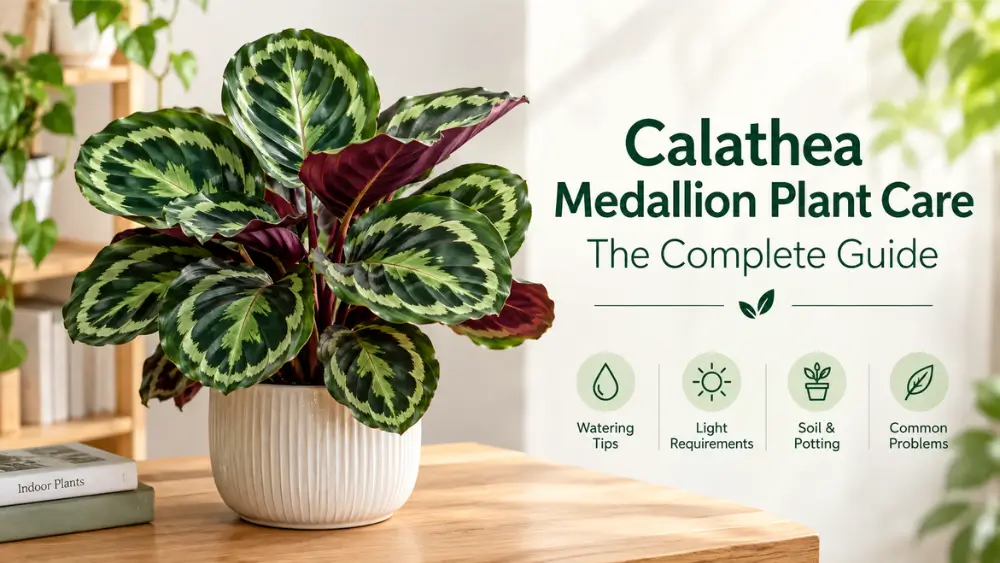
Calathea Medallion shares its genus and core care with the rest of the Calathea family. For general background, humidity basics, and leaf-movement behavior, see our complete Calathea Plant Care guide; this guide focuses on what’s specific to Medallion.
Calathea Medallion needs bright indirect light, consistently moist soil watered with filtered or distilled water, and humidity of 50% or higher, the same core requirements shared across the Calathea genus. What sets it apart is its rounded leaf shape and striking concentric pattern: bands of dark green, silvery-green, and pink radiating outward from the center of each leaf like the rings of a medal, with a deep purple underside visible whenever the leaves fold at night.
Table of Contents
Quick Care Facts
| Care Factor | Requirement |
|---|---|
| Scientific name | Calathea roseopicta ‘Medallion’ (also Goeppertia roseopicta) |
| Common names | Calathea Medallion |
| Light | Bright, indirect light; no direct sun |
| Water | Consistently moist, never soggy; use filtered or distilled water |
| Soil | Well-draining, moisture-retentive mix with perlite |
| Temperature | 65-80°F (18-27°C); avoid cold drafts |
| Humidity | High, ideally 50% or above |
| Fertilizer | Light, diluted balanced feed monthly during growing season |
| Toxicity | Non-toxic to cats and dogs |
| Growth habit | Compact, rounded clump; broader leaves than many other Calathea |
| Difficulty | Moderate; humidity and water quality are key |
About Calathea Medallion
Calathea Medallion is a cultivar of Calathea roseopicta, distinguished by its broad, rounded leaves marked with concentric bands of dark green, silvery-green, and soft pink radiating outward from the central rib, a pattern that resembles a decorative medal or coin, which is exactly where its name comes from. The underside of each leaf is a rich, deep purple, visible whenever the plant’s leaves rise and fold at night as part of the nyctinasty behavior shared across the Calathea genus, a movement that’s especially striking to watch given how symmetrical and eye-catching Medallion’s leaf pattern already is during the day.
Compared to the narrower, more elongated leaves of Calathea Ornata or the delicate, feathery pattern of Peacock Plant (Calathea Makoyana), Medallion has a broader, more rounded leaf shape and a bolder, more symmetrical pattern, making it one of the more instantly recognizable Calathea varieties. Like its relatives, it belongs to the Marantaceae, or prayer plant, family, and shares the same genus-wide care needs around humidity and water quality covered in detail in our main Calathea guide.
Comparing the Three Calathea Varieties
If you’re trying to identify which Calathea you have, or deciding which to add to your collection next, the three most popular varieties are distinguished mainly by leaf shape and pattern rather than by care needs, since all three share essentially the same core requirements around light, humidity, and water quality:
Calathea Medallion has broad, rounded leaves with a bold, symmetrical, concentric pattern of dark green, silver, and pink rings radiating from the center, and tends to grow in a fuller, more compact clump than Ornata.
Calathea Ornata has narrower, more elongated, upright leaves marked with fine pink pinstripes that fade to white as they mature, and grows taller and more upright than either Medallion or Makoyana.
Calathea Makoyana (Peacock Plant) has thin, delicate, almost translucent leaves with a feathery, brushstroke-like pattern, and stays lower and more compact, with leaves that are noticeably more prone to tearing than the sturdier foliage of Medallion or Ornata.
Whichever variety you’re growing, the humidity, water quality, and light guidance in this guide and our main Calathea guide applies equally well.
Choosing a Healthy Calathea Medallion
As with other Calathea, it’s worth inspecting a plant closely before buying. Look for leaves that are firm, fully unfurled, and free of brown edges or spotting, with a vivid, well-defined pattern rather than a dull or washed-out one. Check that the soil isn’t bone dry or waterlogged, both of which can indicate a plant that hasn’t been well maintained on the shelf. Some minor leaf drooping in the days after bringing a new Calathea home is normal as it adjusts to a new environment, but a good start with a genuinely healthy plant makes that adjustment period considerably smoother and reduces the amount of troubleshooting you’ll need to do in the first few weeks.
Once home, place it somewhere it won’t be regularly brushed against by foot traffic, pets, or other plants, since Calathea foliage in general is more vulnerable to accidental damage than sturdier houseplants. A tabletop, shelf, or plant stand in a low-traffic but bright spot generally works better for this variety than a spot along a busy walkway or hallway.
Light Requirements
Calathea Medallion needs bright, indirect light and should never be placed in direct sun, which fades its pink and silver banding and can scorch the leaves. A spot a few feet back from an east-facing window, or filtered light near a north- or west-facing window, works well. In light that’s too low, the pattern tends to look duller and less defined, and growth slows considerably compared to a plant given adequately bright conditions.
Watering
Keep the soil consistently, evenly moist, watering again once the top inch begins to dry rather than letting the pot dry out fully. As with other Calathea, water quality matters significantly: filtered water, distilled water, or rainwater is strongly recommended, since tap water’s chlorine, fluoride, and dissolved minerals commonly cause the brown, crispy edges seen across the genus, including on Medallion’s broad, prominently patterned leaves where any damage tends to be especially noticeable.
Soil and Potting
A well-draining but moisture-retentive potting mix works best, typically a standard potting soil amended with perlite for drainage and a bit of peat moss or coco coir to help maintain even moisture. Repot every year or two in spring, sizing up gradually. Medallion’s broader leaves and rounder growth habit suit a wider, shallower pot well, giving the clump room to spread comfortably as it fills out.
Temperature and Humidity
Calathea Medallion does best in warm, stable conditions, ideally 65-80°F (18-27°C), away from cold drafts and sudden temperature changes that can stress the plant and trigger leaf curling or drooping.
Humidity of 50% or higher is important, consistent with the rest of the Calathea genus. A humidifier is the most reliable way to maintain this; misting alone provides only a brief, minor improvement and generally isn’t enough to prevent the crispy leaf edges this plant is prone to in dry air, particularly during winter months when indoor heating runs continuously.
Fertilizing
Feed with a balanced, water-soluble liquid fertilizer diluted to half strength, roughly once a month during spring and summer. Like other Calathea, Medallion is sensitive to fertilizer salt buildup, so it’s better to fertilize lightly and infrequently than heavily, which can contribute to leaf tip burn on top of any issues from water quality. Stop fertilizing in fall and winter, when growth naturally slows.
Propagation
Like other Calathea, Medallion is propagated by dividing the root clump rather than from stem cuttings, since it doesn’t produce true stems in the way many other houseplants do:
- Remove the plant from its pot and gently loosen the soil around the roots.
- Identify natural divisions in the root mass, where sections have their own roots and leaves attached.
- Gently separate the clump into smaller sections, keeping healthy roots intact with each division.
- Plant each division in fresh, well-draining, moisture-retentive soil.
- Keep divisions warm, humid, and out of direct light while they establish; new growth signals a successful division.
Spring, ideally alongside repotting, is the best time to divide this plant, giving the new divisions a full growing season to establish before winter.
Is Calathea Medallion Toxic to Pets?
Calathea Medallion is considered non-toxic to cats and dogs, consistent with the rest of the Calathea genus, making it a popular choice for pet owners drawn to its bold, decorative foliage. As with any houseplant, it’s still sensible to discourage pets from regularly chewing on the leaves, even though there’s no significant toxicity risk to worry about with this particular plant.
Common Problems and How to Fix Them
Brown, crispy leaf edges The classic Calathea complaint, tied to low humidity, tap water sensitivity, or both. Switch to filtered or distilled water and increase humidity, ideally with a humidifier, rather than relying on misting alone.
Curling leaves Usually a sign of low humidity or the soil drying out too much between waterings. Address both factors together for the most reliable improvement.
Faded or dull pattern Typically caused by insufficient light. Move the plant to a brighter, indirect-light spot to help new leaves develop a more vivid, well-defined pattern over the following growth cycle.
Yellowing leaves A sign of overwatering or poor drainage. Let the soil dry slightly more between waterings and confirm the pot drains well, since consistently soggy roots are a common cause of decline across the whole Calathea genus.
Pests Spider mites are common on Calathea in low humidity. Raising humidity helps prevent infestations in the first place; treat active problems with insecticidal soap and by wiping down affected leaves.
Seasonal Care Summary
| Season | Watering | Fertilizing | Notes |
|---|---|---|---|
| Spring | Keep evenly moist | Monthly, diluted | Good time to divide or repot |
| Summer | Keep evenly moist | Monthly, diluted | Watch humidity closely with AC running |
| Fall | Keep evenly moist | Taper off | Growth begins to slow |
| Winter | Keep evenly moist, slightly less | None | Humidity is critical with indoor heating running |
Frequently Asked Questions
How do you care for a Calathea Medallion?
Provide bright, indirect light, keep the soil consistently moist using filtered or distilled water, and maintain humidity of 50% or higher to prevent the crispy leaf edges common across the Calathea genus.
What makes Calathea Medallion different from other Calathea varieties?
Its broad, rounded leaves and bold, symmetrical, concentric pattern of green, silver, and pink set it apart from narrower-leaved varieties like Calathea Ornata or the more delicate patterning of Peacock Plant.
Why does my Calathea Medallion have brown, crispy leaf edges?
This is usually caused by low humidity combined with sensitivity to chlorine, fluoride, or minerals in tap water. Switching to filtered or distilled water and increasing humidity typically resolves it.
Is Calathea Medallion safe for cats and dogs?
Yes, it’s considered non-toxic to cats and dogs, consistent with other Calathea varieties.
How often should you water a Calathea Medallion?
Water often enough to keep the soil consistently moist, typically every 5-7 days indoors, using filtered or distilled water and never letting the soil fully dry out.
Does Calathea Medallion need a humidifier?
While not strictly mandatory, a humidifier is strongly recommended, since this variety is prone to crispy leaf edges in average indoor humidity.
How do you propagate a Calathea Medallion?
Divide the root clump into smaller sections with roots attached, rather than using stem cuttings, ideally done in spring alongside repotting.
How is Calathea Medallion different from Calathea Ornata and Peacock Plant?
Medallion has broad, rounded leaves with a bold, symmetrical ring pattern, Ornata has narrower, more upright leaves with fading pink pinstripes, and Peacock Plant (Makoyana) has thin, delicate, feathery-patterned leaves. All three share the same core care needs.
Is Calathea Medallion a good plant for beginners?
It’s better suited to growers with some houseplant experience, since it shares the genus-wide sensitivity to humidity and water quality, though a humidifier and a consistent routine make it manageable for a motivated newer grower.
What should I look for when buying a Calathea Medallion?
Choose a plant with firm, fully unfurled leaves and a vivid, well-defined pattern, avoiding specimens with browning edges or soil that’s bone dry or waterlogged.