
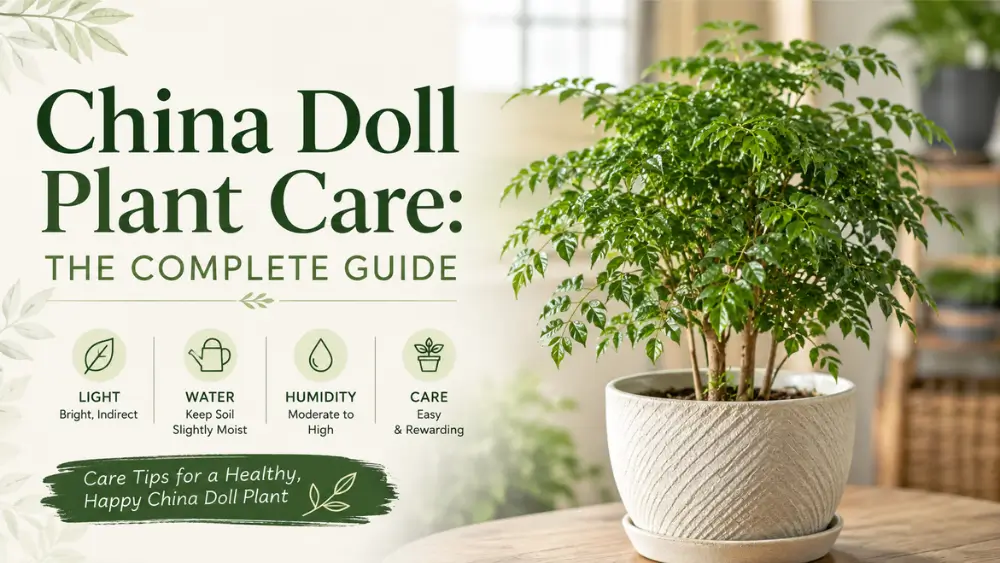
China Doll plant (Radermachera sinica) needs bright, indirect light, evenly moist but well-draining soil, and stable warm temperatures of 65-75°F (18-24°C) with moderate to high humidity. Its biggest challenge isn’t difficulty so much as sensitivity to change: sudden shifts in light, temperature, drafts, or even just being moved to a new spot commonly trigger leaf drop. Once settled into a consistent location, China Doll is a reliably attractive, low-maintenance plant with glossy, finely divided, fern-like foliage.
Table of Contents
Quick Care Facts
| Care Factor | Requirement |
|---|---|
| Scientific name | Radermachera sinica |
| Common names | China Doll, Serpent Tree, Emerald Tree |
| Light | Bright, indirect light; consistent location matters |
| Water | When top inch of soil is dry; keep evenly moist |
| Soil | Rich, well-draining potting mix |
| Temperature | 65-75°F (18-24°C); avoid drafts and fluctuations |
| Humidity | Moderate to high preferred |
| Fertilizer | Balanced liquid feed monthly, spring through summer |
| Toxicity | Generally considered non-toxic to cats and dogs |
| Growth habit | Bushy, tree-like shrub with glossy, feathery compound leaves |
| Difficulty | Easy once settled; sensitive to relocation and drafts |
About the China Doll Plant
China Doll, botanically Radermachera sinica, is a small ornamental tree native to the subtropical forests of southern China and Taiwan. It’s grown as a houseplant primarily for its attractive, glossy, dark green compound leaves, which are finely divided into small leaflets, giving the whole plant a delicate, fern-like or almost lacy appearance despite being a true woody shrub rather than a fern.
In its native range, China Doll can grow into a substantial tree, but as a houseplant it’s typically kept compact through regular pruning, often sold as a bushy, rounded specimen that fits neatly on a plant stand, desk, or shelf. It’s a popular choice for bringing lush, textured greenery into a space without the bold, dramatic leaves of plants like monstera or fiddle leaf fig.
China Doll has a reputation among houseplant growers for being somewhat temperamental, not because its care requirements are especially difficult, but because it reacts more visibly and more quickly to environmental changes than many other common houseplants, as explained in detail below. Understanding this one quirk upfront resolves most of the confusion new owners run into with this plant.
Choosing the Right Spot From the Start
Because China Doll reacts strongly to being relocated, it’s worth taking a bit of extra care when first choosing where to put it, rather than picking a spot casually and planning to adjust later. Look for a location with consistently bright, indirect light throughout the day, away from drafty doors, windows that get opened often, and heating or cooling vents. A spot near an east-facing window, or a few feet back from a bright south- or west-facing window, tends to work well in most homes.
Once you’ve settled on a good location, resist the temptation to rotate the plant between rooms or move it outside for summer and back in for winter, since each move resets the acclimation process and often triggers another round of leaf drop. If you do need to move it, such as for a genuine relocation, expect some leaf loss as a normal part of the adjustment and simply maintain consistent care afterward.
Light Requirements
China Doll needs bright, indirect light and does best when kept in a consistent spot rather than moved around frequently.
A location a few feet from an east- or west-facing window, or in bright filtered light near a south-facing window, works well. A small amount of gentle direct morning sun is generally fine, but strong, prolonged direct sun can scorch the leaves. More important than finding the single “perfect” spot is choosing a reasonably bright location and then leaving the plant there consistently, since frequent moves are one of the most common triggers for stress-related leaf drop.
Watering
Water when the top inch of soil feels dry, aiming to keep the soil evenly moist without letting it become soggy or fully dry out.
China Doll is sensitive to both extremes: overwatering can lead to root rot, while underwatering or letting the plant dry out completely is a common trigger for sudden leaf drop. During the growing season, this typically means watering roughly once a week, adjusted based on your home’s light and humidity levels. Always use a pot with drainage holes and let excess water drain away fully.
Soil and Potting
A rich but well-draining potting mix works well, ideally a standard indoor potting soil amended with perlite to improve drainage while still retaining enough moisture between waterings. Repot every 1-2 years in spring as needed, sizing up gradually. Because China Doll can be sensitive to disruption, try to minimize root disturbance during repotting and expect the possibility of some temporary leaf drop afterward as the plant adjusts.
Temperature and Humidity
China Doll prefers stable, warm conditions, ideally 65-75°F (18-24°C), and is notably sensitive to cold drafts, hot dry air from heating vents, and sudden temperature swings. Keep it well away from exterior doors, drafty windows, air conditioning vents, and radiators or heaters, since temperature fluctuations are one of the most common causes of unexpected leaf drop.
It prefers moderate to high humidity, and dry indoor air, especially during winter heating season, can contribute to browning leaf tips and increased leaf shedding. A humidifier, pebble tray, or grouping it with other humidity-loving plants can help maintain more consistent moisture in the air around it.
Fertilizing
Feed with a balanced, water-soluble liquid houseplant fertilizer once a month during spring and summer while the plant is actively growing. Reduce or stop fertilizing in fall and winter, when growth naturally slows.
Why China Doll Plants Drop Their Leaves
This is the single most common concern new China Doll owners run into, and understanding it changes how you approach caring for this plant.
China Doll is unusually sensitive to change compared to many houseplants. The most frequent triggers for sudden or significant leaf drop include:
- Being moved to a new location, even within the same home
- Sudden temperature changes or exposure to cold drafts
- A significant change in light levels
- Both under- and overwatering, or inconsistent watering
- The stress of being recently repotted or transplanted
The encouraging news is that this leaf drop is usually a temporary stress response rather than a sign the plant is dying. Once China Doll is settled into a stable location with consistent light, temperature, and watering, it typically stabilizes and pushes out new growth within a few weeks. The best long-term strategy is simply to choose a good spot for it once, avoid unnecessary moves, and keep its care routine as consistent as possible.
Pruning and Shaping
China Doll responds well to pruning and is often sold already trained into a neat, rounded, bushy shape by nurseries. At home, regular light trimming of leggy or overly long stems helps maintain a fuller, more compact form and encourages new branching. It tolerates fairly hard pruning if needed to control size or rejuvenate an older, sparse plant.
How to Propagate China Doll Plant
China Doll can be propagated from stem cuttings, though it roots somewhat more slowly and with more variable success than many common houseplants:
- Take a 4-6 inch semi-hardwood cutting (a stem that’s begun to firm up rather than being brand new soft growth), cutting just below a leaf node.
- Remove the lower leaves so a bare section of stem is exposed.
- Optionally dip the cut end in rooting hormone to improve success rates.
- Plant the cutting in a small pot of moist, well-draining potting mix, or a mix of perlite and peat.
- Keep it warm, in bright indirect light, and consistently moist, ideally covered loosely with a clear bag or propagator to maintain humidity while roots develop.
Rooting can take several weeks to a couple of months, so patience is especially important with this plant.
Is China Doll Toxic to Pets?
China Doll is generally considered non-toxic to cats and dogs, making it a reasonable choice for pet owners looking for lush, textured greenery without significant toxicity concerns. As always, it’s still sensible to discourage pets from regularly chewing on any houseplant, since even non-toxic plants can occasionally cause mild stomach upset if eaten in quantity.
Common Problems and How to Fix Them
Sudden leaf drop Usually a stress response to being moved, a temperature change, a draft, or a watering inconsistency. Settle the plant into a stable location and maintain consistent care; new growth typically follows within a few weeks.
Yellowing leaves Often a sign of overwatering. Let the soil dry out slightly more between waterings and check that the pot drains well.
Brown leaf tips Usually linked to low humidity or inconsistent watering. Increasing humidity and watering more consistently typically resolves it.
Leggy, sparse growth Usually caused by insufficient light. Move the plant to a brighter spot and prune back leggy stems to encourage bushier regrowth.
Pests Spider mites, aphids, mealybugs, and scale can occasionally appear, particularly on stressed plants. Wipe down leaves periodically with a damp cloth and treat promptly with insecticidal soap if pests are spotted, checking the undersides of leaves where pests often hide first.
Seasonal Care Summary
| Season | Watering | Fertilizing | Notes |
|---|---|---|---|
| Spring | Weekly | Monthly | Good time to prune or take cuttings |
| Summer | Weekly | Monthly | Maintain stable temperature and humidity |
| Fall | Reduce gradually | Taper off | Avoid moving the plant near cold drafts |
| Winter | Every 1-2 weeks | None | Watch humidity with indoor heating running |
Frequently Asked Questions
How do you care for a China Doll plant?
Give it bright, indirect light in a consistent location, water when the top inch of soil is dry, maintain stable warm temperatures away from drafts, and provide moderate to high humidity.
Why is my China Doll plant dropping leaves?
This is usually a stress response to being moved, a sudden temperature change, a draft, or inconsistent watering, rather than a sign of a dying plant. It typically stabilizes and regrows once settled into consistent conditions.
Is China Doll a good indoor plant?
Yes, it’s a popular indoor plant valued for its lush, fern-like foliage, though it does best when placed in a stable spot and left there rather than moved frequently.
How often should you water a China Doll plant?
Water when the top inch of soil is dry, typically about once a week during the growing season, keeping the soil evenly moist without letting it become soggy.
Is China Doll plant toxic to cats and dogs?
It’s generally considered non-toxic to cats and dogs, making it a reasonably pet-friendly houseplant choice.
Can China Doll plant tolerate low light?
It prefers bright, indirect light and tends to grow leggy and drop more leaves in low light, so a consistently bright spot is recommended over a dim one.
Why did my China Doll plant drop all its leaves after I brought it home?
This is a very common reaction to the stress of transport and a new environment. As long as the stems remain flexible and green, the plant is usually still alive and will typically regrow leaves once settled into a stable spot.
Does China Doll plant need to be repotted often?
No, repotting every 1-2 years is usually enough. Because the plant can be sensitive to disturbance, it’s best to repot only when genuinely needed rather than on a strict schedule, and to expect some temporary leaf drop as it readjusts.