
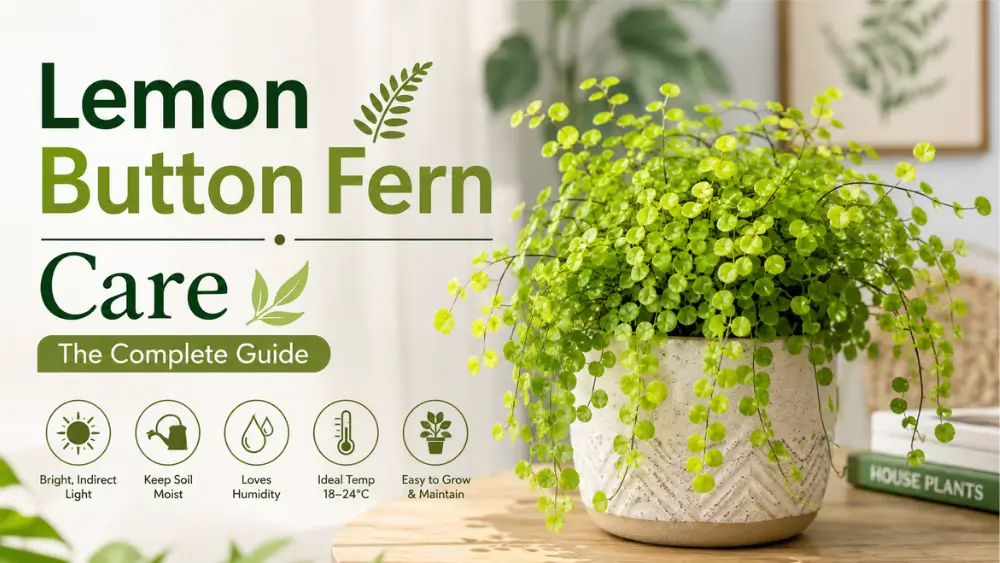
Lemon Button Fern (Nephrolepis cordifolia ‘Duffii’) needs bright, indirect light, evenly moist soil, and warm, humid air to thrive and produce lush, healthy new growth throughout the growing season. It’s a compact dwarf fern, a smaller relative of the Boston fern, known for its small, round, button-shaped leaflets and a subtle lemony scent some growers notice when the fronds are crushed. Unlike many ferns with a reputation for being fussy and hard to keep alive indoors, Lemon Button Fern is notably forgiving and resilient, making it a good choice for anyone who’s struggled to keep a fern going before.
Table of Contents
Quick Care Facts
| Care Factor | Requirement |
|---|---|
| Scientific name | Nephrolepis cordifolia ‘Duffii’ |
| Common names | Lemon Button Fern, Lemon Buttons |
| Light | Bright, indirect or filtered light; tolerates low light and some direct sun |
| Water | Keep evenly moist; water when the soil surface is dry |
| Soil | Well-draining, moisture-retentive potting mix |
| Temperature | 60-75°F (16-24°C); avoid drafts |
| Humidity | Prefers humid air; struggles in very dry indoor conditions |
| Fertilizer | Balanced liquid feed, diluted to half strength, monthly in spring and summer |
| Toxicity | Non-toxic to cats and dogs |
| Growth habit | Compact, dwarf, mounding; rarely taller than 1 foot |
| Difficulty | Easy and forgiving, unusually so for a fer |
About the Lemon Button Fer
Lemon Button Fern is the common name for Nephrolepis cordifolia ‘Duffii’, a dwarf cultivar of a fern species closely related to the widely grown Boston fern found in countless homes and offices. It gets its name from its small, round, button-like leaflets arranged along arching fronds, and from the subtle citrus scent some growers notice when the foliage is crushed or brushed, particularly during its active growing months, though the scent is admittedly faint enough that not everyone detects it clearly.
As a dwarf cultivar, it stays genuinely compact, rarely growing taller than about a foot, which makes it a great fit for small spaces, terrariums, and plantless nooks where a full-sized fern or larger houseplant simply wouldn’t fit. In the wild, the species it’s derived from grows across parts of the Americas, Asia, and Australia, both terrestrially on shaded forest floors and epiphytically tucked into the nooks of tree bark, a dual habitat that explains its tolerance for a range of light conditions in cultivation.
Where to Display Lemon Button Fern
Thanks to its small size and love of humidity, Lemon Button Fern is an excellent candidate for terrariums, where the enclosed, consistently moist environment closely mirrors the humid conditions it prefers naturally. It also works well as a bathroom plant, given a window with enough light, since the ambient humidity from showers and baths benefits it considerably. For those without a terrarium or particularly humid room, grouping it with other humidity-loving plants, or placing it near (but not directly touching) a running humidifier, can achieve much the same effect.
Why This Fern Is Easier Than Most
Ferns have a well-earned reputation for being finicky, high-maintenance houseplants, but Lemon Button Fern is a genuine exception.
Compared to famously fussy relatives like the maidenhair fern, which demands very precise humidity and consistent moisture to avoid rapid decline, Lemon Button Fern tolerates a meaningfully wider range of conditions and bounces back from occasional neglect far more readily. This makes it a good recommendation for anyone who has struggled to keep a more delicate fern alive in the past, without giving up the lush, feathery look ferns are prized for.
Light Requirements
Lemon Button Fern does best in bright, indirect or filtered light, such as near an east- or west-facing window. It’s genuinely flexible on this front: it tolerates low light reasonably well, simply growing more slowly, and can also handle an hour or two of direct sun without harm, though prolonged, all-day direct sun can scorch its delicate leaflets.
Watering
Keep the soil evenly moist, watering when the surface feels dry, and avoid letting the soil become fully saturated or soggy.
Water thoroughly until it flows through the drainage holes, then allow the pot to drain completely rather than letting it sit in standing water. Consistent moisture matters more for this fern than for many drought-tolerant houseplants, but good drainage still matters just as much, since waterlogged soil can lead to root and crown problems over time even for a moisture-loving plant like this one.
Soil and Potting
A well-draining but moisture-retentive potting mix suits Lemon Button Fern well, similar to the kind of soil recommended for many other tropical foliage houseplants. When planting or repotting, take care not to bury the crown, the point where the fronds emerge from the rhizome, since doing so can lead to crown rot. Position the plant so the crown sits at or just above the soil surface rather than beneath it. Repot as needed when the plant becomes visibly crowded in its container, generally choosing a pot only slightly larger than the current one.
Temperature and Humidity
Lemon Button Fern prefers warm conditions, ideally 60-75°F (16-24°C), and should be kept away from cold drafts and air conditioning vents, since sudden temperature swings can stress the plant.
Humidity matters a great deal for this fern’s long-term health. Like most houseplants native to tropical and subtropical regions, it struggles in the dry air produced by home heating systems in winter, often showing crisping or browning fronds when humidity drops too low for extended periods. Running a humidifier nearby is the most effective way to keep humidity levels comfortable; a pebble tray filled with water beneath the pot can offer some additional benefit as well.
Fertilizing
Feed monthly during spring and summer with a balanced, water-soluble fertilizer diluted to half the recommended strength, applied to moist rather than dry soil to avoid stressing the roots. Fertilizing isn’t necessary during fall and winter, when growth naturally slows.
Pruning
Mature fronds naturally die back and turn brown in fall and winter, which is a normal part of the plant’s cycle rather than a sign of poor health. When new growth appears in spring, prune away the dead, withered fronds at their base using clean, sharp shears, taking care not to accidentally cut any green or newly emerging fronds, since new growth tends to be crowded closely together at the base of the clump. Sterilizing your shears with rubbing alcohol before and after pruning helps prevent spreading any potential disease between cuts.
Growing Lemon Button Fern Outdoors
In frost-free climates, Lemon Button Fern can also be grown outdoors in a shady spot with filtered light, either directly in the ground or in container plantings alongside other shade-loving companions. Once established in favorable outdoor conditions, this fern can spread and multiply readily via its rhizomes. Because certain Nephrolepis species have shown invasive tendencies in some regions, it’s worth checking with your local agricultural extension office before planting it directly in the ground outdoors, particularly in warm, humid climates where it could potentially spread beyond where it’s wanted.
How to Propagate Lemon Button Fern
Lemon Button Fern can be propagated by dividing its rhizome clumps, ideally in spring:
- Remove the plant from its pot and gently separate the root mass by hand, or with a clean, sharp knife if needed.
- Divide it into sections, making sure each division has healthy roots, a portion of rhizome, and at least a few fronds attached.
- Pot each division into fresh, well-draining potting soil, positioning the crown at the soil surface rather than buried.
- Keep divisions warm, humid, and consistently moist while they reestablish.
Division is generally more reliable for this fern than other propagation methods, and it also gives you a natural opportunity to refresh an older, overcrowded plant into several healthier, more manageable ones over time.
Is Lemon Button Fern Toxic to Pets?
Lemon Button Fern is considered non-toxic to cats and dogs, making it a safe choice for households with pets. This is a genuine advantage over many other popular houseplants, and it’s one of several reasons this fern shows up so often on lists of pet-friendly plant recommendations.
Common Problems and How to Fix Them
Crown or root rot Often caused by burying the crown too deeply when planting, combined with consistently soggy soil. Make sure the crown sits at the soil surface and let the soil dry slightly between waterings.
Fronds turning brown and dying back In fall and winter, this is normal seasonal behavior. If it happens during the active growing season instead, low humidity or inconsistent watering are the more likely causes.
Scorched or bleached fronds Usually a sign of too much direct sun. Move the plant to a spot with bright, indirect light instead.
Slow growth Often simply a sign of lower light conditions. The plant will still survive, just more slowly, and moving it to a brighter spot will speed things up.
Pests Mealybugs and spider mites can occasionally appear, particularly in dry indoor air. Increasing humidity helps prevent infestations in the first place; treat active problems with insecticidal soap and by wiping down affected fronds.
Seasonal Care Summary
| Season | Watering | Fertilizing | Notes |
|---|---|---|---|
| Spring | When soil surface is dry | Monthly, half strength | Prune away winter-damaged fronds |
| Summer | When soil surface is dry | Monthly, half strength | Can move outdoors to a shady spot |
| Fall | Keep evenly moist | Taper off | Older fronds may begin dying back naturally |
| Winter | When soil surface is dry | None | Watch humidity closely with indoor heating running |
Frequently Asked Questions
How do you care for a Lemon Button Fern?
Give it bright, indirect light, keep the soil evenly moist without letting it become soggy, provide humid air, and avoid burying the crown when planting or repotting.
Does Lemon Button Fern really smell like lemon?
Some growers notice a subtle citrus scent when the leaves are crushed, particularly during active growth, though the scent is faint enough that not everyone detects it clearly.
Is Lemon Button Fern easier to care for than other ferns?
Yes, it’s notably more forgiving and resilient than many popular ferns, such as the maidenhair fern, making it a good choice for growers who have struggled with fussier ferns in the past.
Is Lemon Button Fern toxic to cats and dogs?
No, it’s considered non-toxic, making it a safe option for households with pets.
Why did my Lemon Button Fern develop crown rot?
This is usually caused by planting or repotting with the crown buried too deep in the soil, combined with consistently wet conditions. Keep the crown at the soil surface and avoid overwatering.
Can Lemon Button Fern grow in low light?
Yes, it tolerates low light reasonably well, though growth will be noticeably slower than in bright, indirect light.
Can Lemon Button Fern be grown outdoors?
Yes, in frost-free climates it can grow outdoors in a shady spot, though it’s worth checking local guidance first, since some Nephrolepis varieties can spread aggressively once established.
How do you propagate a Lemon Button Fern?
Divide the rhizome clump into sections, each with healthy roots, some rhizome, and a few fronds attached, then pot the divisions in fresh, well-draining soil with the crown at the surface.
How big does a Lemon Button Fern get?
As a dwarf cultivar, it stays quite compact, generally reaching no more than about a foot tall and wide, which is part of why it works so well in small spaces and terrariums.