
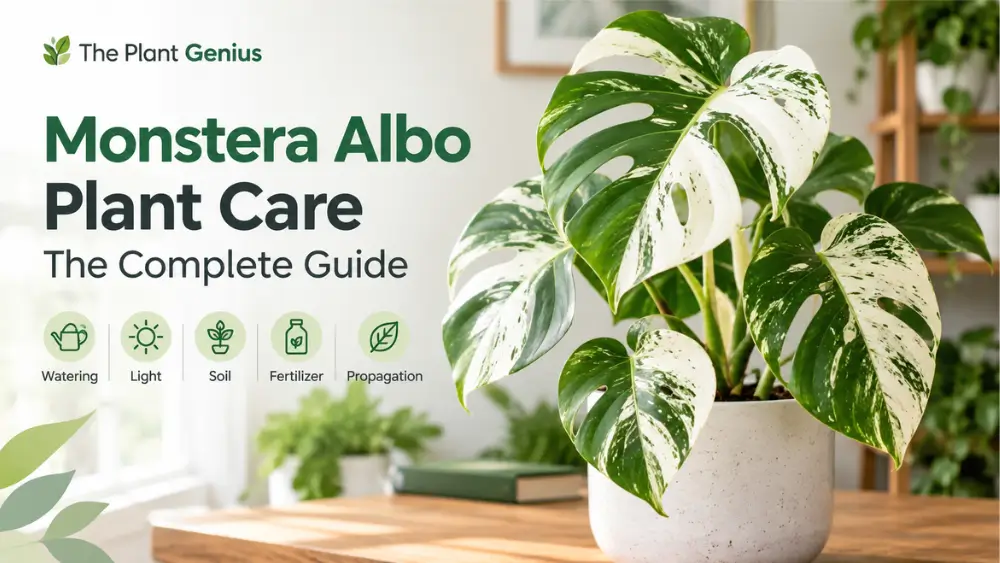
Monstera Albo shares its species and most of its care with standard Monstera deliciosa. For general background on fenestration, aerial roots, and toxicity, see our main Monstera care guide; this guide focuses on what’s different about growing a variegated plant.
Monstera Albo needs several hours of bright, indirect, filtered light daily, since its white variegated sections lack chlorophyll and need more overall light to compensate, while paradoxically being far more prone to sunburn than an all-green Monstera if that light is direct. It also needs less water than a standard Monstera, since the white tissue photosynthesizes less and uses energy more slowly. Growth is naturally slower, variegation is genetically unstable and can revert to green, and how a cutting is propagated genuinely affects whether the new plant stays variegated at all.
Table of Contents
Quick Care Facts
| Care Factor | Requirement |
|---|---|
| Scientific name | Monstera deliciosa ‘Albo Variegata’ (often M. deliciosa var. borsigiana) |
| Common names | Monstera Albo, Variegated Monstera, Albo Borsigiana |
| Light | Bright, filtered indirect light, several hours daily; never direct midday sun |
| Water | When top inch of soil is dry; needs less water than green Monstera |
| Soil | Chunky, well-draining aroid mix |
| Temperature | 65-85°F (18-29°C); avoid cold drafts |
| Humidity | Above 40% preferred |
| Fertilizer | Diluted balanced feed during the growing season only |
| Toxicity | Toxic to cats, dogs, and humans if chewed or ingested |
| Growth habit | Climbing vine; slower growing than standard green Monstera |
| Difficulty | Moderate to advanced; light balance and variegation stability are the challenge |
About Monstera Albo
Monstera Albo is a variegated form of Monstera deliciosa, most commonly M. deliciosa var. borsigiana, distinguished by bold white or cream patches, streaks, or half-moon sections across its otherwise dark green leaves. This variegation is a naturally occurring genetic mutation in which some plant cells lose the ability to produce chlorophyll, the pigment responsible for both a leaf’s green color and its capacity to photosynthesize.
It’s one of the most sought-after and expensive houseplants in cultivation, prized specifically for the unpredictability and drama of its patterning, since no two leaves, or even two plants, display quite the same variegation. It’s often confused with or compared to Thai Constellation, a different variegated Monstera with a more stable, speckled cream pattern; Albo’s variegation tends to appear in bolder, more solid blocks and is generally considered less stable and more prone to reverting than Thai Constellation’s. Because of this rarity and unpredictability, well-variegated specimens of Monstera Albo often command significantly higher prices than standard green Monstera plants of similar size.
Why Variegated Leaves Need More Light AND More Protection
This is the central paradox of growing Monstera Albo: the white sections of its leaves need more overall light than a standard green Monstera to make up for their lost photosynthetic capacity, yet those same white sections are far more vulnerable to sunburn from direct sun than ordinary green tissue.
The green parts of a variegated leaf are doing extra work, since they’re the only sections still capable of producing energy for the entire leaf, including the non-photosynthesizing white areas. This is why Monstera Albo genuinely needs brighter conditions overall, several hours of bright, indirect light a day, often more than a standard Monstera would need. At the same time, the white tissue has no chlorophyll to help protect it and burns easily in direct sun, showing up as brown, crispy patches specifically on the pale sections rather than across the whole leaf.
The practical solution is filtered rather than direct light: a spot a few feet back from a south- or west-facing window, sheer curtains to diffuse direct sun, or a supplemental grow light positioned to provide bright light without direct exposure. Rotating the plant periodically also helps ensure even growth rather than a lopsided lean toward the light source.
Watering
Monstera Albo generally needs less frequent watering than a standard green Monstera, since its reduced photosynthetic capacity means it uses energy, and therefore water, more slowly.
Water when the top inch of soil is dry, and err on the side of underwatering rather than overwatering, since root rot from excess moisture is one of the more common ways to lose this plant. Always use a chunky, well-draining aroid mix and a pot with good drainage.
Soil and Potting
The same chunky, well-draining aroid mix recommended for standard Monstera, combining potting soil with perlite and orchid bark, works well for Albo. Repot every 1-2 years as needed, and consider adding a moss pole at this time if you haven’t already, since a supported, climbing plant tends to produce larger, more mature leaves than one left to sprawl.
Temperature and Humidity
Monstera Albo does best in typical warm indoor temperatures, ideally 65-85°F (18-29°C), and should be kept away from cold drafts. It appreciates humidity above 40%, and while it can tolerate average household conditions, higher humidity supports healthier, larger leaf growth, particularly given the extra strain variegation already places on the plant’s energy budget.
Fertilizing
Feed with a balanced liquid fertilizer, diluted to around half strength, during the active growing season in spring and summer. Because variegated tissue is generally more sensitive to fertilizer salt buildup than solid green foliage, it’s better to underfeed slightly than to overdo it. Skip fertilizing in fall and winter.
Understanding Reversion: Why Variegation Can Disappear
Monstera Albo’s variegation is genetically unstable, meaning new growth doesn’t always match the pattern of older leaves, and can sometimes revert to solid green, particularly in insufficient light. If a stem starts producing consistently green, unvariegated leaves, the usual recommendation is to prune the stem back to the last leaf that still showed good variegation, since new growth from that point is more likely to carry the variegated pattern forward, while also increasing light levels going forward to reduce the chances of it happening again.
The All-White Leaf Dilemma
Occasionally, a Monstera Albo produces a leaf that’s entirely or almost entirely white, with no green tissue at all. Because that leaf has no chlorophyll whatsoever, it can’t photosynthesize and contributes nothing back to the plant’s energy supply, instead drawing on resources produced elsewhere. Many experienced growers choose to trim these fully white leaves off, particularly if the plant already seems to be struggling, to redirect its limited energy toward leaves that can actually support its growth. Others prefer to leave them for their striking appearance on an otherwise healthy, vigorous plant. There’s no single right answer here; it’s a genuine trade-off between aesthetics and the plant’s overall energy budget.
Propagation: Why the Node You Choose Matters
Unlike propagating a solid green houseplant, where any healthy cutting will grow into an identical copy, Monstera Albo cuttings only reliably keep their variegation if the node you propagate from itself contains variegated cells.
Because the variegation exists as a genetic mosaic across the plant rather than being uniform throughout, a cutting taken from a section of stem with an all-green node can grow into an entirely green, non-variegated plant, even if the parent plant is beautifully variegated elsewhere. To maximize the odds of variegated new growth, choose a cutting that includes a node located near variegated leaf tissue, ideally with at least some white or cream coloring visible right at the node itself. Beyond this consideration, propagation follows the same basic method as standard Monstera: a stem cutting with at least one node, rooted in water or moist soil, kept warm and in bright, indirect light until roots establish.
Is Monstera Albo Toxic to Pets or Humans?
Like standard Monstera, Albo is toxic to cats, dogs, and humans if chewed or ingested, due to calcium oxalate crystals in its leaves and sap that cause irritation and swelling in the mouth and throat. See our main Monstera guide for full details on handling and symptoms. Keep the plant out of reach of pets and small children regardless of its variegation.
Common Problems and How to Fix Them
Brown, crispy patches specifically on white sections A clear sign of sunburn from direct sun. Move the plant to filtered, indirect light.
New leaves emerging solid green A sign of reversion, usually linked to insufficient light. Increase light and consider pruning back to the last well-variegated leaf.
Slow growth Expected to some degree, since variegated tissue is less efficient at photosynthesis than solid green leaves. Confirm light and humidity are adequate before assuming something else is wrong.
Yellowing leaves Usually a sign of overwatering, which this plant is especially prone to given its lower water needs compared to standard Monstera.
Pests Spider mites, mealybugs, scale, and thrips can appear, the same as with standard Monstera. Treat promptly with insecticidal soap, checking the undersides of leaves regularly since infestations are often easier to catch early there.
Seasonal Care Summary
| Season | Watering | Fertilizing | Notes |
|---|---|---|---|
| Spring | When top inch is dry | Diluted, monthly | Good time to prune, repot, or propagate |
| Summer | When top inch is dry | Diluted, monthly | Watch for sunburn if light is too direct |
| Fall | Reduce gradually | Taper off | Growth naturally slows further |
| Winter | Sparingly | None | Maximize available light to reduce reversion risk |
Frequently Asked Questions
How is Monstera Albo different from a regular Monstera?
Albo has white or cream variegated sections that lack chlorophyll, needing more overall light but less water, and growing more slowly than a standard all-green Monstera deliciosa.
Why is my Monstera Albo losing its variegation?
This is called reversion and is usually caused by insufficient light. Increasing light and pruning back to the last well-variegated leaf typically helps future growth stay variegated.
Why do only some Monstera Albo cuttings stay variegated?
Variegation depends on which cells are present at the node you propagate from. A cutting taken near variegated tissue is more likely to grow into a variegated plant than one taken from an all-green section.
Should I remove all-white leaves from my Monstera Albo?
This is a matter of preference. All-white leaves can’t photosynthesize and draw energy from the rest of the plant, so some growers remove them, especially if the plant seems to be struggling, while others keep them for their appearance.
Is Monstera Albo toxic to cats and dogs?
Yes, like standard Monstera, it’s toxic if chewed or ingested due to calcium oxalate crystals, and should be kept out of reach of pets.
Does Monstera Albo need more water than a regular Monstera?
No, it actually needs less, since its reduced photosynthetic capacity means it uses water more slowly than an all-green Monstera of similar size.
Is Monstera Albo the same as Thai Constellation?
No, they’re different variegated forms. Albo typically has bolder, blockier white patches and less stable variegation, while Thai Constellation has a more consistent, speckled cream pattern.
Why is Monstera Albo so expensive?
Its rarity, slower growth, and the unpredictability of its variegation, no two plants display quite the same pattern, make well-variegated specimens highly sought after among collectors, driving prices considerably higher than standard green Monstera.
Does Monstera Albo need a moss pole?
Yes, the same as standard Monstera, giving it something to climb supports larger, more mature leaf growth than leaving it to sprawl unsupported.