
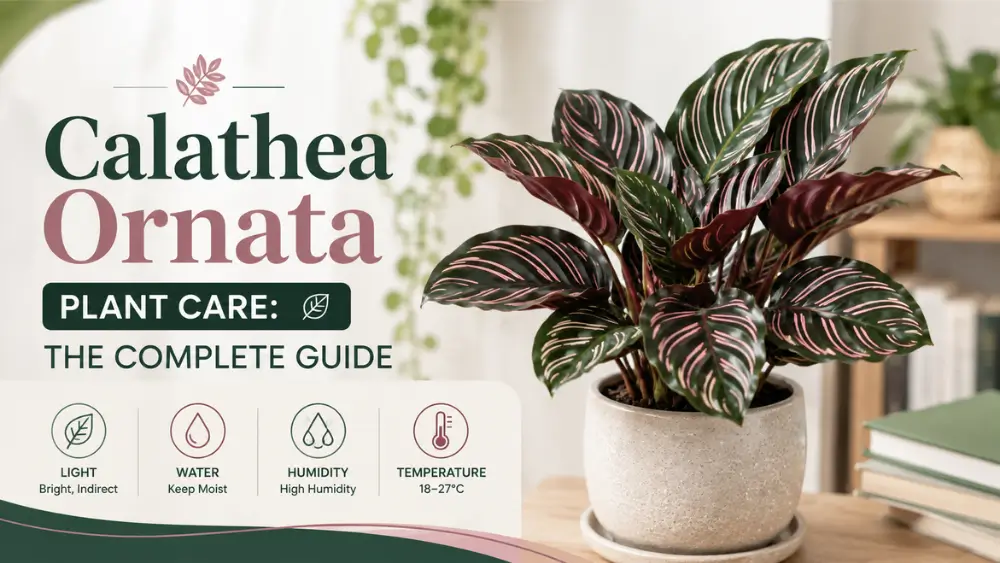
Calathea Ornata, commonly called Pinstripe Calathea, needs bright indirect light, consistently moist soil watered with filtered or distilled water, and humidity of 50% or higher. It’s known for its dark green, oval leaves marked with fine pink pinstripes that fade to white as the leaf matures, with a deep maroon-purple underside. Among Calathea varieties, Ornata has a reputation as one of the more demanding species, largely because it’s especially quick to develop crispy, browning leaf edges if humidity or water quality slip.
Table of Contents
Quick Care Facts
| Care Factor | Requirement |
|---|---|
| Scientific name | Calathea ornata (also Goeppertia ornata) |
| Common names | Pinstripe Calathea, Pinstripe Plant |
| Light | Bright, indirect light; no direct sun |
| Water | Consistently moist, never soggy; filtered or distilled water |
| Soil | Well-draining, moisture-retentive mix with perlite |
| Temperature | 65-80°F (18-27°C); avoid cold drafts |
| Humidity | High, ideally 50% or above; more demanding than many Calathea |
| Fertilizer | Light, diluted balanced feed monthly during growing season |
| Toxicity | Non-toxic to cats and dogs |
| Growth habit | More upright than many Calathea; can reach 2-3 ft indoors |
| Difficulty | Challenging; one of the more demanding Calathea varieties |
About Calathea Ornata
Calathea Ornata, widely known as Pinstripe Calathea, is prized for its dark green, glossy, oval leaves marked with delicate, thin pink lines running from the central rib out to the leaf edges, a pattern that closely resembles hand-painted pinstripes. As each leaf matures, those pink stripes gradually fade to a soft white or cream, so a single healthy plant often displays a mix of vivid pink new growth alongside older, white-striped leaves at the same time. The undersides of the leaves are a deep maroon-purple, visible whenever a leaf turns or folds.
Native to tropical regions of Colombia and Venezuela, Calathea Ornata is part of the same Marantaceae, or prayer plant, family as other Calathea species, sharing the same daily leaf movement, rising at night and lowering during the day, that the genus is known for. For a full explanation of that behavior and general Calathea background, see the complete Calathea Plant Care guide linked above.
Compared to many other Calathea varieties, Ornata tends to grow somewhat more upright, with a more distinct, non-clumping stem structure, and can reach 2-3 feet tall indoors with good care, larger than lower-growing types like Calathea Makoyana.
Choosing a Healthy Calathea Ornata
Because Ornata can be sensitive to shipping and transitional stress, it’s worth inspecting a plant carefully before buying, whether from a nursery shelf or an online order. Look for leaves that are firm and fully upright rather than limp or curling, with pink striping that looks crisp rather than faded or washed out. Check the leaf edges closely for any early signs of browning or crisping, since a plant that’s already struggling with humidity or water quality at the point of sale will likely need extra recovery time once it’s home. It’s also worth gently checking that the soil isn’t bone dry or waterlogged, both of which can indicate a plant that hasn’t been well maintained on the shelf. A little transitional leaf loss after bringing a new Calathea Ornata home is normal as it adjusts to a new environment, but starting with a genuinely healthy specimen makes that adjustment period considerably smoother.
Why Calathea Ornata Has a Reputation for Being Especially Demanding
All Calathea varieties are sensitive to humidity and water quality, but Ornata is frequently singled out by growers as one of the trickier species within an already particular genus. In practice, this usually comes down to how quickly and visibly it reacts to less-than-ideal conditions: dry air or hard tap water tends to show up as browning, curling leaf edges on Ornata noticeably faster than on some hardier Calathea varieties.
This doesn’t mean Ornata requires anything fundamentally different from other Calathea, just that there’s less room for error. Consistent humidity in the 50%+ range, filtered or distilled water, and steady, even soil moisture matter more here than they might for a more forgiving houseplant, and growers who dial in these three factors from the start tend to have much better long-term success than those who try to correct problems after the fact.
Light Requirements
Calathea Ornata needs bright, indirect light and should never be placed in direct sun, which quickly fades its pink pinstriping and can scorch the leaves. A spot a few feet back from an east-facing window, or filtered light near a north- or west-facing window, works well. In light that’s too low, growth slows and the pink striping on new leaves tends to be less vivid.
Watering
Keep the soil consistently, evenly moist, watering again once the top inch begins to dry rather than letting the pot dry out fully. As with other Calathea, water quality matters a great deal: filtered water, distilled water, or rainwater is strongly recommended, since Ornata is quick to develop brown, crispy edges in response to the chlorine, fluoride, and dissolved minerals present in most tap water.
Soil and Potting
A well-draining but moisture-retentive potting mix works best, typically a standard potting soil amended with perlite for drainage and a bit of peat moss or coco coir to help maintain even moisture. Repot every year or two in spring, sizing up gradually, since Ornata’s more upright growth habit means a top-heavy plant can benefit from a slightly wider, sturdier pot as it matures. Avoid jumping to a pot that’s much larger than the current root ball, since excess unused soil holds moisture longer than the roots can use, increasing the risk of root rot.
Temperature and Humidity
Calathea Ornata does best in warm, stable conditions, ideally 65-80°F (18-27°C), away from cold drafts and sudden temperature changes.
Humidity is the single most important factor for growing this particular Calathea successfully. Aim for 50% or higher, and treat this as a firm target rather than a nice-to-have, since Ornata tends to be one of the first plants in a collection to show stress from dry indoor air. A humidifier placed nearby is by far the most reliable way to maintain adequate humidity; pebble trays and misting provide only minor, short-lived improvements and generally aren’t enough on their own for this variety.
Fertilizing
Feed with a balanced, water-soluble liquid fertilizer diluted to half strength, roughly once a month during spring and summer. Like other Calathea, Ornata is sensitive to fertilizer salt buildup, which can contribute to leaf tip burn alongside water-quality and humidity issues, so it’s better to fertilize lightly and infrequently than heavily. Stop fertilizing in fall and winter.
Propagation
Calathea Ornata is propagated by dividing the root clump rather than from stem cuttings, since it doesn’t produce true stems in the way many other houseplants do:
- Remove the plant from its pot and gently loosen the soil around the roots.
- Identify natural divisions in the root mass, where sections have their own roots and leaves.
- Gently separate the clump into smaller sections, keeping healthy roots intact with each division.
- Plant each division in fresh, well-draining, moisture-retentive soil.
- Keep divisions warm, humid, and out of direct light while they establish; new growth signals a successful division.
Spring, ideally alongside repotting, is the best time to divide this plant.
Is Calathea Ornata Toxic to Pets?
Calathea Ornata is considered non-toxic to cats and dogs, consistent with the rest of the Calathea genus, making it a popular choice for pet owners drawn to its dramatic striped foliage. As with any houseplant, it’s still sensible to discourage pets from regularly chewing on the leaves.
Common Problems and How to Fix Them
Brown, crispy leaf edges The most frequent Ornata complaint, and it tends to show up faster on this variety than on many other Calathea. Increase humidity, ideally with a humidifier, and switch to filtered or distilled water if you haven’t already.
Curling leaves Usually a sign of low humidity or the soil drying out too much between waterings. Address both factors together for the best results.
Fading pink pinstripes on new growth Often linked to insufficient light. Move the plant to a brighter, indirect-light spot to help new leaves develop more vivid striping.
Yellowing leaves Typically a sign of overwatering or poor drainage. Let the soil dry slightly more between waterings and confirm the pot drains well.
Pests Spider mites are particularly drawn to Ornata when humidity is low, since dry air stresses the plant and creates favorable conditions for mites to establish. Raising humidity is both a treatment and a prevention strategy; treat active infestations with insecticidal soap and by wiping down affected leaves.
Seasonal Care Summary
| Season | Watering | Fertilizing | Notes |
|---|---|---|---|
| Spring | Keep evenly moist | Monthly, diluted | Good time to divide or repot |
| Summer | Keep evenly moist | Monthly, diluted | Watch humidity closely with AC running |
| Fall | Keep evenly moist | Taper off | Growth begins to slow |
| Winter | Keep evenly moist, slightly less | None | Humidity is critical with indoor heating running |
Frequently Asked Questions
What makes Calathea Ornata different from other Calathea varieties?
Its most distinctive feature is the fine pink pinstripe pattern on new leaves, which fades to white as the leaves mature, combined with a more upright growth habit that can reach 2-3 feet tall indoors.
Why is Calathea Ornata harder to care for than other Calathea?
It tends to react more quickly and visibly to low humidity and poor water quality than some other Calathea species, developing brown, crispy leaf edges faster if those conditions aren’t well managed.
Why do the pink stripes on my Calathea Ornata fade to white?
This is a normal part of leaf maturity. New leaves emerge with vivid pink striping that gradually lightens to white or cream as the leaf ages, so it’s common to see both colors on a healthy, mature plant at once.
Is Calathea Ornata safe for cats and dogs?
Yes, it’s considered non-toxic to cats and dogs, consistent with other Calathea varieties.
How often should you water Calathea Ornata?
Water often enough to keep the soil consistently moist, typically every 5-7 days indoors, using filtered or distilled water and never letting the soil fully dry out.
Does Calathea Ornata need a humidifier?
While not strictly mandatory, a humidifier is strongly recommended for this variety, since it’s especially prone to crispy leaf edges in average indoor humidity.
How tall does Calathea Ornata grow indoors?
With good care, it typically reaches 2-3 feet tall indoors, making it one of the larger, more upright Calathea varieties compared to lower, clumping types.
What should I look for when buying a Calathea Ornata?
Choose a plant with firm, upright leaves, crisp pink striping, and no early browning on the edges. Avoid plants with bone-dry or waterlogged soil, since both can signal a stressed specimen that will need extra recovery time.
Is Calathea Ornata a good plant for beginners?
It’s generally better suited to growers who already have some houseplant experience, since it’s less forgiving of inconsistent humidity and water quality than many beginner-friendly houseplants. That said, with a humidifier and a consistent watering routine, it’s entirely manageable even for a newer grower who’s willing to stay attentive.