
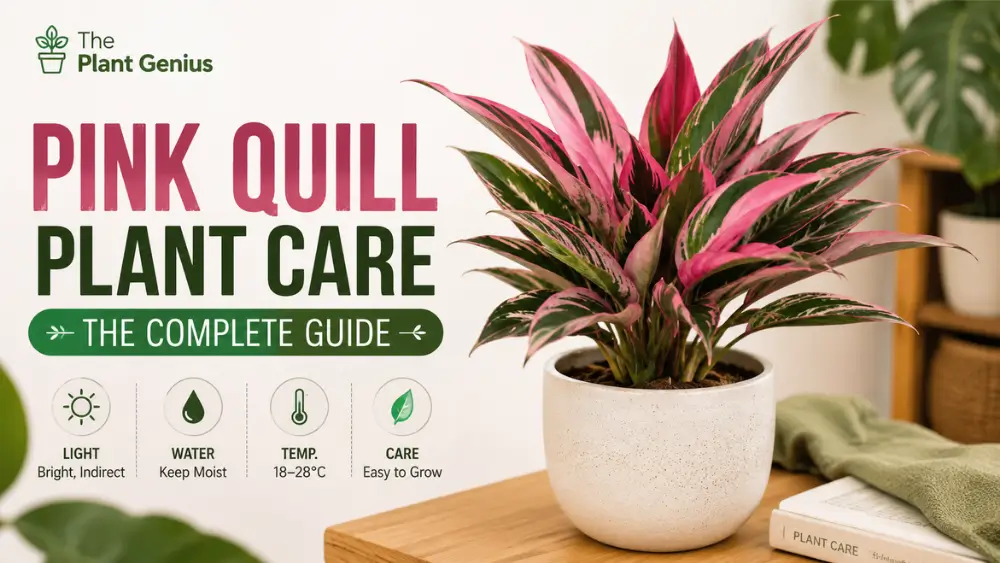
Pink Quill Plant (Tillandsia cyanea) needs bright, indirect light, regular misting rather than traditional soil watering, and warm temperatures around 75°F (24°C) to bloom well. It’s a bromeliad grown for its vivid, feather-shaped pink bract, which can stay colorful for two to three months, with small violet-blue true flowers emerging briefly from within it. Because it absorbs most of its water and nutrients through its leaves rather than its roots, its care looks a little different from a typical potted houseplant, even though it’s usually sold and grown in a pot rather than mounted bare like many other Tillandsia.
Table of Contents
Quick Care Facts
| Care Factor | Requirement |
|---|---|
| Scientific name | Tillandsia cyanea (also reclassified as Wallisia cyanea) |
| Common names | Pink Quill Plant, Fan Flower, Feather Plant |
| Light | Bright, indirect light; tolerates a little direct morning sun |
| Water | Mist thoroughly 2-3 times a week; keep soil on the dry side |
| Soil | Loose, well-draining epiphyte mix (bark, perlite, and peat or coco coir) |
| Temperature | Warm, ideally around 75°F (24°C) to encourage blooming |
| Humidity | Appreciates higher humidity |
| Fertilizer | Diluted bromeliad or orchid fertilizer during the growing season |
| Toxicity | Not commonly listed as toxic; bromeliads are generally considered non-toxic |
| Growth habit | Low, arching rosette; blooms once, then produces offsets |
| Difficulty | Easy and low-maintenance, though blooming takes patience |
About the Pink Quill Plant
Pink Quill Plant, botanically Tillandsia cyanea, is one of the most eye-catching members of the bromeliad family, prized for the flattened, feather-like pink bract that rises from the center of its rosette like a paddle-shaped plume. It’s native to the rainforests of Ecuador, where it grows as an epiphyte, anchoring itself to tree bark using small roots that serve mainly for support rather than water absorption, much like an orchid.
Unlike many of its Tillandsia relatives, the gray, wispy “air plants” often sold mounted on driftwood or displayed bare with no growing medium at all, Pink Quill Plant is commonly potted in a loose, well-draining substrate for retail and home cultivation, which sets it apart both visually and in terms of everyday care. It’s a relative of the pineapple plant and other well-known Tillandsia species, sharing the same general epiphytic biology despite the differences in how it’s typically displayed.
The plant forms a low rosette of narrow, arching, grayish-green leaves, from which the pink bract emerges, often persisting for two to three months at a time. The true flowers are small, tubular, and violet-blue, appearing briefly, just a few days each, from between the overlapping segments of the pink bract, while the bract itself remains colorful and showy for far longer.
Where to Display Pink Quill Plant
Because its blooming period is genuinely the star of the show, many growers like to place Pink Quill Plant somewhere it will get extra attention while flowering, such as a dining table centerpiece, an entryway console, or a prominent plant stand, then move it back to its regular bright spot once the bract eventually fades. Its compact rosette shape and modest size, generally 10-16 inches wide, make it well suited to smaller spaces where a larger houseplant wouldn’t fit as comfortably.
Understanding Pink Quill’s Life Cycle: Why It Blooms Once
Pink Quill Plant is monocarpic, meaning each individual rosette flowers only once in its lifetime before gradually declining, a completely normal part of its life cycle rather than a sign that something has gone wrong.
After blooming, the main rosette will slowly fade over the following months, but rather than being the end of the plant, this decline typically coincides with the production of offsets, commonly called “pups,” that emerge near the base of the mother plant. These pups are genetically identical new plants that will eventually mature, produce their own bract, and repeat the cycle. Most Pink Quill Plants take about 2-3 years to reach maturity and bloom for the first time, so patience is a real part of growing this plant successfully, both while waiting for the first bloom and while waiting for pups to develop into new blooming plants after the original declines.
Light Requirements
Pink Quill Plant needs bright, indirect light to grow and bloom well. A spot near an east- or west-facing window works well, and it can tolerate a little direct morning sun, but should be kept out of hot, intense midday sun, which can scorch both the leaves and the delicate pink bract. Insufficient light is the most common reason a mature plant fails to bloom at all.
Watering
Water by misting the leaves thoroughly a few times a week, rather than relying primarily on watering the soil.
Because Pink Quill Plant absorbs much of its water and nutrients through specialized structures on its leaves rather than through its roots, regular misting until the leaves are thoroughly wet is more effective than traditional watering alone. If you mist frequently, it’s fine, and even preferable, to keep the soil itself on the drier side. Avoid soaking the pink bract directly when watering or misting, especially once it’s in bloom, and be cautious about overwatering the soil, since root rot from consistently soggy conditions is the most common problem with this plant. An underwatered Pink Quill is generally much easier to recover than an overwatered one.
Soil and Potting
When grown in a pot, Pink Quill Plant does best in a loose, well-draining mix formulated for epiphytes, such as a blend of orchid bark, perlite, and peat moss or coco coir, rather than a dense standard potting soil. Good drainage matters far more than soil richness for this plant. If repotting is needed, do it in early spring, choosing a pot only slightly larger than the current one to avoid instability, since this plant’s root system is relatively small and mainly used for anchoring rather than active water uptake.
Temperature and Humidity
Pink Quill Plant prefers warm conditions, and needs temperatures around 75°F (24°C) to bloom reliably; cooler conditions can slow growth and delay flowering considerably. It isn’t cold tolerant and should be kept away from cold drafts.
It appreciates higher humidity, consistent with its rainforest origins, though regular misting for watering purposes also helps address humidity needs at the same time. In very dry indoor air, a humidifier or pebble tray can provide additional benefit alongside your regular misting routine.
Fertilizing
Feed with a diluted bromeliad or orchid fertilizer during the active growing season. Because this plant absorbs nutrients readily through its leaves, a foliar feed applied along with misting can be an effective way to fertilize, in addition to or instead of soil-applied fertilizer.
How to Propagate Pink Quill Plant
Pink Quill Plant is propagated from the offsets, or pups, that develop near the base of the mother plant as it begins to decline after blooming:
- Wait until a pup has grown reasonably large and robust, ideally at least a third to half the size of the parent rosette, before separating it.
- Carefully cut the pup away from the base of the mother plant using a clean, sharp knife.
- Pot the pup in a well-draining epiphyte mix, or mount it if you prefer to display it bare like a traditional air plant.
- Care for the new pup as you would a mature plant, keeping in mind it will take time, often a couple of years, to reach blooming size itself.
Is Pink Quill Plant Toxic?
Pink Quill Plant isn’t commonly listed as toxic in major plant toxicity databases, and bromeliads as a family are generally considered non-toxic. As with any houseplant, it’s still sensible to discourage pets and children from chewing on it regularly, but there’s no significant toxicity concern associated with this particular plant.
Common Problems and How to Fix Them
No flowers Usually a sign of insufficient light, or simply a plant that hasn’t yet reached the 2-3 years of maturity typically needed to bloom for the first time. Move it to a brighter spot and be patient with younger plants.
Root rot The most common serious problem, caused by overwatering the soil. Let the soil stay on the drier side, especially if you’re misting regularly, and make sure the pot drains well.
Scorched or sunburned leaves and bract Caused by too much direct, intense sun. Move the plant to a spot with bright but indirect light, allowing only gentle morning sun if any direct exposure at all.
Mother plant declining after blooming This is normal, expected monocarpic behavior rather than a sign of poor care. Look for offsets developing at the base, which will carry the plant forward.
Pests Scale, aphids, and spider mites can occasionally appear, though pests are relatively uncommon on this plant when it’s kept in good conditions. Check regularly and treat promptly with insecticidal soap if spotted.
Seasonal Care Summary
| Season | Watering | Fertilizing | Notes |
|---|---|---|---|
| Spring | Mist 2-3 times weekly | Diluted feed | Good time to repot or separate pups |
| Summer | Mist 2-3 times weekly | Diluted feed | Flower spikes often appear in summer |
| Fall | Reduce slightly | Taper off | Growth slows as temperatures cool |
| Winter | Mist less frequently | None | Keep warm and away from cold drafts |
Frequently Asked Questions
How do you care for a Pink Quill plant?
Give it bright, indirect light, mist the leaves thoroughly a few times a week rather than relying on soil watering alone, keep it warm around 75°F, and feed with a diluted bromeliad fertilizer during the growing season.
Why is my Pink Quill plant not blooming?
This is usually caused by insufficient light or a plant that hasn’t yet reached maturity, which typically takes about 2-3 years. Moving it to a brighter spot often helps once it’s old enough to bloom.
Why is my Pink Quill plant dying after it bloomed?
This is normal. Pink Quill is monocarpic, meaning each rosette flowers once and then gradually declines, typically producing offsets, or pups, at its base that will grow into new plants.
How do you water a Pink Quill plant?
Mist the leaves thoroughly two to three times a week rather than watering the soil heavily, since this plant absorbs most of its water through its leaves. Keep the soil on the drier side if you’re misting regularly.
Is Pink Quill Plant a true air plant?
It’s part of the same Tillandsia genus as many true air plants and shares the same epiphytic biology, but unlike bare-mounted air plants, it’s typically grown potted in a loose, well-draining medium.
Is Pink Quill Plant toxic to pets?
It isn’t commonly listed as toxic, and bromeliads as a family are generally considered non-toxic, though it’s still sensible to discourage pets from chewing on any houseplant.
How do you propagate a Pink Quill plant?
Wait for offsets, or pups, to grow large and sturdy near the base of the declining mother plant, then carefully cut them away and pot them in a well-draining epiphyte mix.
How long does the pink bract on a Pink Quill plant last?
The colorful bract typically remains vibrant for two to three months, considerably longer than the small violet-blue true flowers that emerge from within it, which last only a few days each.
Can Pink Quill Plant be mounted like other air plants instead of potted?
Yes, since it shares the same epiphytic biology as other Tillandsia, it can be mounted on bark or wood and misted regularly instead of grown in a pot, though potting in a well-draining mix is the more common approach for this particular species.